THE OIL ATLAS
Beluga blubber oil
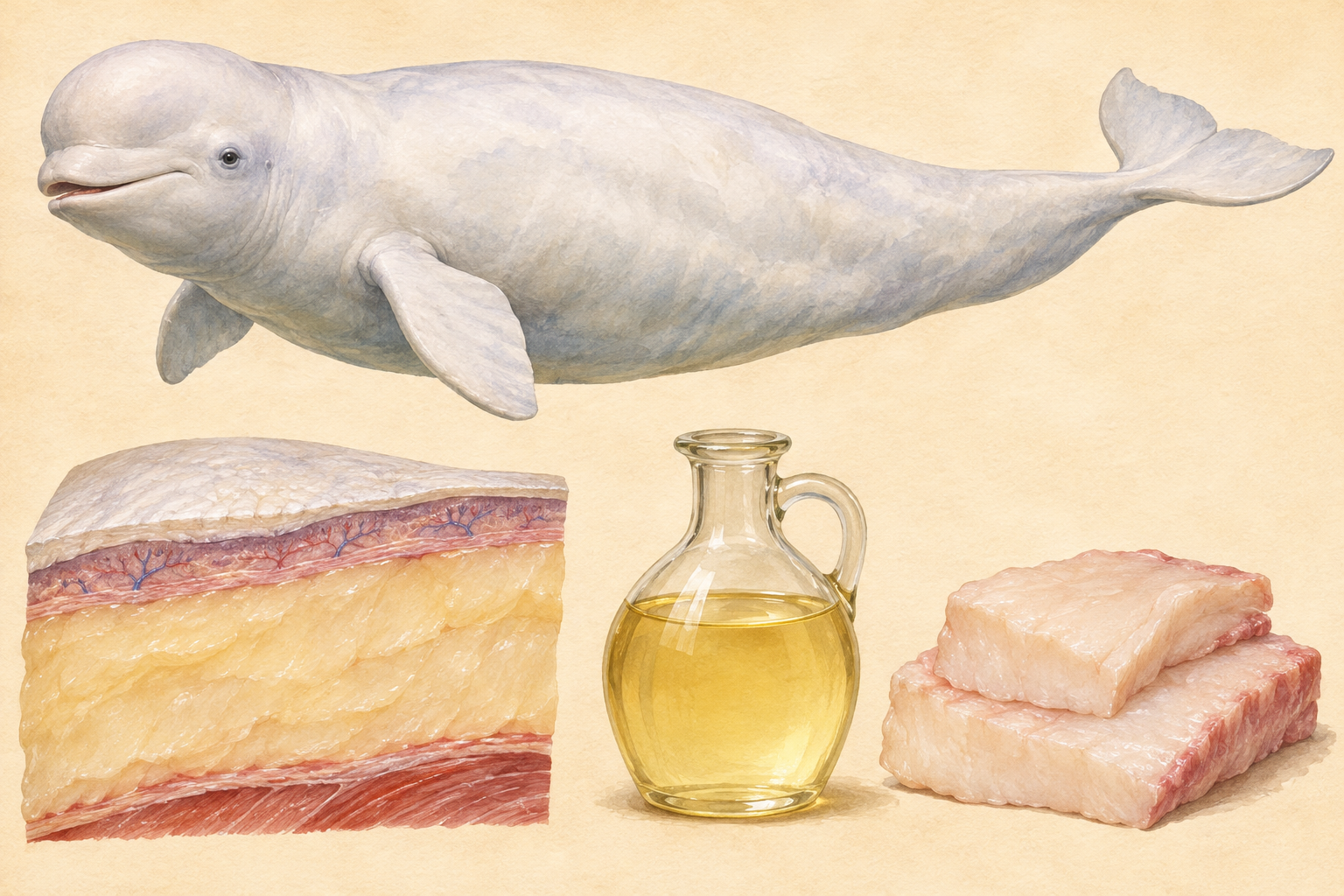
Overview
Oil rendered from beluga whale blubber. Historical Dena’ina accounts from Alaska describe its use in food preservation and trade. This entry concerns separated oil, not direct consumption of blubber.
Source material
Blubber of the beluga whale (Delphinapterus leucas), rendered into a separate oil.
Composition
The cited ethnographic and government records do not provide sample-specific fatty-acid composition with units and analytical conditions. No values are supplied by inference.
Region
NOAA documentation of Cook Inlet Dena’ina communities records beluga oil used for food preservation and traded among communities.
Food use
An account describes cooked clams placed in a container and covered with oil from beluga and other marine mammals for winter preservation. This is a distinct use of separated oil, not merely consumption of fatty tissue.
Extraction
Historical sources describe rendering blubber into oil and storing it in containers. Specific time and temperature parameters are not established.
Safety
Harvest and trade of marine mammals may be legally restricted. Contaminant exposure, hygiene and storage safety cannot be established from historical accounts alone.
Sources
1. NOAA Fisheries, Relationship between the Native Village of Tyonek, Alaska and Beluga Whales in Cook Inlet, Alaska (2011). https://media.fisheries.noaa.gov/dam-migration/tyonek-belugas0611-akr.pdf 2. NOAA, Environmental Assessment: Co-Management Agreement Between the National Marine Fisheries Service and the Cook Inlet Marine Council (2000), sec. 3.2.1. https://repository.library.noaa.gov/view/noaa/18151/noaa_18151_DS1.pdf