THE OIL ATLAS
Moose bone grease
Overview
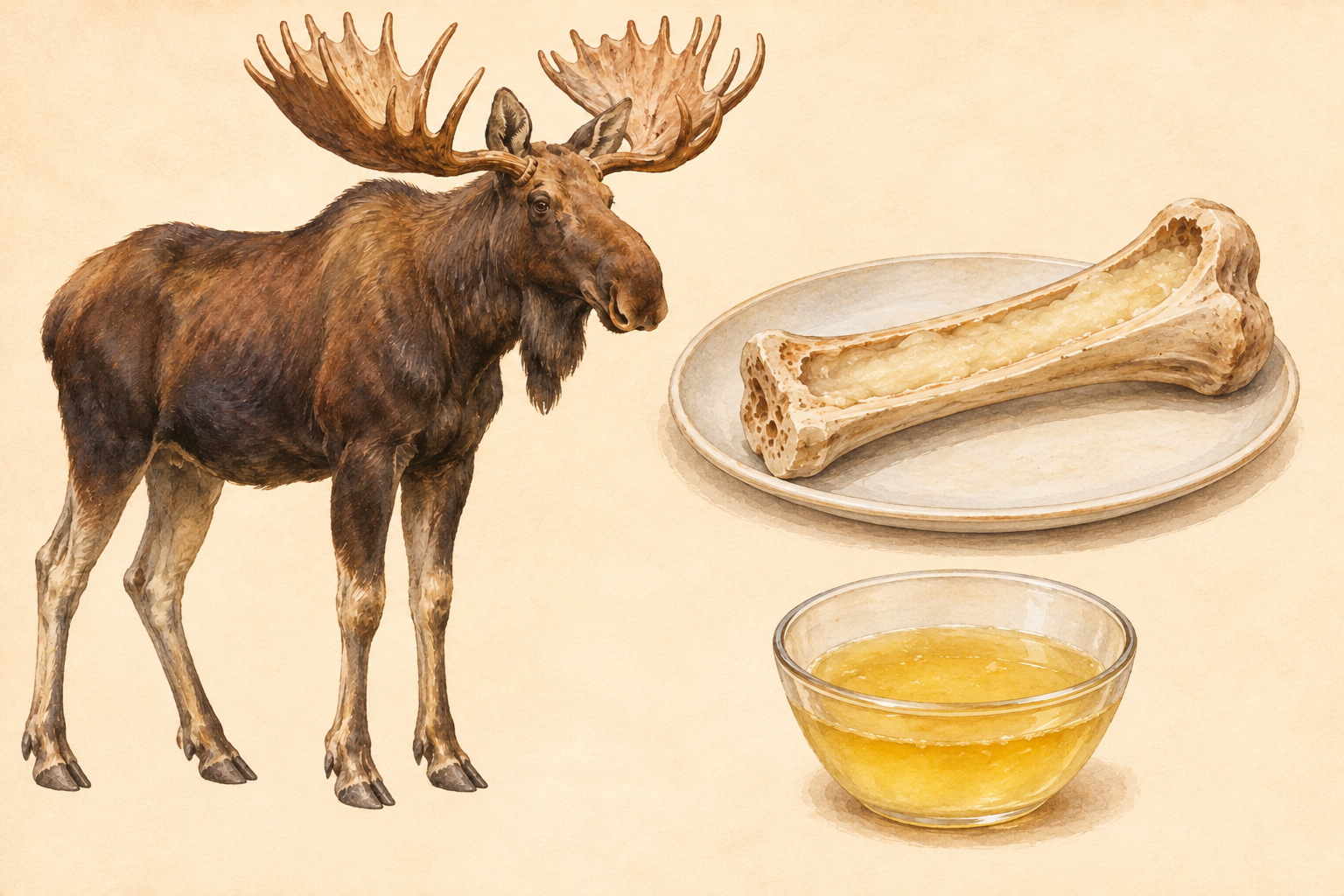
Traditional edible bone grease recovered by boiling broken moose bones and skimming the fat from the surface. This is distinct from eating marrow directly.
Source material
Bones of North American moose (Alces alces), including marrow-bearing and cancellous bone portions, rather than pieces of fatty meat.
Composition
The ethnographic sources cited here do not supply sample-specific fatty-acid measurements with units for moose bone grease. No numerical composition is inferred from marrow or generic animal-fat tables.
Region
An Alaska study of Nenana Village documents rendering grease from moose bones. A Yukon Flats technical report also records recollections of boiling bones to produce grease.
Food use
The Nenana Village study records bone grease eaten with berries and dried meat. This refers to separated grease rather than simply eating marrow.
Extraction
Bones were broken and boiled in water, and the rising fat was collected. This describes a historical practice, not a validated commercial process with specified temperatures or durations.
Safety
Wildlife harvest and trade rules, hygienic handling, heating and storage require attention. Historical consumption does not establish current authorization for commercial food sale or guarantee safety.
Sources
1. Alaska Department of Fish and Game, Modern Foragers: Wild Resource Use in Nenana Village, Alaska, Technical Paper 91, p. 69. https://www.adfg.alaska.gov/download/indexing/Technical%20Papers/tp091.pdf 2. Alaska Department of Fish and Game, Technical Paper 377, p. 53. https://www.adfg.alaska.gov/download/indexing/Technical%20Papers/TP%20377.pdf