THE OIL ATLAS
Caribou/reindeer bone grease
Overview
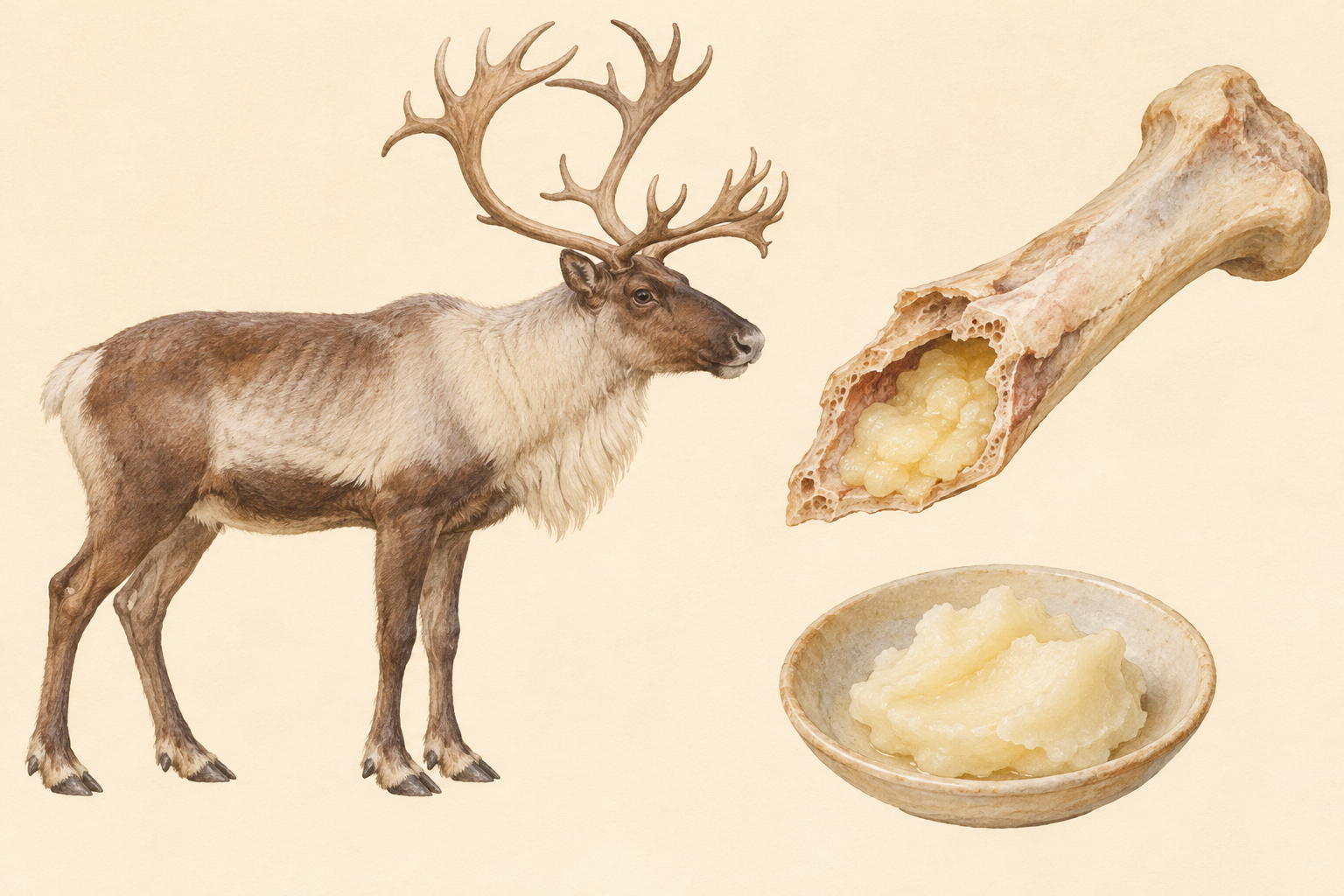
Bone grease recovered by crushing and boiling reindeer or caribou bones and skimming the floating fat, distinct from eating raw marrow.
Source material
Bones and fat-bearing internal tissues of caribou/reindeer (Rangifer tarandus).
Composition
The cited Gwich’in ethnography does not provide sample-specific fatty-acid composition with measurement conditions and units. No numerical values are inferred.
Region
A 2019 report on Gwich’in knowledge in northwestern Canada documents production and consumption of caribou bone grease.
Food use
The recovered grease was stored and later eaten, especially as a dip for dried meat; it was also used to preserve berries.
Extraction
Bones were broken, boiled and the floating grease skimmed from the water. This is separate from direct consumption of marrow.
Safety
Traditional use does not establish compliance with present-day wildlife harvest, trade or food-safety rules. Hygienic processing and storage remain important.
Sources
1. Gwich’in Tribal Council, Department of Cultural Heritage, Gwich’in Knowledge of Porcupine Caribou: State of Current Knowledge and Gaps Assessment (2019), pp. 39, 41. https://grrb.nt.ca/wp-content/uploads/2022/03/Gwichin-Knowledge-of-Porcupine-Caribou.pdf