THE OIL ATLAS
Culinary argan oil
Overview
Culinary argan oil is a roasted-kernel oil from southwestern Morocco, closely associated with Amazigh food culture.
Source material
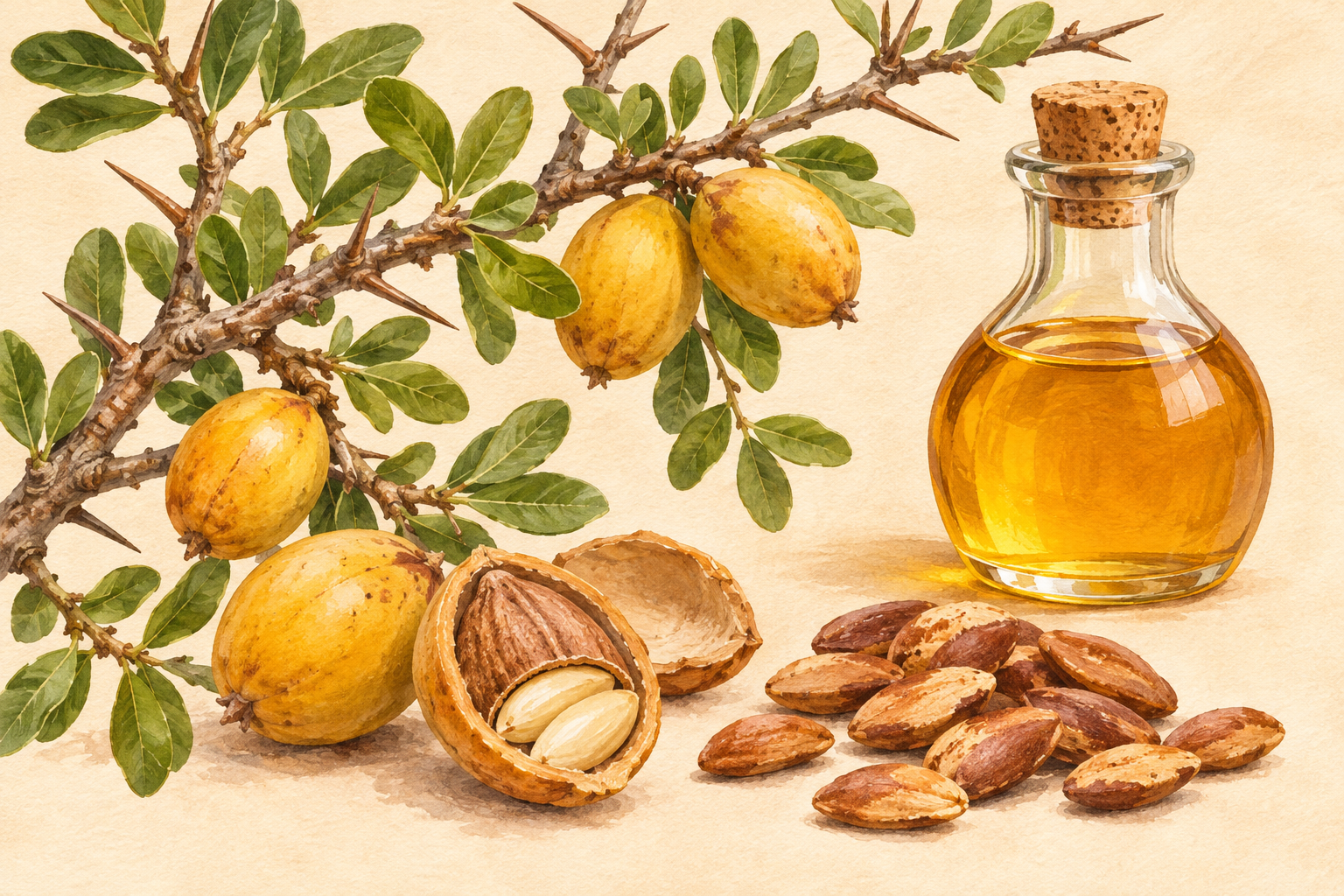
The oil comes from kernels inside the hard stones of Argania spinosa. Culinary kernels are generally roasted, unlike the unroasted kernels commonly used for cosmetic oil.
Composition
FAO’s Minor oil crops argan account reports literature values as percentages of total fatty acids: oleic 45.2–46.9%, linoleic 31.5%, palmitic 13.5–13.9%, and stearic 5.6–5.7%. The single linoleic value is a reported figure, not a guaranteed range across products.
| Fatty acid | FAO-reported value (% of total fatty acids) |
|---|---|
| Oleic C18:1 | 45.2–46.9% |
| Linoleic C18:2 | 31.5% |
| Palmitic C16:0 | 13.5–13.9% |
| Stearic C18:0 | 5.6–5.7% |
Source: FAO, Minor oil crops, argan section (literature attributed to Mellado and Morton). Sample counts and analytical conditions are not supplied with this table.
Region
The oil is rooted in Amazigh food traditions of southwestern Morocco, including celebratory and guest meals in the Anti-Atlas.
Food use
In southwestern Morocco, oil separated from roasted argan kernels is eaten with bread and mixed with almonds and honey to make amlou. An ethnographic food-use study around Essaouira also documents tagoulla, made with barley or maize semolina and argan oil, and labsis, combining toasted barley flour and other ingredients with the oil. Percentages reported in that local survey must not be generalized to all of Morocco.
Extraction
WIPO describes a traditional method in which the hard stones are cracked, kernels roasted and ground, and the paste kneaded with warm water to separate the oil. As an illustrative traditional yield, WIPO reports roughly 20 kg of fruit and 20 hours of work per litre of oil. Modern production can use mechanical pressing, settling and filtration; those traditional figures are not specifications for all producers.
Safety
Choose a product manufactured and labelled for food use, distinguishing it from cosmetic-grade argan oil. The difference in roasting does not by itself establish that all unroasted-kernel oil is harmful. Protect opened oil from light, heat and air, and follow the product’s storage instructions.
Sources
FAO, Minor oil crops: Argan: https://www.fao.org/4/x5043e/x5043e04.htm WIPO, Protecting Society and the Environment with a Geographical Indication: https://www.wipo.int/en/web/ip-advantage/w/stories/protecting-society-and-the-environment-with-a-geographical-indication Ethnopharmacological study of Argania spinosa in Essaouira: https://pmc.ncbi.nlm.nih.gov/articles/PMC11300070/ Argan oil: Chemical composition, extraction and quality control: https://pmc.ncbi.nlm.nih.gov/articles/PMC8850956/