THE OIL ATLAS
Moringa seed oil
Overview
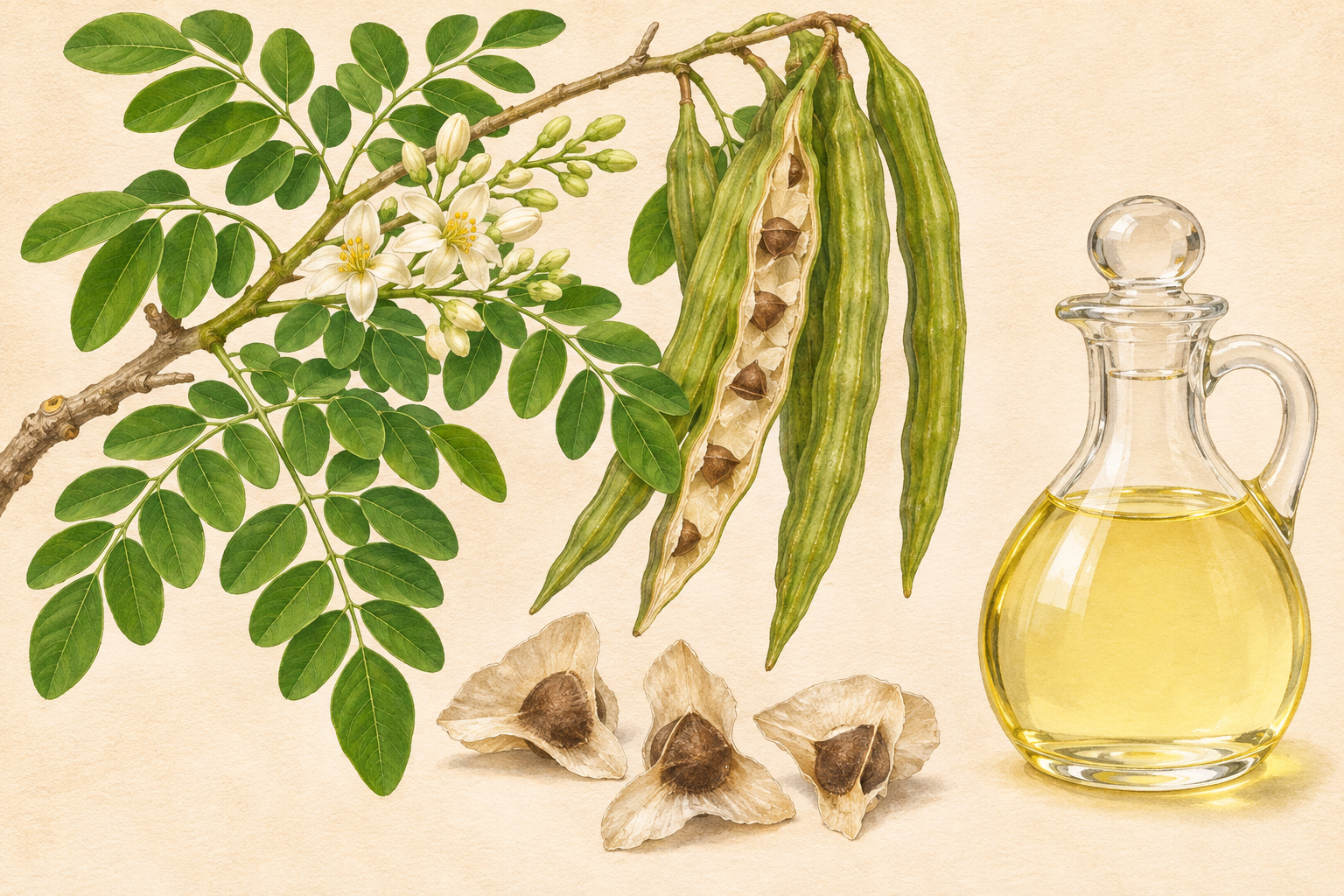
Ben oil is an edible oil separated from mature moringa seeds. Its recorded use in salads and cooking is distinct from eating the leaves or pods.
Source material
A fixed oil separated from mature seeds of Moringa oleifera. The approximate seed oil content of 30–40% refers to the seed material by weight, not the fatty-acid composition of bottled oil. Eating the leaves or pods as vegetables does not itself establish culinary use of the oil.
Composition
| Measure | Value | Material, unit and conditions |
|---|---|---|
| Oleic acid | 72.06 ± 0.17% | Oil sample in a 2025 study; share of total fatty acids |
| Tocopherols | 224.04 ± 1.78 mg/kg | Same study; per kg of oil |
| Phytosterols | 2,155.65 ± 23.45 mg/kg | Same study; per kg of oil |
| Oleic acid | 73.36 ± 0.22% | Separate 2021 study of Tunisian-grown material; share of total fatty acids |
Region
Moringa originated in the Indian subcontinent and is grown in parts of Africa and Asia. World Agroforestry documents recovery of edible oil from mature seeds; a GIZ factsheet for Namibia also describes the separated oil as suitable for cooking and salad dressing. The geographical range of cultivation is not evidence that the oil is widely consumed in every growing region.
Food use
World Agroforestry and GIZ-related materials describe the separated ben oil as an oil for salads and cooking. The cited materials do not establish a specific named regional dish, so none is inferred. Use of leaves in soups or pods as vegetables is separate from culinary use of the oil.
Extraction
The mature seeds are shelled and the kernels pressed to separate oil. World Agroforestry also describes roasting and crushing mature seeds, then recovering oil that rises to the surface of hot water. Cold pressing and heat-assisted water separation are different processes and need not describe the same commercial product.
Safety
Choose products explicitly intended for food; do not consume oils sold for cosmetics or lubrication. Reports of undesirable constituents in leaves, seeds or presscake cannot be assumed to describe the concentration in finished edible oil. Store away from light and heat after opening.
Its oleic-acid-rich profile is associated with relatively good oxidative stability, but appropriate storage remains necessary.
Sources
1. World Agroforestry, Moringa oleifera: https://apps.worldagroforestry.org/treedb/AFTPDFS/Moringa_oleifera.PDF 2. GIZ / NAFSAN, Moringa oleifera: https://www.nafsan.org/wp-content/uploads/2022/01/GIZ-F4R-Moringa-Oleifera-English.pdf 3. FAO Feedipedia, Moringa oleifera: https://feedipedia.review.fao.org/node/124
Additional references - https://www.foodstandards.gov.au/sites/default/files/2025-12/A1294%20Supporting%20Document.pdf - https://pmc.ncbi.nlm.nih.gov/articles/PMC7430547/ - https://pubmed.ncbi.nlm.nih.gov/39761328/ - https://www.sciencedirect.com/science/article/pii/S0254629920311662 - https://pmc.ncbi.nlm.nih.gov/articles/PMC5187941/