THE OIL ATLAS
Nia kuta palm oil (cocão)
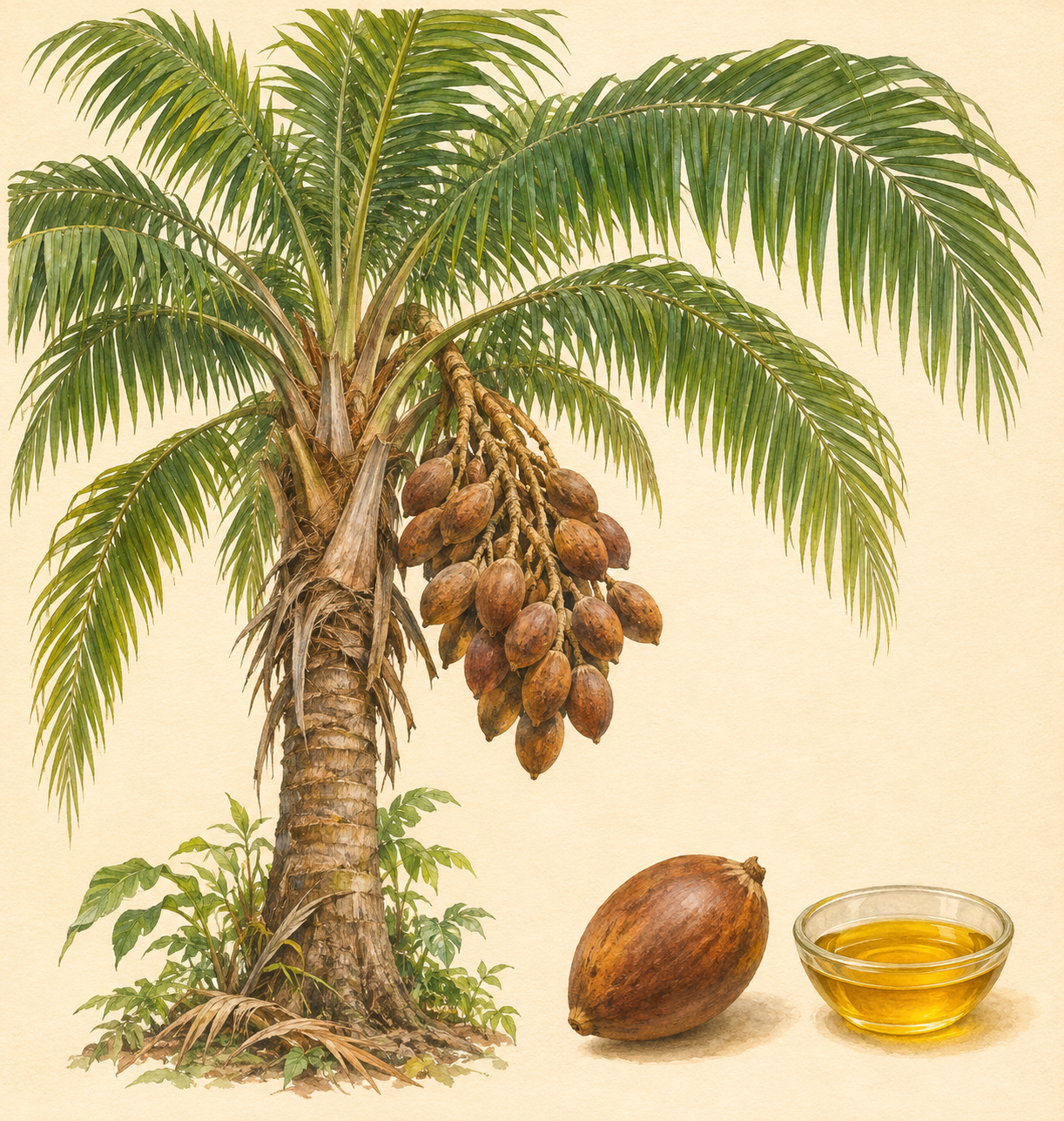
Overview
Nia kũta oil is a traditionally separated oil associated with Attalea tessmannii (cocão), recorded among Huni Kuĩ food plants in Acre, Brazil. The ethnobotanical study explicitly names the palm as an oil source.
Source material
Attalea tessmannii, locally nia kũta or cocão. The study also describes a seed-derived “milk”, which must not be conflated with separated oil; the exact oil-bearing plant part is not established.
Composition
No source-matched quantitative values have been established here for oil yield, fatty-acid profile or nutrients per 100 g of food. Values from related species or different plant parts are not substituted.
Region
Traditional Huni Kuĩ use in Acre, western Brazil. A 2023 study reports that oil-extraction knowledge is declining and is mainly retained by older women in the surveyed villages.
Food use
The study identifies A. tessmannii among palms used for extracted oils and describes both food and topical uses of such oils. No species-specific dish, dosage or present-day sales are established.
Extraction
An elder described pounding palm material with water and recovering the oil that rose after standing overnight. Separately, she described pounding A. tessmannii seeds to obtain a milk-like preparation; this is not evidence that the milk itself was oil.
Safety
Traditional use is not equivalent to modern food-safety assessment or authorization for sale. The oil and seed milk are distinct products; product-specific quality data remain unavailable.
Sources
Pilnik et al. (2023), Rodriguésia 74, e00482021, Modes of consumption and Huni Kuĩ testimony. https://www.scielo.br/j/rod/a/pQ8rtZgnG9SLwB6KsPf3Pyg/?format=html&lang=en