THE OIL ATLAS
African canarium kernel oil
Overview
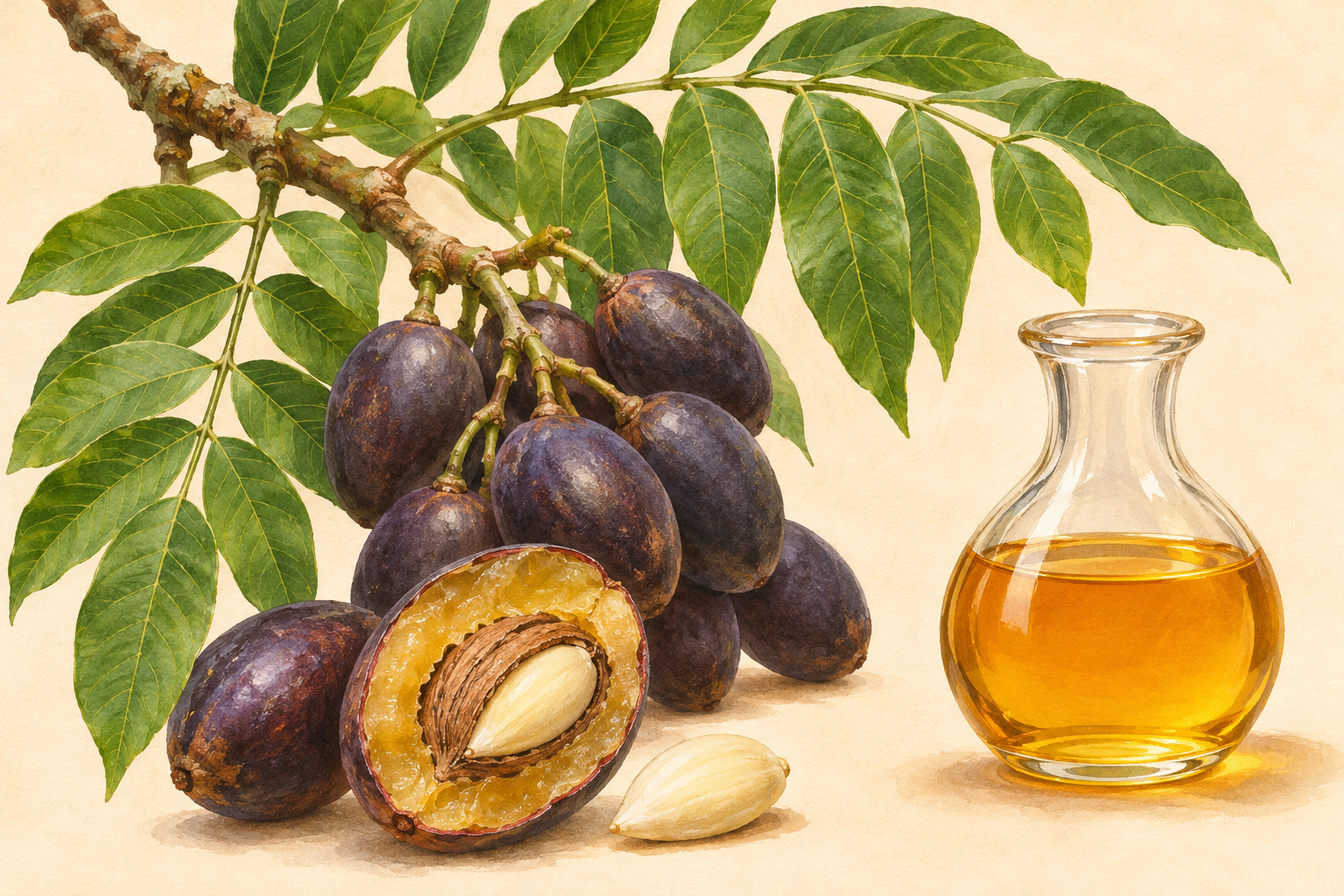
Oil separated from the seed kernels of the African tree Canarium schweinfurthii. A 2001 scholarly report records the Kama people of Nigeria extracting oil from the seeds and using the crude oil for cooking. This is distinct from consuming the pulp or extracting pulp oil.
Source material
Seed kernels of Canarium schweinfurthii Engl. Pulp, kernels and resin are different materials and their analytical results must not be interchanged.
Composition
A 1999 paper reports extracted lipids from the mesocarp and endocarp, but its material and extraction conditions cannot be equated with the traditional kernel cooking oil discussed here; no numerical fatty-acid profile is transferred.
Region
A 2001 journal article documents use by the Kama people in Adamawa State, Nigeria. Consumption of the fruit elsewhere does not itself establish culinary use of separately extracted kernel oil.
Food use
The Kama community is reported to have used crude oil extracted from the seeds for cooking. Widespread contemporary marketing and particular dishes were not verified.
Extraction
The 2001 account records seed-oil extraction and crude use, but does not establish detailed traditional equipment, temperatures or refining stages. Laboratory solvent extraction is a separate process.
Safety
Historical consumption of crude oil does not establish the safety or standards compliance of current products. Choose oil with verified food-grade quality and manufacturing controls, with attention to contamination and oxidation.
Sources
1. *Journal of Tropical Agriculture* 39 (2001), p.193, *Canarium schweinfurthii* seed oil, https://jtropag.kau.in/index.php/ojs2/article/download/60/60 2. Abayeh et al., *Quality characteristics of Canarium schweinfurthii Engl. oil*, Plant Foods for Human Nutrition 54 (1999):43–48, https://pubmed.ncbi.nlm.nih.gov/10646628/