THE OIL ATLAS
Dabai kernel oil
Overview
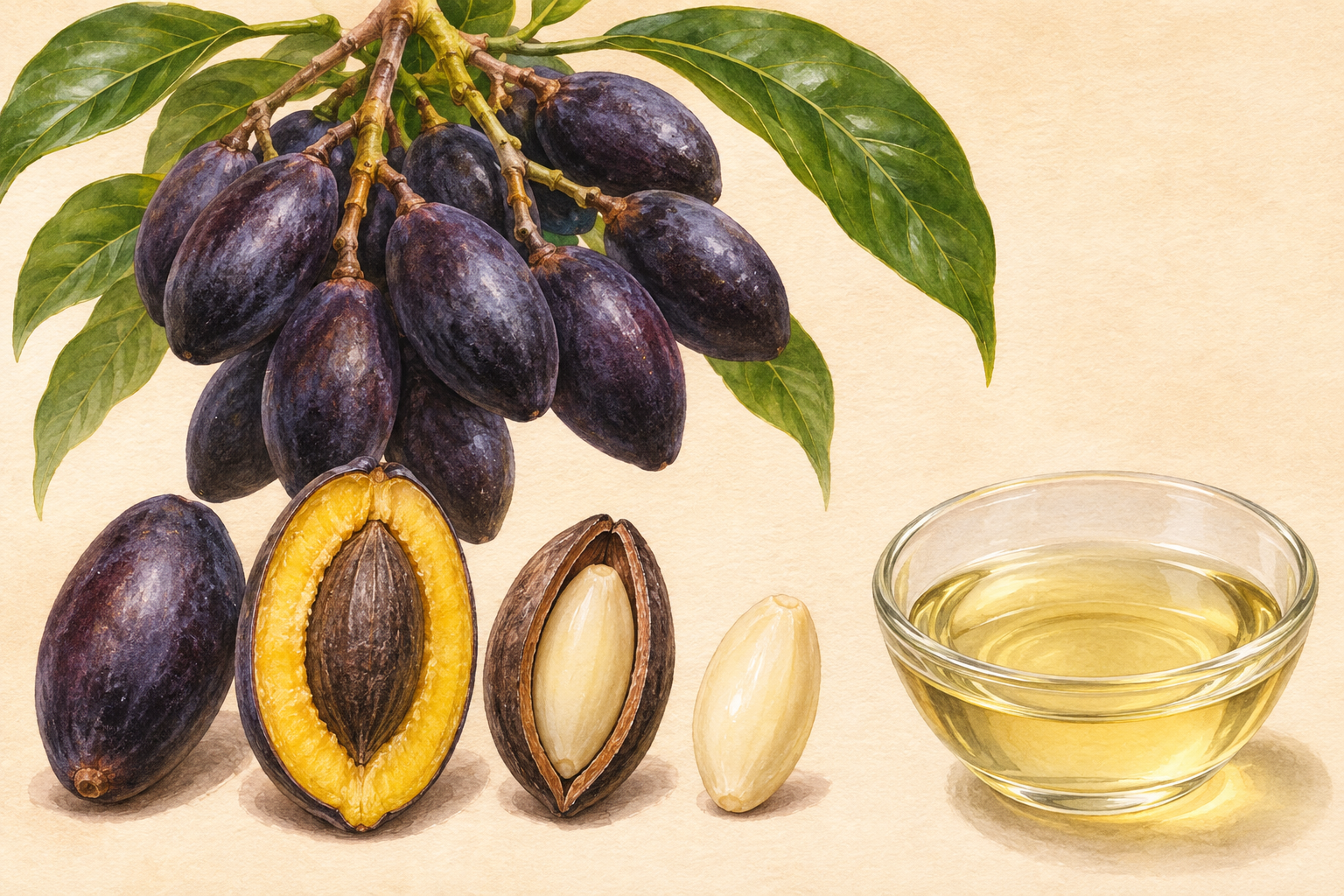
Dabai kernel fat is separated from kernels of Canarium odontophyllum Miq., a Bornean fruit. It is distinct from dabai pulp oil. An academic review records use of the highly saturated kernel fat as a substitute for palm-kernel fat and cocoa butter in chocolate manufacture.
Source material
The source is the kernel of dabai, Canarium odontophyllum.
Composition
In a 2010 study of experimentally extracted dabai kernel oil, palmitic acid was 46.4%, myristic acid 9.3%, oleic acid 35.1%, and linoleic acid 2.8% of total fatty acids. This profile differs from pulp oil and does not establish dietary use or safety of the isolated oil.
Region
Records of fruit consumption and research samples concern Sarawak, Borneo, and related areas; they do not establish culinary use of separated kernel oil there.
Food use
Beyond eating the kernel itself, separated kernel fat is reported as a substitute for palm-kernel fat and cocoa butter in chocolate. A 2020 food study also distinguished dabai pulp oil, oleoresin and kernel when manufacturing and sensory-testing cocoa bars. The documented chocolate application supports independent food use of kernel fat; it does not show widespread use as a household cooking oil.
Extraction
The kernel is removed from the seed shell and its fat is separated. Research uses solvent or ultrasound-assisted extraction, but analytical and prototype methods should not be presented as a traditional Sarawak oil-making practice.
Safety
Edibility of the kernel alone does not certify oil made by any extraction method. Food-grade extraction and refining require control of oxidation, residual solvent and contaminants. Its high saturated-fat content is not presented as a health advantage.
Sources
1. Mundi et al. (2022). Exploring Dabai (Canarium odontophyllum), Plants 11, 2646. https://pmc.ncbi.nlm.nih.gov/articles/PMC9572975/ 2. Nutritional quality and sensory evaluation of dabai-fortified cocoa bar (2020), International Journal of Food Properties 23. https://doi.org/10.1080/10942912.2020.1800031 3. Azlan et al. (2010). Comparison of fatty acids, vitamin E and physicochemical properties of dabai, olive and palm oils. https://doi.org/10.1016/j.jfca.2010.03.026