THE OIL ATLAS
Dabai pulp oil (research)
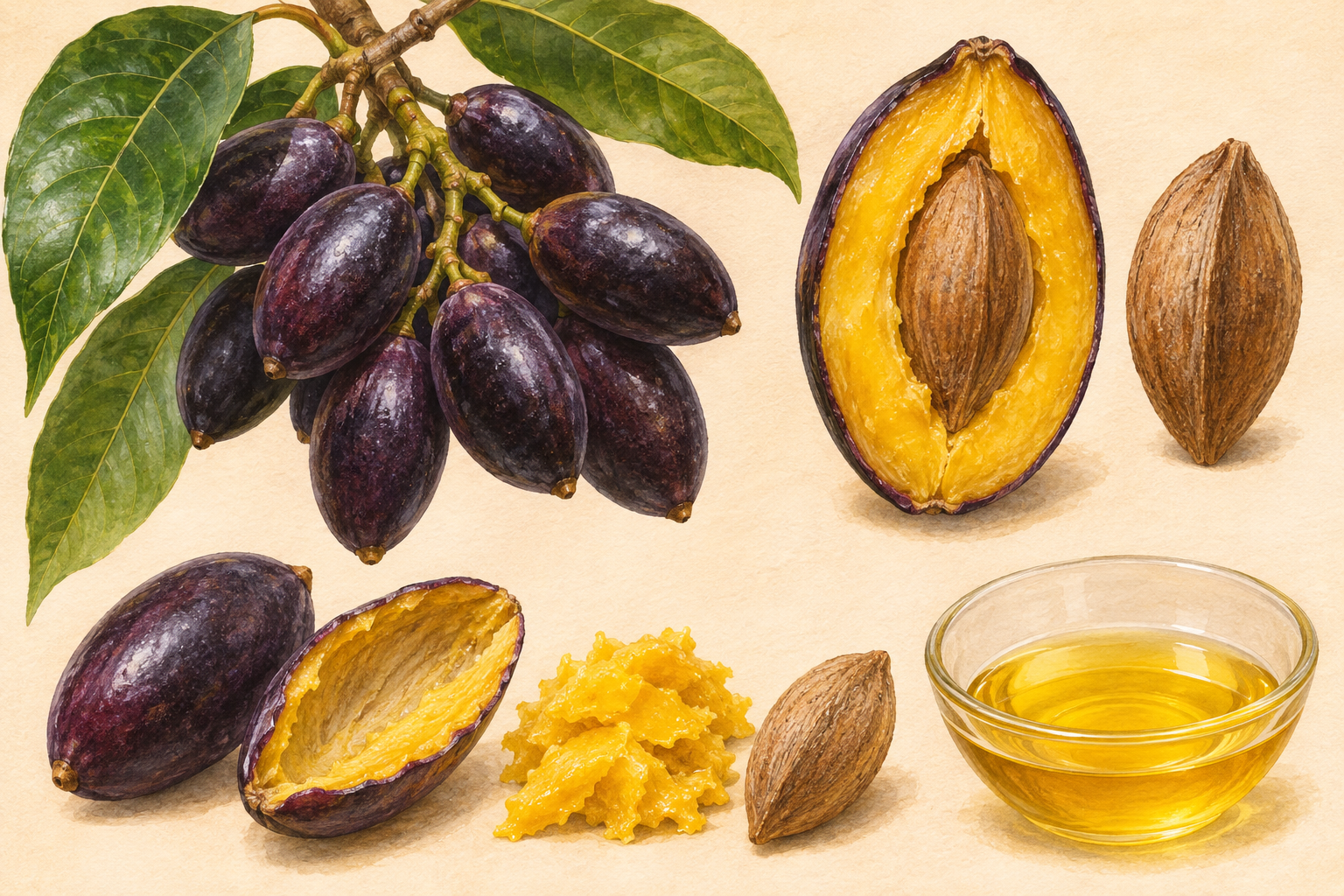
Overview
Dabai pulp oil is separated from the pulp of Canarium odontophyllum Miq., an edible Bornean fruit. Beyond consumption of the fruit itself, a food study manufactured and sensory-tested dabai-fortified cocoa bars using separated pulp oil. This does not establish widespread use as a traditional cooking oil.
Source material
The source is the pulp of Canarium odontophyllum Miq., distinct from kernel oil.
Composition
A 2010 food-composition study reported palmitic acid 36.1%, myristic acid 5.8%, oleic acid 41.5%, and linoleic acid 11.8% of total fatty acids in experimentally extracted dabai pulp oil. These are study-sample fatty-acid percentages, not a commercial nutrition label or evidence of customary use of separated oil.
Region
The cited research concerns dabai from Sarawak, Borneo, and related records. Sampling and fruit-consumption locations do not establish where separated oil is used in cooking.
Food use
A 2020 food study treated dabai pulp oil, oleoresin and kernel as distinct edible fractions, manufactured fortified cocoa bars and evaluated their nutritional, antioxidant and sensory properties. Incorporation of the pulp oil is direct evidence of food use of the separated oil. Existing dabai mayonnaise and sauces may use whole pulp, so they are not all counted as pulp-oil products.
Extraction
Research separates oil from the fruit pulp for food formulation. Supercritical-carbon-dioxide extraction in another study is an experimental quality-controlled process and should not be described as a traditional Sarawak production method.
Safety
Consumption of dabai fruit does not establish the safety of oil separated from its pulp. Food-grade processing, quality control and applicable food regulations require separate verification.
Sources
1. Azlan et al. (2010), Comparison of fatty acids, vitamin E and physicochemical properties of Canarium odontophyllum Miq. (dabai), olive and palm oils, Journal of Food Composition and Analysis 23, 772–776. https://doi.org/10.1016/j.jfca.2010.03.026 2. Nutritional quality and sensory evaluation of dabai-fortified cocoa bar (2020), International Journal of Food Properties 23. https://doi.org/10.1080/10942912.2020.1800031 3. Mundi et al. (2022), Exploring Dabai, Plants 11, 2646. https://pmc.ncbi.nlm.nih.gov/articles/PMC9572975/ 4. Quality of Dabai Pulp Oil Extracted by Supercritical Carbon Dioxide (2021). https://pmc.ncbi.nlm.nih.gov/articles/PMC7912196/