THE OIL ATLAS
Ethiopian mustard oil
Overview
Warning: conventional oil can be high in erucic acid and is not interchangeable with low-erucic edible oil.
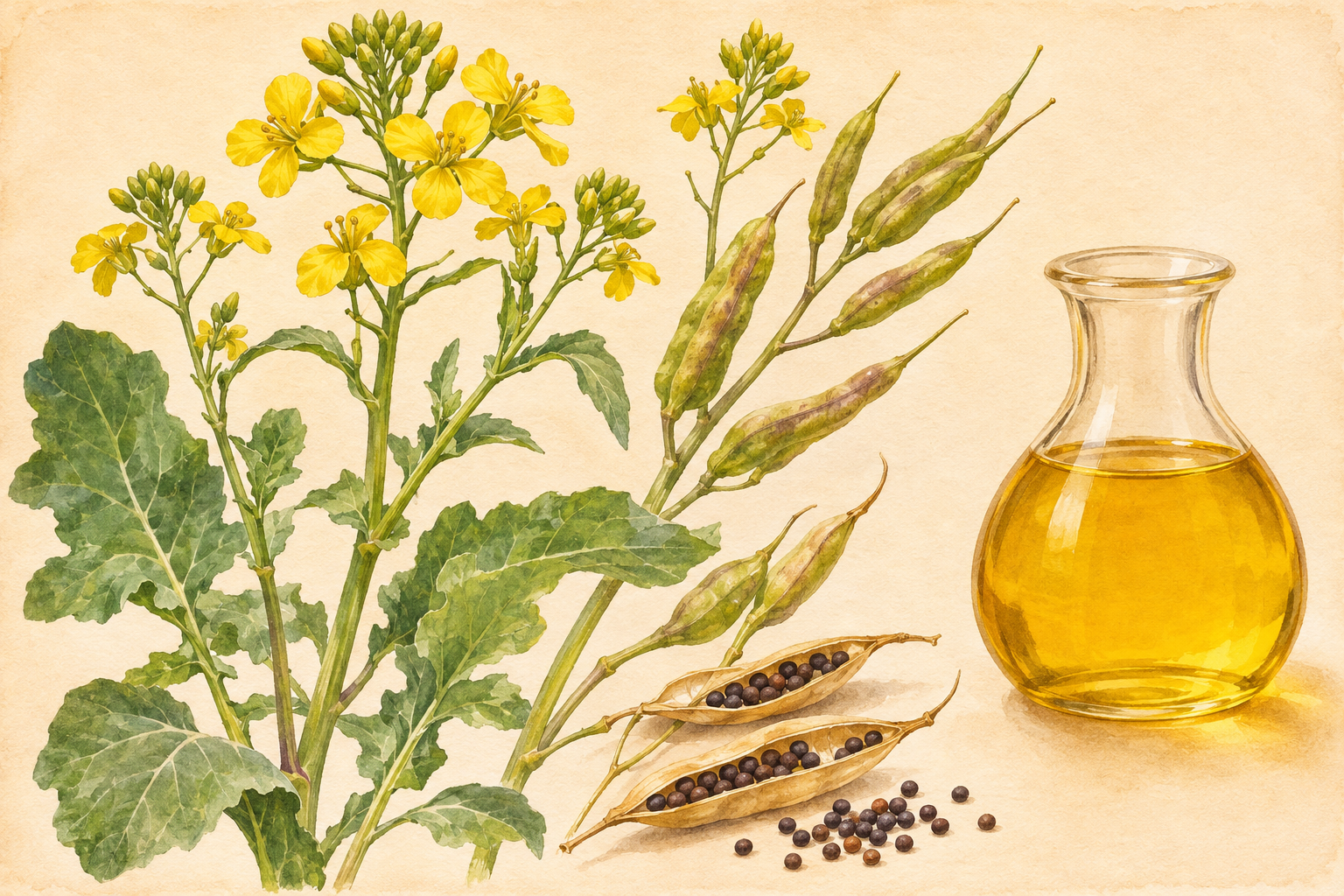
Oil separated from the seeds of Ethiopian mustard (Brassica carinata). Cooking uses and oiling of earthenware injera griddles are documented in Ethiopia. Conventional varieties can be high in erucic acid and should not be confused with low-erucic edible rapeseed oil.
Source material
Seed oil from Brassica carinata, called gomen zer in Ethiopia. Traditional high-erucic varieties require particular caution; verify that a product is suitable for food use.
Region
Known in Ethiopia as gomen zer, the crop has a documented history of seed-oil use. PROTA describes oilseed cultivation as concentrated mainly in Ethiopia. Eating the leaves as a vegetable elsewhere in Africa is distinct from using separated seed oil.
Food use
In Ethiopia, the extracted seed oil has been used in cooking and to oil earthenware griddles used to bake injera. Greasing a griddle does not imply adding large quantities of oil to the food. This use is also distinct from using the pungent seeds themselves as a spice.
Extraction
The seeds are crushed and oil is separated. PROTA records crushed seeds and cooking-oil use but does not establish one universal pressing machine or refining process across all locations. Conventional high-erucic material should be distinguished from low-erucic breeding lines.
Safety
Do not substitute conventional high-erucic B. carinata oil for ordinary low-erucic edible rapeseed oil. PROTA identifies erucic acid and glucosinolates as constraints on cooking use. Historical food use is not evidence that a product meets present-day food-safety requirements. Consumption is not recommended unless food-grade compliance is established. Follow the storage instructions of a compliant food product.
Product-specific compliance in Japan, the US and EU and safe intake conditions remain unverified. Purchase, consumption and home extraction or detoxification are not recommended here.
Sources
1. PROTA, “Brassica carinata (PROTA)”, Pl@ntUse. https://plantuse.plantnet.org/en/Brassica_carinata_%28PROTA%29 2. Tesfaye et al. (2024), “Identification of High Erucic Acid Brassica carinata Genotypes through Multi-Trait Stability Index”, *Agriculture* 14(7), 1100. https://doi.org/10.3390/agriculture14071100 3. Wageningen University & Research, *Oilseeds: Business Opportunities in Ethiopia*, p.48. https://edepot.wur.nl/14197 FDA Import Alert 26-04 (updated 15 April 2026; expressed mustard oils with unsafe erucic acid, not all Brassica oils): https://www.accessdata.fda.gov/cms_ia/importalert_89.html EFSA, Erucic acid in feed and food: https://doi.org/10.2903/j.efsa.2016.4593