THE OIL ATLAS
Grapeseed oil
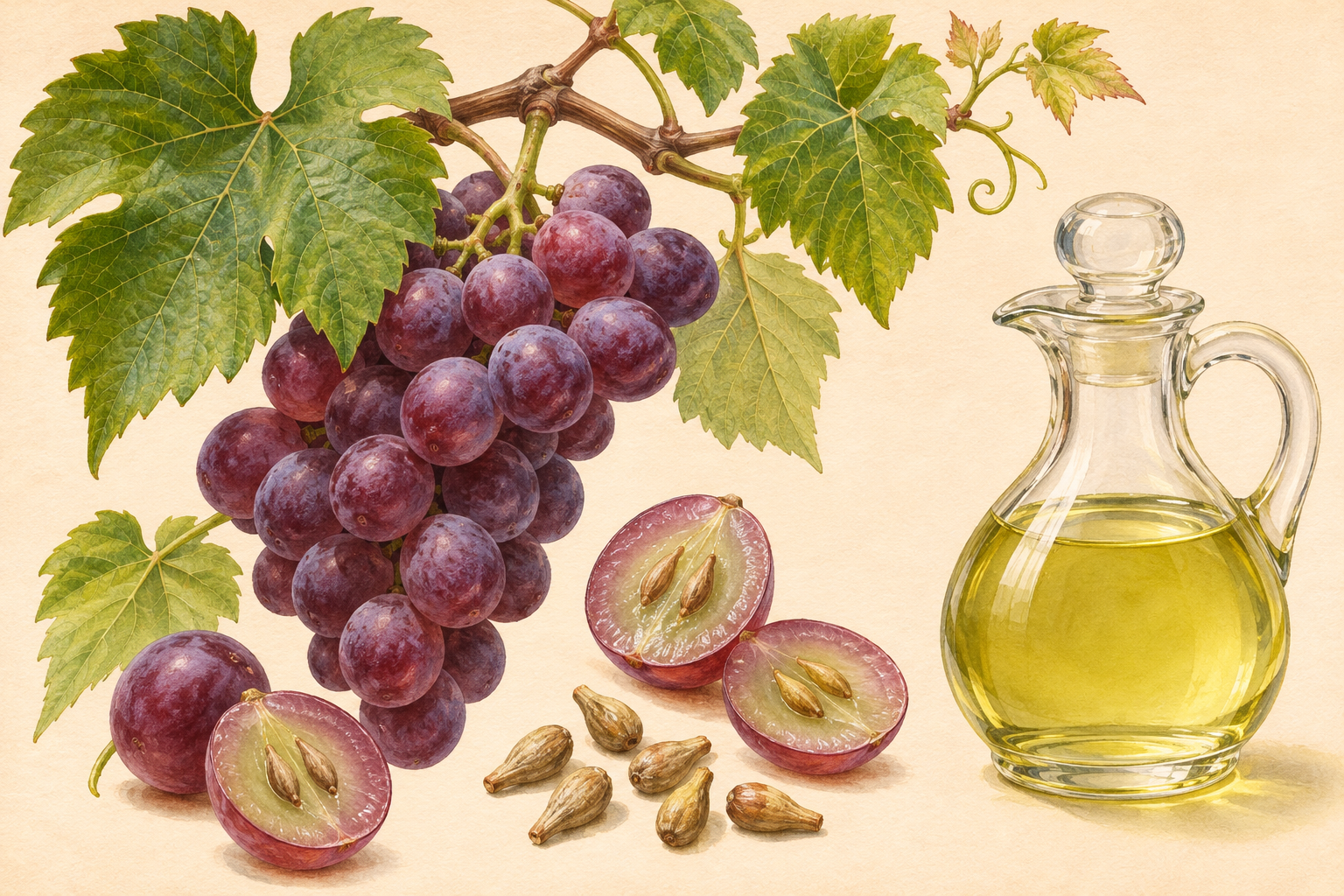
Overview
Grapeseed oil is a separated edible oil made from Vitis vinifera seeds, often recovered as by-products of wine, juice and raisin production. It is rich in linoleic acid and needs protection against oxidation.
Source material
The principal feedstock is grape seed remaining after wine or juice production. Unlike consuming grape juice or skins, production involves separating oil from the seeds and preparing it for food use. Grape variety and refining conditions can affect the finished oil.
Composition
Codex CXS 210-1999, Table 1: specification ranges based on gas-liquid chromatography of authentic oil samples. Unit: percentage of total fatty acids (%), not a measurement of one retail brand.
| Fatty acid | Specification range (%) |
|---|---|
| palmitic C16:0 | 5.5–11.0 |
| oleic C18:1 | 12.0–28.0 |
| linoleic C18:2 | 58.0–78.0 |
A high linoleic-acid proportion is a compositional fact, not a complete measure of shelf stability; exposure to light and heat also affects quality.
Region
FAO lists France, Spain, Italy, Chile, the United States and Australia among major grape-producing countries relevant to seed supply. It records 42,000 tonnes of grapeseed oil produced in Italy, France and Spain combined in 1983; this is historical, not a current production estimate.
Food use
FAO explicitly records food use of the extracted oil. Food-grade refined oil is used for dressings and cooking. This is distinct from eating whole grape seeds.
Mild refined products can be used in dressings and everyday cooking. Unrefined versions should not automatically be assumed to have the same flavour.
Extraction
Seeds are recovered from by-products of wine, juice and raisin production, then dried and pressed or extracted for oil. FAO reports seed oil content ranging from 6% to 21%, averaging about 15%. This is oil yield in seeds, not the fatty-acid composition of finished oil.
When seeds are recovered from winery pomace, separation and drying precede oil extraction. Seed oil content and actual recovered oil yield are distinct measures.
Safety
Choose food-grade oil and follow label directions for heating and storage. Because the oil is rich in linoleic acid, protect it against light, heat and oxygen and discard rancid oil. The oil also has industrial uses, which must not be confused with edible products.
Sources
FAO, Minor Oil Crops, “Grapeseed” (by-product origin, geography, historical production, food use); Codex Alimentarius CXS 210-1999, Table 1 (authentic-oil fatty-acid specification ranges).