THE OIL ATLAS
Tea seed oil
Overview
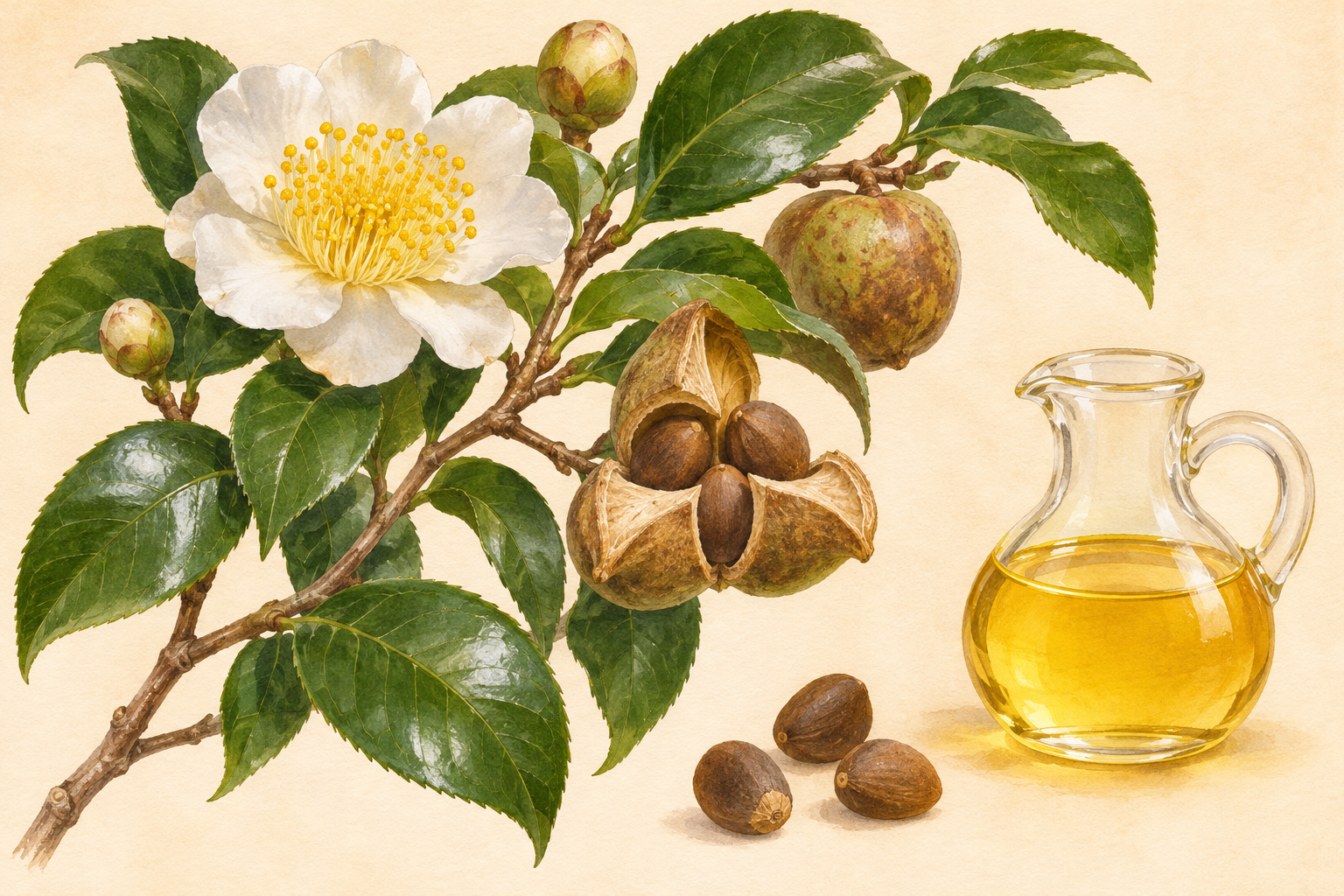
Oil-tea camellia oil from Camellia oleifera seeds is used in southern Chinese cooking. Its source differs from seed oil of the beverage-tea plant, C. sinensis.
Source material
The name “tea seed oil” can refer to different Camellia species. This article focuses on oil physically separated from C. oleifera seeds.
Composition
A peer-reviewed 2024 study analysed 11 C. oleifera seed-oil samples from southern China. Oleic acid ranged from 59.66±0.72 to 82.89±2.16 g/100 g of oil; squalene from 45.8±0.8 to 184.1±5.5 mg/kg; and beta-sitosterol from 143.7±4.8 to 1704.6±72.0 mg/kg. These are measurements of study samples, not guaranteed retail specifications.
| Component | Study-sample range | Unit |
|---|---|---|
| Oleic acid | 59.66±0.72–82.89±2.16 | g/100 g oil |
| Squalene | 45.8±0.8–184.1±5.5 | mg/kg oil |
| Beta-sitosterol | 143.7±4.8–1704.6±72.0 | mg/kg oil |
Region
The oil is produced and used for cooking in southern China, identified by the Royal Botanic Gardens, Kew as a principal culinary region.
Food use
The separated oil serves as a cooking oil and is also used in salad dressings, sauces and dips. These are uses of extracted oil rather than consumption of whole seeds.
Extraction
Kew describes powdering, steaming and pressing the seeds to obtain oil. Drying, shelling, extraction and refining practices vary between products.
Safety
Choose finished food-grade oil. Do not confuse C. oleifera with C. sinensis tea-leaf seed oil or cosmetic camellia oils. Laboratory antioxidant findings do not establish disease prevention. Protect the oil from heat, light and oxygen and follow its label.
Sources
Royal Botanic Gardens, Kew, Tea oil camellia. Li, Zhu & Qin (2024), Journal of Oleo Science 73(7):943–952, DOI:10.5650/jos.ess23228: https://www.jstage.jst.go.jp/article/jos/73/7/73_ess23228/_article