THE OIL ATLAS
Akebia seed oil
Overview
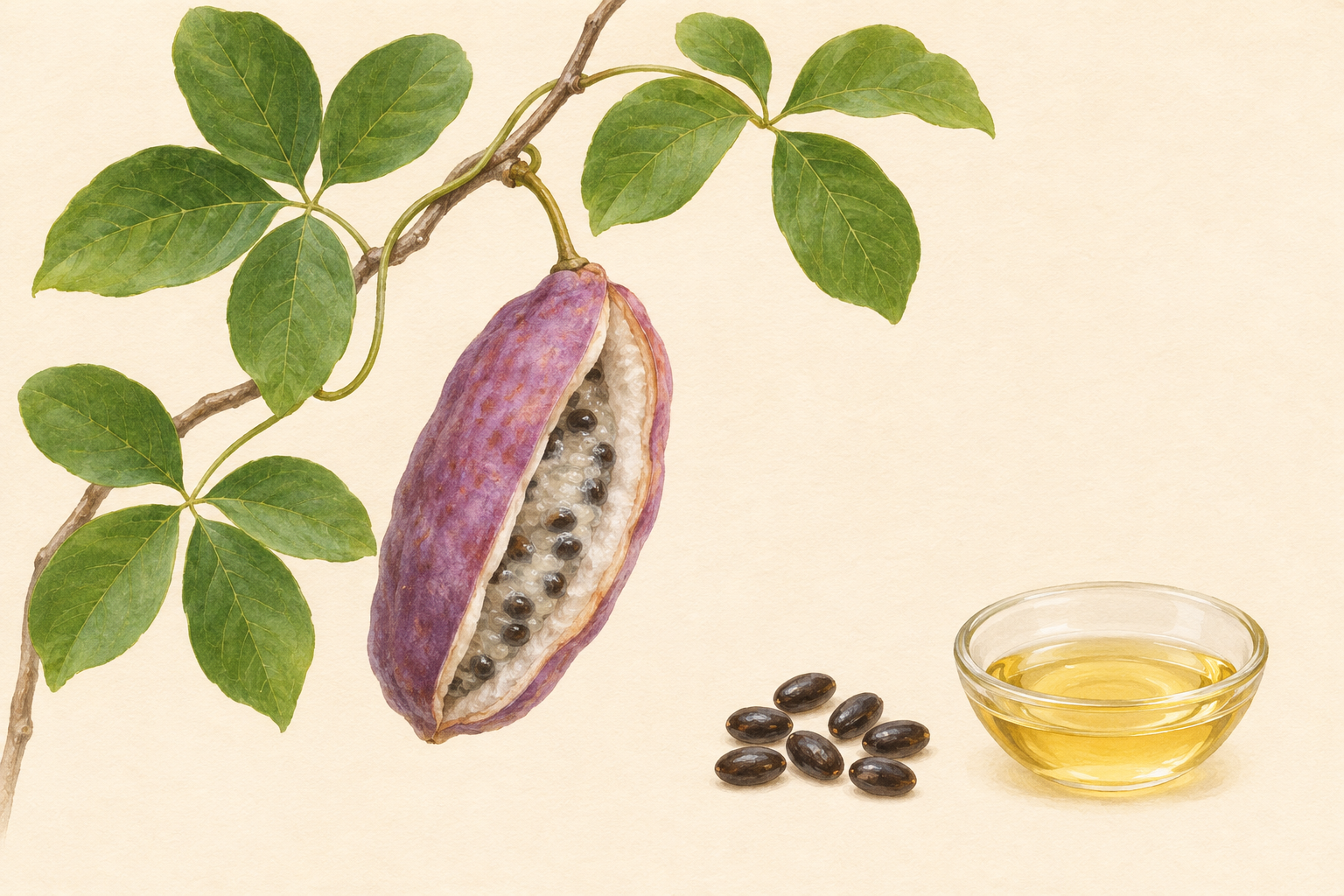
Pressed from the fruit’s dark seeds, akebia seed oil once linked household production in Akita with urban restaurants. Production disappeared as mass-produced cooking oils spread, before local efforts revived oil pressing.
Source material
The raw material is seed from Akebia fruits. The 2018 paper identifies Akebia quinata but also discusses other Akebia species and hybrids. The historical supply cannot all be authenticated as a single pure species.
Composition
Ikemoto (2018) reports analyses of oil from the Nishiki revival in which the fatty-acid composition was approximately 45% oleic acid, 30% linoleic acid and 21% palmitic acid. These values were obtained by gas chromatography after conversion to fatty-acid methyl esters; they are not amounts per 100 g of oil or specifications for every product. The principal lipid was reported as 1,2-diacylglycero-3-acetate (DAGA).
Region
Records describe household oil pressing around present-day Nishiki in Semboku, Akita, during the Edo period. In the Meiji period, a local oil merchant collected supplies for trade, including sales to restaurants in Tokyo. Production ceased in the early Showa period as inexpensive oils spread; revival work began in Nishiki in 2003.
Food use
An account of late-Meiji Tokyo describes a mixture of akebia seed oil and sesame oil as a prized oil for tempura served in private dining settings. The 2003 revival included a tasting of the pressed oil at a village festival.
Extraction
The revival drew on interviews with residents familiar with earlier production and a surviving Meiji-era oil press. The documented method involved steaming and crushing the seeds, then pressing them in a cloth bag to separate the oil.
Safety
Animal experiments on DAGA digestion and body fat do not establish weight-loss effects in humans.
Sources
池本敦 (2018) 秋田県に眠るオレオマテリアル-アケビ種子油-, オレオサイエンス18(3):107–112. DOI 10.5650/oleoscience.18.107. https://www.jstage.jst.go.jp/article/oleoscience/18/3/18_107/_article/-char/ja https://www.akita-u.ac.jp/honbu/lab/vol_95.html