THE OIL ATLAS
Pangtse Makhu (Symplocos paniculata seed oil)
Overview
Pangtse Makhu is a traditional cooking oil separated from the sapphire berry tree, Symplocos paniculata, in Bhutan. The National Biodiversity Centre reported a revival and product launch in 2023.
Source material
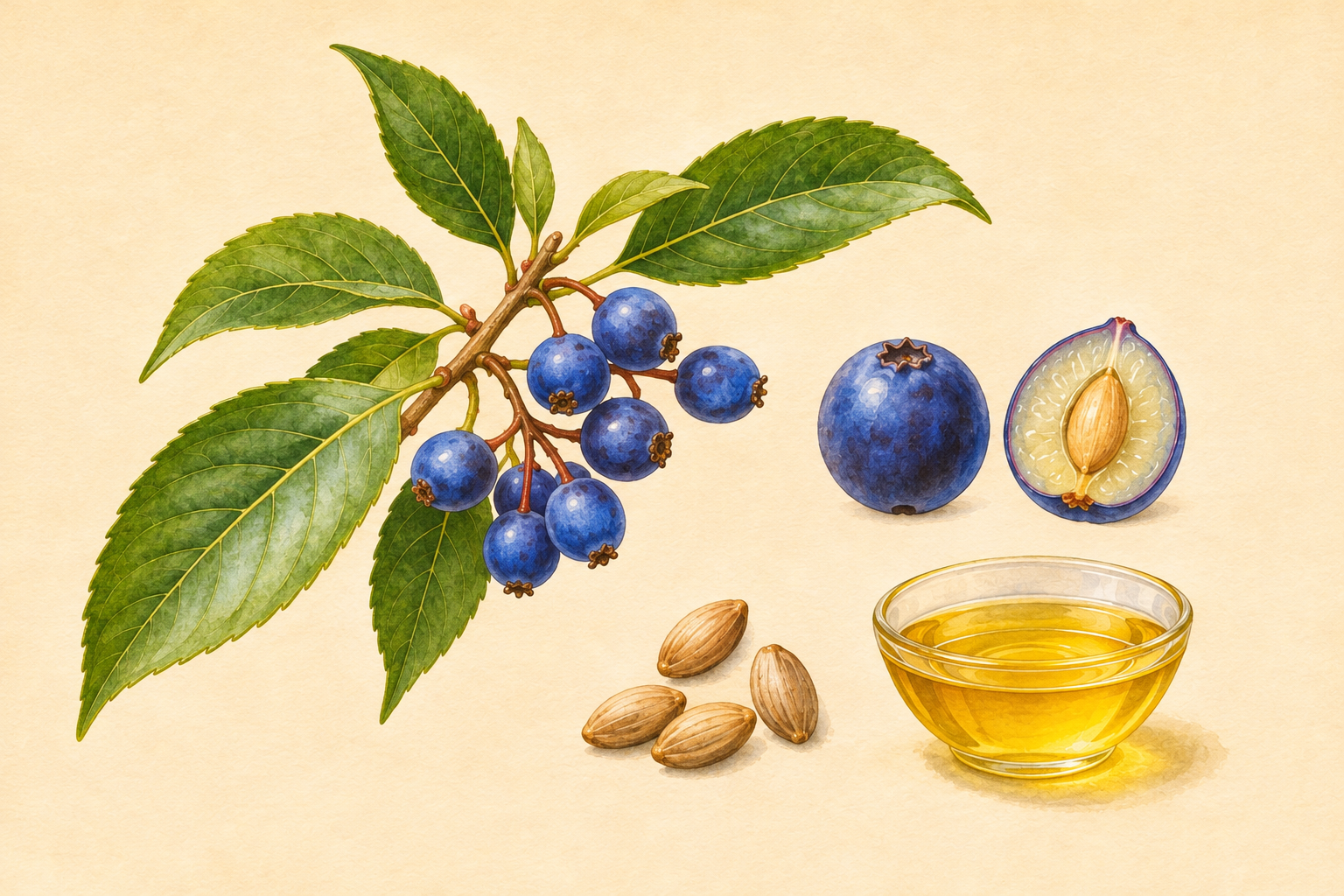
Fruits and seeds of Symplocos paniculata. The National Biodiversity Centre describes fruit-derived oil, while a FAO-hosted Bhutanese account and cultural documentation describe crushing, heating and pressing seeds. The difference in descriptions is retained rather than assuming a distinct pulp oil.
Region
Documented in Bhutan, including Punakha and the Wangdue valley. The 2023 revival involved small-scale producers in Punakha; nationwide prevalence is not assumed.
Food use
The National Biodiversity Centre and local cultural records explicitly document its use as a separated cooking oil. A local report also records its use to prepare mengay. This is distinct from eating whole seeds.
Extraction
Ripe fruits are collected and seeds processed by pounding, heating or steaming, and pressing to separate oil. The National Biodiversity Centre describes dried berries being ground, heated and pressed with traditional stone equipment.
Safety
Traditional consumption and the 2023 product launch do not establish that every batch meets microbiological, oxidation or country-specific market requirements. Use products manufactured and labelled for food, following storage guidance.
Sources
1. National Biodiversity Centre, Bhutan (2023), “The Centre launches Pangtse Makhu!” https://nbc.gov.bt/the-centre-launches-pangtse-makhu/ 2. FAO-hosted Bhutan agricultural attachment, “Pangtse Description,” p.236. https://www.fao.org/4/ah928e/ah928e05.pdf 3. Bhutan ICH Links, Pangtse oil extraction tradition. https://bhutan.ichlinks.com/archive/elements/elementsV.do?contentsI18NCd=en-US&elementsUid=13874052798783341322 4. National Biodiversity Centre, status report 2022–2023. https://nbc.gov.bt/download/status-report-2022-2023/