THE OIL ATLAS
Sorghum bug oil
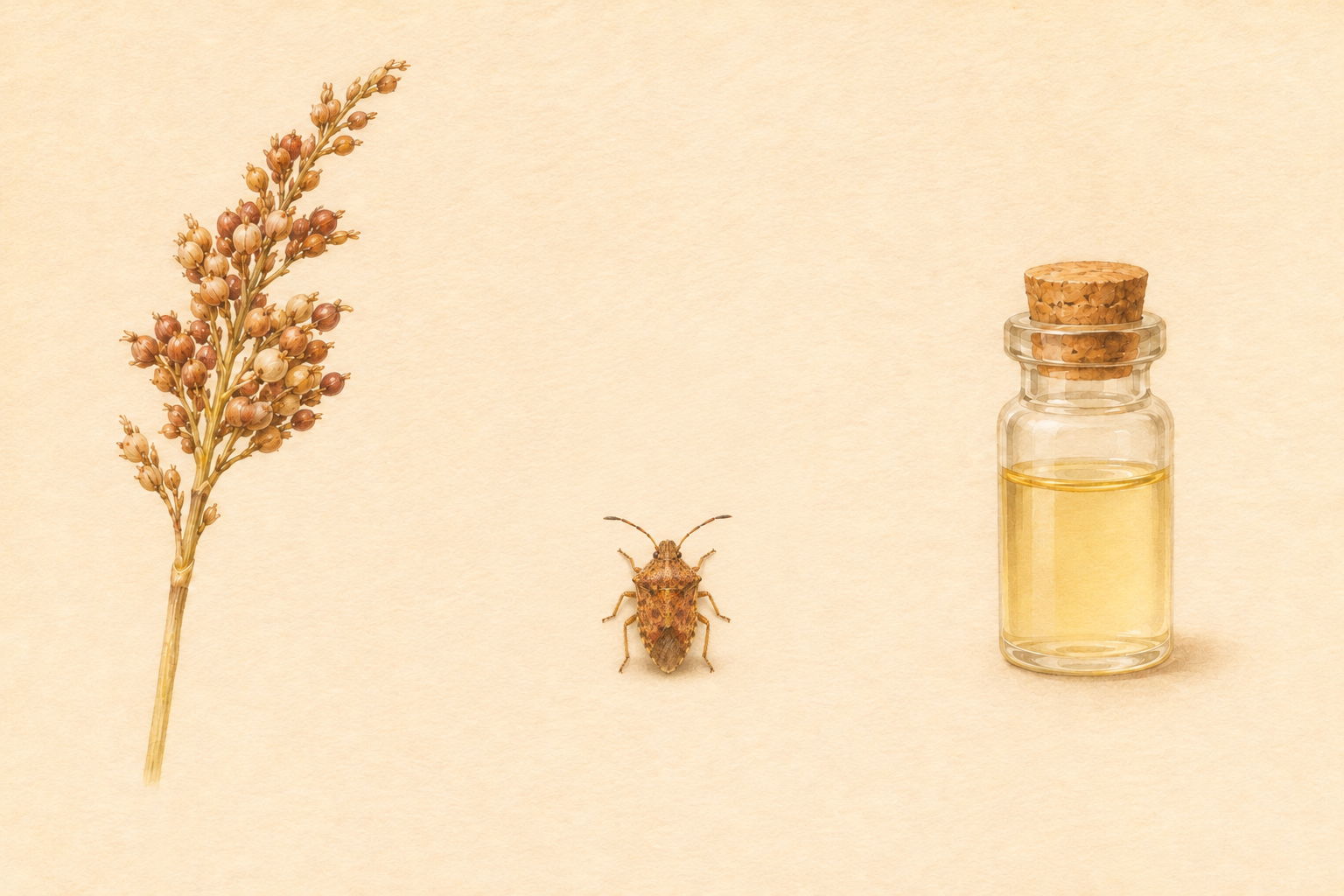
Overview
Sorghum-bug oil is separated from bugs associated with sorghum in Sudan. FAO documents extraction of oil for cooking as a practice distinct from eating the insects themselves.
Source material
FAO (2013), section 2.4.4, names Agonoscelis pubescens as the sorghum bug and documents extracted oil used for cooking in some areas. Section 2.2 separately mentions cooking oil derived from A. versicolor. The two species-level accounts are retained separately rather than treated as a single verified identification.
Composition
Oil content of the raw material and fatty-acid proportions in the separated oil are different measures. Whole-source composition and analyses of related species cannot establish this oil’s nutrition values.
Region
FAO (2013) reports cooking with oil extracted from sorghum bugs in some areas of western former Sudan. It also describes insect collection in the Nuba Mountains; this does not establish oil extraction and cooking in every collection locality.
Food use
FAO §2.4.4 (around printed pp. 33–34) distinguishes eating fried adults from extracting oil from the insects for cooking in some areas.
Extraction
Bugs are collected and oil is extracted. FAO does not establish a particular temperature, solvent or press for this oil. Tar heated from the insects to treat camel skin infections is not edible cooking oil.
Safety
Species identification and hygienic collection require attention. Medicinal tar used on camels is not cooking oil. Historical food use does not certify present-day food safety.
Sources
FAO (2013), *Edible insects: Future prospects for food and feed security*, Forestry Paper 171, §§2.2.2 and 2.4.4, around printed pp. 15 and 33–34 (distinguishing *A. versicolor* and *A. pubescens*). https://www.fao.org/4/i3253e/i3253e.pdf