THE OIL ATLAS
Ethiopian moringa seed oil
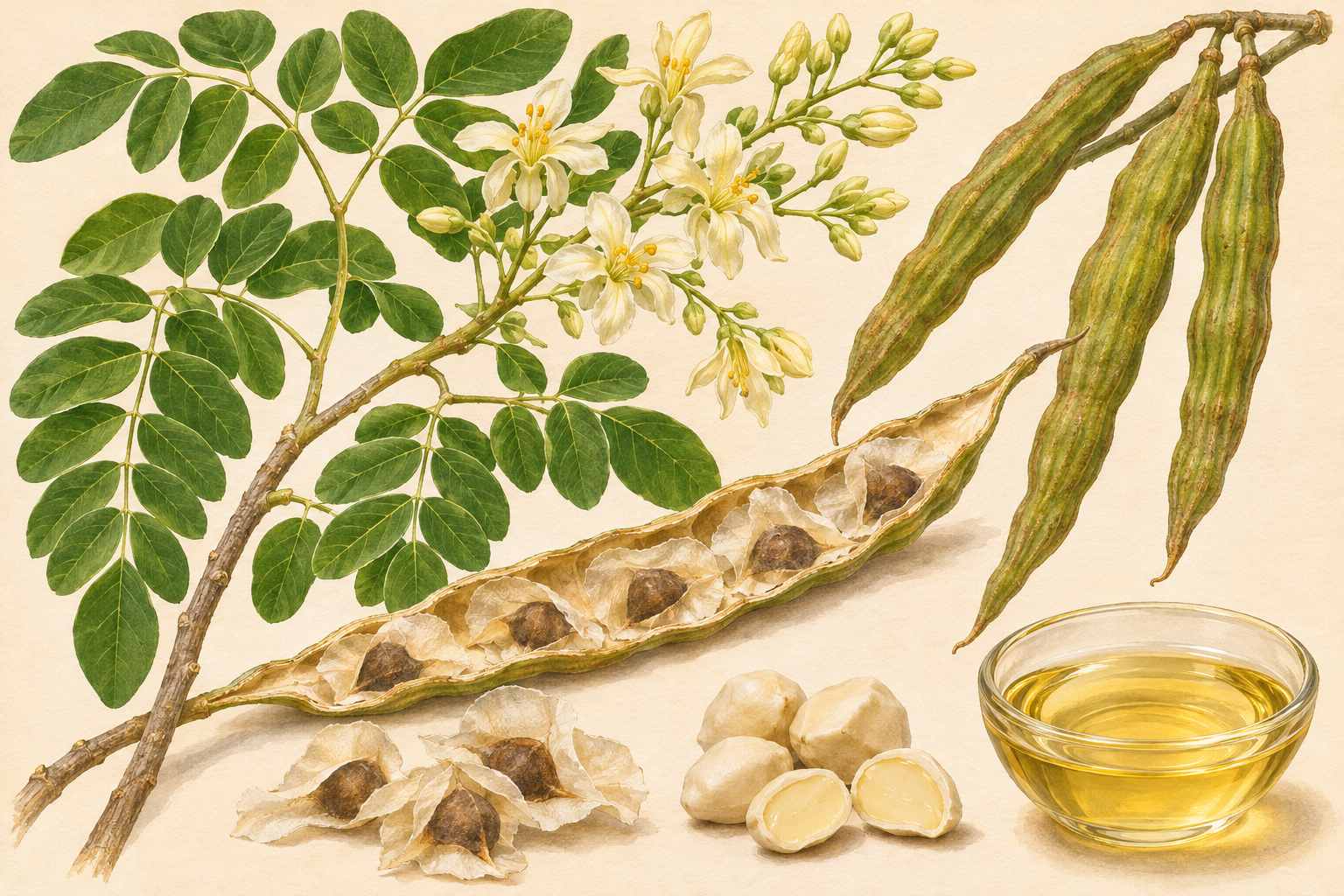
Overview
Oil obtained from the seeds of Moringa stenopetala, associated with southern Ethiopia. Food-science literature records cooking and salad-oil applications, but the food suitability of any particular product must be checked separately.
Source material
The source is the seed of Moringa stenopetala, a different species from Moringa oleifera. Composition data for the two must not be interchanged.
Composition
The cited sources do not establish a standard fatty-acid profile for this species. Figures for M. oleifera should not be substituted. A 2019 study reported crude-oil extraction yields of 34.8–44.3% from seeds sampled at three Ethiopian locations, using hexane or petroleum ether. These figures describe extracted oil yield, not fatty-acid composition.
Region
The source species occurs in southern Ethiopia. The prevalence of household use and the scale of commercial distribution are not established here.
Food use
The 2019 original paper explicitly describes the seed oil as edible and usable for cooking and salad dressing. The 2024 survey of 180 households directly documented leaves as the principal everyday food, so household frequency of seed-oil use and specific dishes are not inferred.
Extraction
The oil-bearing part is the seed. Extraction and refining conditions differ among reports; no universal pressing temperature or yield is asserted.
Safety
Do not confuse this oil with M. oleifera oil. Choose products produced and labelled for food use; do not assume that an unverified extract is edible.
Sources
Effects of location and extraction solvent on physico chemical properties of Moringa stenopetala seed oil (2019), https://pmc.ncbi.nlm.nih.gov/articles/PMC6895682/ ; Shage (2022), Extraction and Characterization of Oil from Moringa Stenopetala Seed, https://doi.org/10.20372/ejssdastu:v9.i2.2022.393