THE OIL ATLAS
Korean pine nut oil
Overview
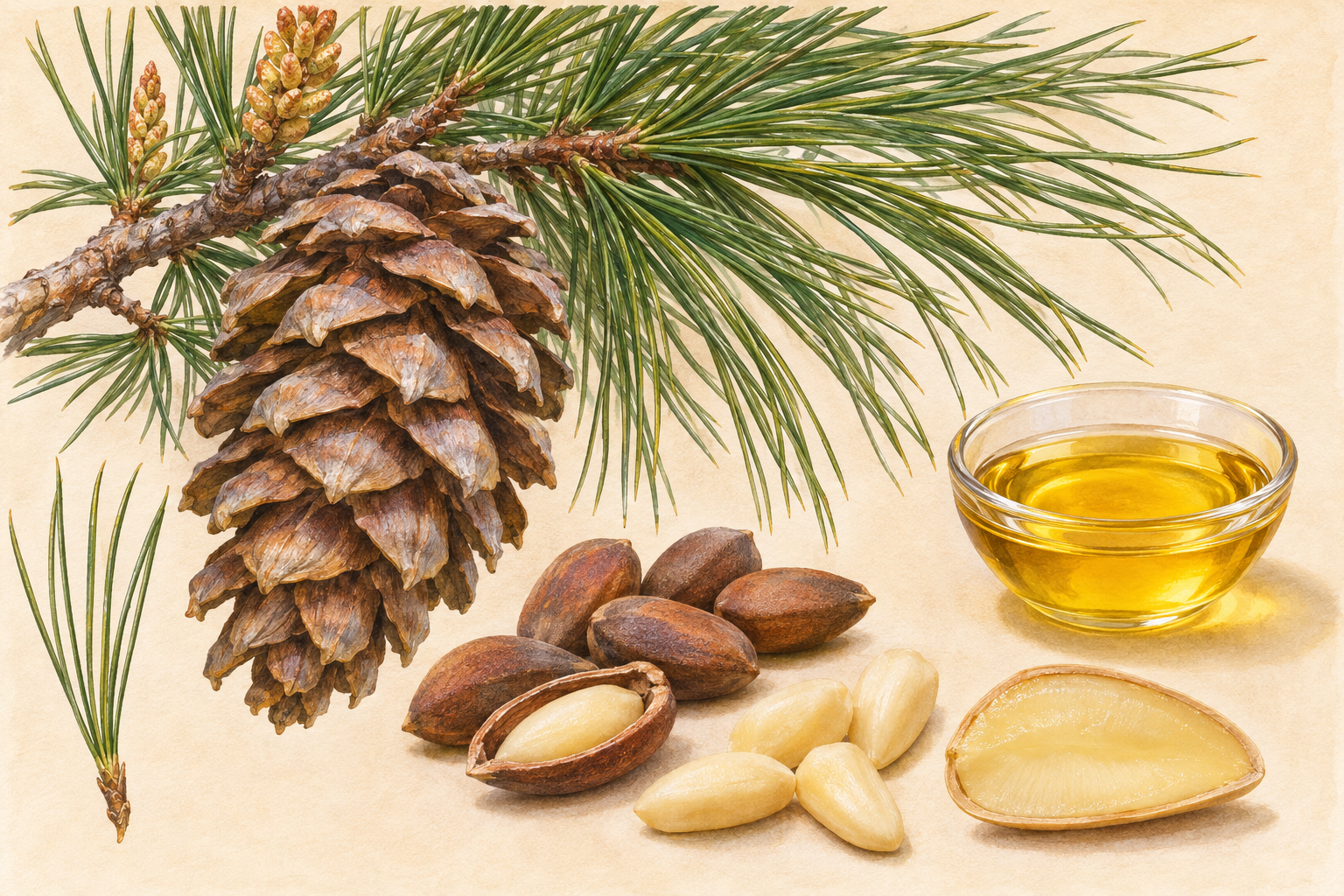
Korean pine nut oil is separated oil obtained from the kernels of Pinus koraiensis. It is distinct from eating whole pine nuts. A 2018 food-oil study compared oils produced by several extraction methods.
Source material
The raw material is the pine nut kernel of Pinus koraiensis. Oils of P. sibirica or P. pinea should not be conflated with it.
Composition
Hou, Li and Qiu (2018) reported fatty-acid profiles by gas chromatography for P. koraiensis oils from different extraction methods: linoleic acid 45.36–45.91%, oleic acid 26.91–27.10%, and pinolenic acid 13.33–13.63% of total fatty acids. These study-specific ranges are not universal specifications for every oil batch.
Region
P. koraiensis is an East Asian pine, and the cited oil research was conducted in China. The range of the tree, the research location and documented culinary consumption should not be conflated.
Food use
The pine nuts of Pinus koraiensis are eaten, but consumption of the seeds alone is not evidence of use of the separated oil. The University of Texas at El Paso Herbal Safety factsheet explicitly notes that oil extracted from Korean pine nuts is sold as a nutritional supplement. A 2018 study examined separated nut oil produced using different extraction technologies. These sources do not establish use in a particular traditional dish or the extent of culinary adoption in any given locality.
Extraction
The 2018 study compared cold and hot pressing, hexane extraction and subcritical extraction. Extraction method affected aroma, tocopherol content and oxidative stability. Laboratory solvent extraction is not presented as a home food-processing method.
Safety
Use only oil manufactured and controlled for food use. People with pine-nut allergy should check ingredient information. Storage conditions matter because the oil is susceptible to oxidative deterioration.
Sources
Hou L., Li C., Qiu J. (2018). Comparison of the Physicochemical Characteristics of Pinus koraiensis L. Nut Oils from Different Extraction Technologies. *Grain & Oil Science and Technology* 1(3):113–118. DOI: 10.3724/SP.J.1447.GOST.2018.18042. https://www.sciencedirect.com/science/article/pii/S2590259819300974 ; Hirata Y. et al. (1994). Components of Pine Seed Lipids. *Journal of Japan Oil Chemists’ Society* 43(7):579–582. https://doi.org/10.5650/jos1956.43.579 ; University of Texas at El Paso, Herbal Safety: Korean Pine Nut, https://www.utep.edu/herbal-safety/herbal-facts/herbal%20facts%20sheet/korean-pine-nut.html ; Incegul Y. et al. (2020), Cold pressed pine (Pinus koraiensis) nut oil, Cold Pressed Oils, pp. 525–536, DOI: 10.1016/B978-0-12-818188-1.00047-5.