THE OIL ATLAS
Sasanqua camellia seed oil
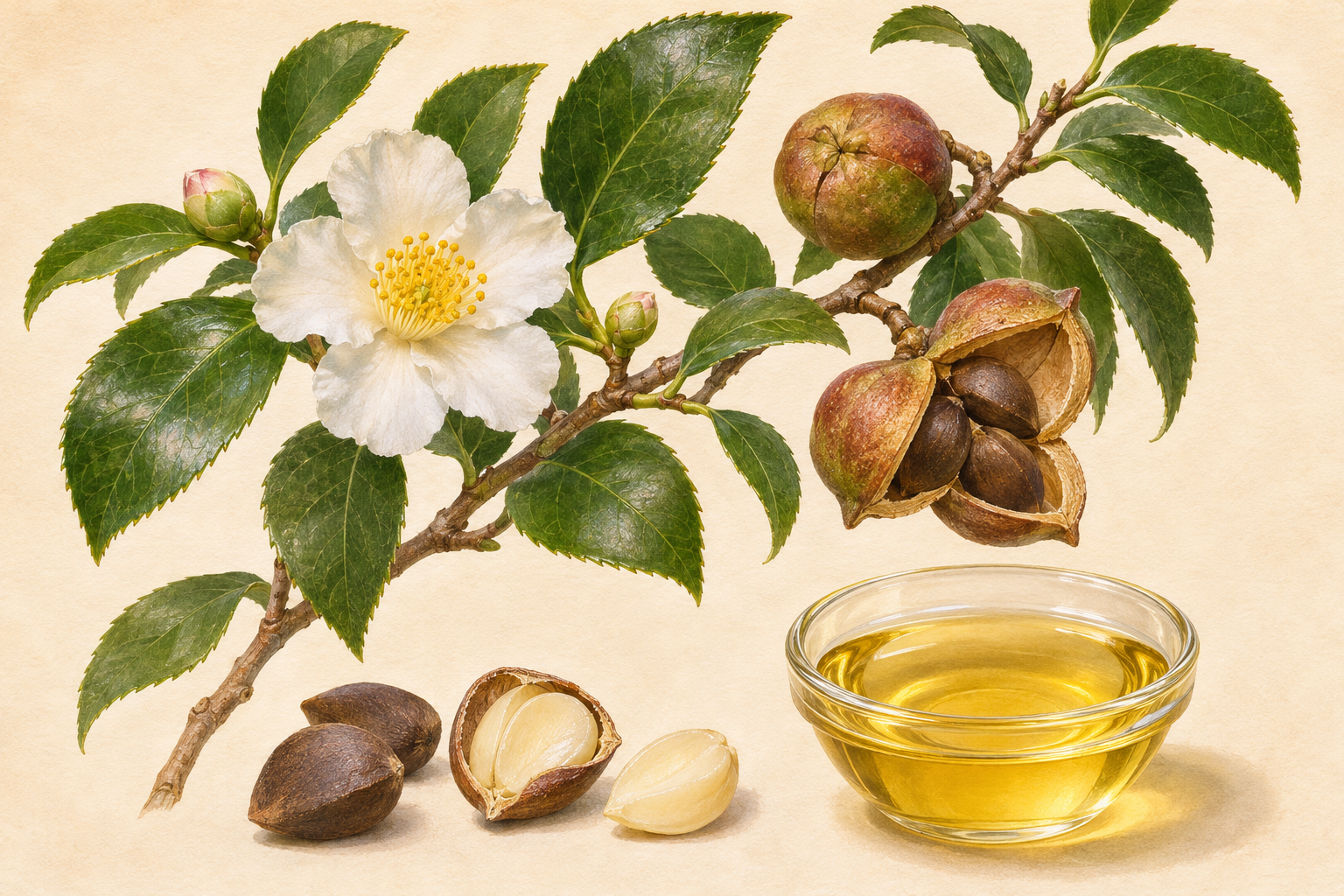
Overview
Oil extracted from Camellia sasanqua seeds and refined for food use. PROSEA records edible-oil and cocoa-butter-substitute uses.
Source material
The source is the seed kernel of Camellia sasanqua, distinct from C. japonica, C. oleifera and C. sinensis. A commercial name such as camellia oil does not identify the species.
Composition
FAO, citing Eckey, lists oleic acid at 72–78%, linoleic acid at 2–15% and saturated fatty acids at 6–12%. These are fatty-acid proportions, not seed oil yield or a nutrition label per 100 g of oil. The account does not identify sample-specific origins or refining conditions, so these ranges are not product guarantees.
Region
PROSEA describes southwestern Japan as its origin and records cultivation or introduction in China, Assam and northern Vietnam. Tea-seed-oil industry statistics are not treated as production figures for this species alone.
Food use
Recorded uses include edible oil and a cocoa-butter substitute. Comparison with olive oil does not establish identical flavour or regulatory specifications.
Extraction
Dried, dehulled kernels may be ground, steamed and pressed, or solvent-extracted. FAO states that traditionally recovered crude oil needs refining, including bleaching and vacuum deodorisation, before food use.
Safety
Do not use crude or cosmetic oil as food. The saponin-containing presscake is distinct from the edible oil. Inclusion in Japanese quasi-drug ingredient specifications is not food authorisation. Verify botanical identity, food processing and labelling.
Sources
1. PROSEA, Camellia sasanqua. https://plantuse.plantnet.org/en/Camellia_sasanqua_(PROSEA) 2. FAO, Minor oil crops, Teaseed. https://www.fao.org/4/x5043e/x5043E0b.htm 3. PMDA, Sasanqua Oil (quasi-drug ingredient specification). https://www.pmda.go.jp/files/000240227.pdf