THE OIL ATLAS
Macaúba kernel oil
Overview
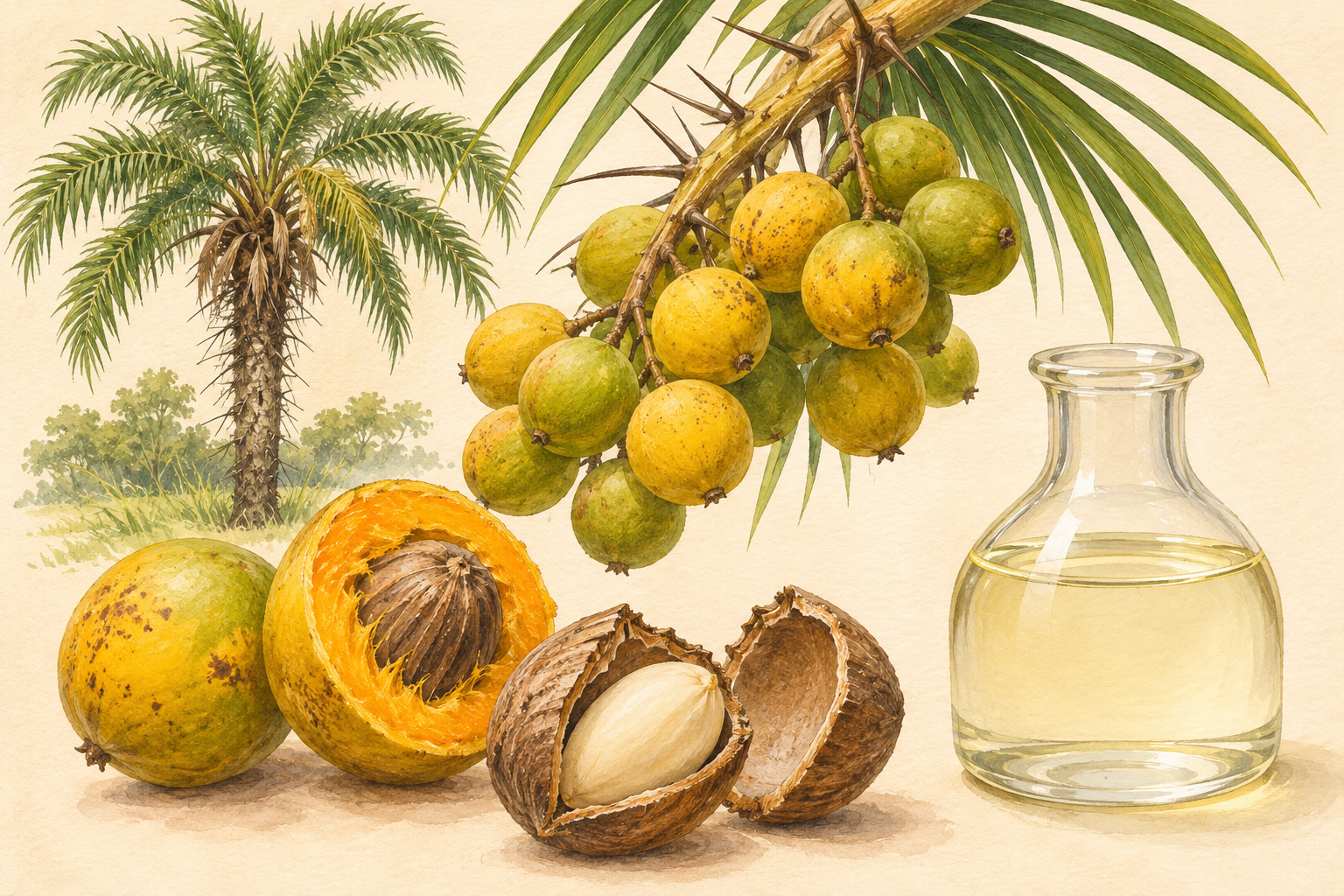
Macauba kernel oil is separated from the kernel enclosed by the hard endocarp of Acrocomia aculeata fruit. It differs from the mesocarp oil in both source tissue and composition. A nut reference handbook records the kernel oil as edible and cites margarine making as a use. This does not establish that it is widely used in contemporary Brazilian households.
Source material
The seed kernel of Acrocomia aculeata, also discussed under the older name Acrocomia sclerocarpa in some references. The mesocarp, shell and kernel are distinct parts. Eating kernels in confectionery is not itself evidence that separated kernel oil was used as food.
Composition
A study of macauba pulp and kernel oils published in Ciência Rural (2025) identifies lauric acid as the leading fatty acid in kernel oil, followed by oleic acid. Pulp oil is comparatively rich in oleic acid. No numerical fatty-acid percentages are presented without matching the particular sample, extraction and analytical conditions. Kernel oil composition must not be confused with the oil content of whole kernels.
Region
Macauba occurs and is used in Brazil, with fruit and kernel food traditions documented in areas including Mato Grosso do Sul. A nut reference handbook records edible and margarine uses for the kernel oil, but does not establish current household prevalence or regional retail availability.
Food use
A nut reference handbook describes the sweet, coconut-like kernel oil as an edible oil, including use in margarine preparation. This concerns the separated oil, not simply the kernel as food. Named household dishes are omitted because the consulted sources do not securely establish them.
Extraction
The kernel is separated from the fruit and its hard endocarp, then oil is recovered by pressing or extraction. Research characterizes kernel and pulp oils separately. Refining and processing vary; an historical use statement should not be treated as evidence for the manufacturing conditions of present-day products.
Safety
Historical edible use and food-application research do not certify every commercial product or establish authorization in every jurisdiction. Use only oil manufactured and labelled for food; do not substitute cosmetic-grade or laboratory oil. Oxidation, hygienic processing, refining, labelling and current local requirements require product-specific verification.
Sources
James A. Duke, Handbook of Nuts: Herbal Reference Library, Acrocomia sclerocarpa, p. 1. https://doi.org/10.1201/9780203752685 Preview: https://api.pageplace.de/preview/DT0400.9781351079587_A32307710/preview-9781351079587_A32307710.pdf Ciência Rural (2025), Macauba (Acrocomia aculeata) pulp and kernel oils, and co-products: chemical characterization and antioxidant properties. https://scielo.br/j/cr/a/cTrW7WFWLTQCWvjKp355dZn/?lang=en Brazilian Journal of Food Technology, Óleo da polpa e amêndoa de bocaiúva: caracterização e composição em ácidos graxos. https://bjft.ital.sp.gov.br/arquivos/artigos/v8n3212a.pdf