THE OIL ATLAS
Roasted coffee bean oil
Overview
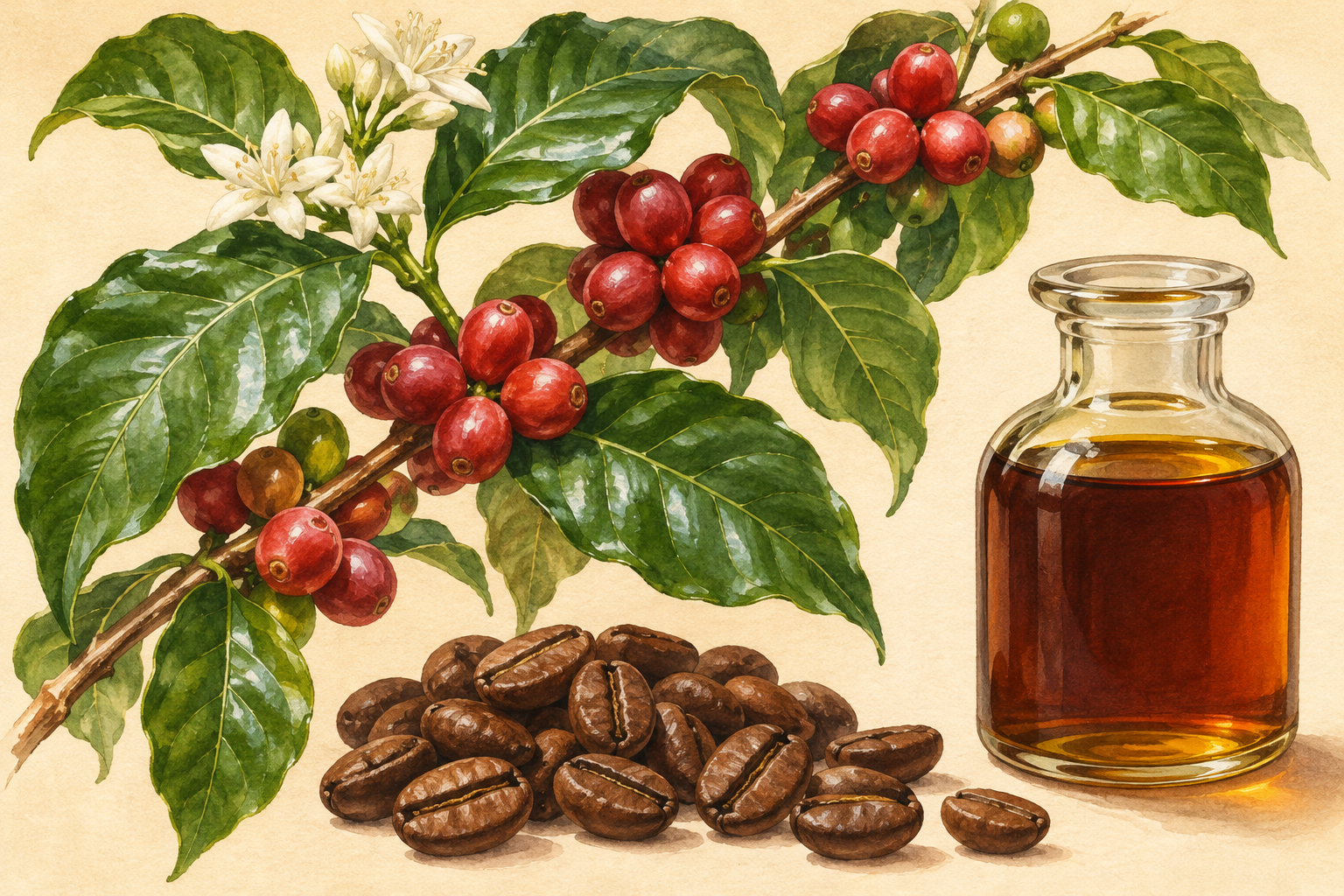
An aromatic fixed oil separated from roasted coffee beans. A 2024 food-science review describes its use in flavouring instant coffee, cakes and candies. It is distinct from green-coffee oil and from brewed coffee.
Source material
Roasted coffee beans, including Arabica beans used in published extraction studies. Roast level, bean origin and extraction method influence aroma, oxidation and composition. Data for unroasted-bean oil must not be transferred without qualification.
Composition
A 2016 study of supercritical-fluid-extracted oil from roasted Colombian coffee beans reported palmitic acid 46.1%, linoleic acid 32.9%, oleic acid 8.0%, stearic acid 6.6% and arachidic acid 1.9%, as percentages of total fatty acids in that study sample. These are not product specifications or per-100-g nutrition-label values. A 2024 review also discusses linoleic acid, tocopherols and diterpenes without establishing a universal nutrient profile.
Region
Published studies examine oil extracted from roasted Colombian beans and pressed roasted Arabica beans. The origin of coffee beans is not evidence of traditional local consumption of the separated oil. The 2024 review documents food-flavouring applications but does not quantify adoption by country.
Food use
A 2024 food-science review explicitly reports the use of roasted coffee oil, which retains roasted-coffee aroma compounds, to flavour instant coffee, cakes and candies. This is a documented food application of the separated oil rather than consumption of whole beans. It is not evidence that the oil is a common household frying medium.
Extraction
Mechanical pressing of roasted Arabica beans and supercritical-CO₂ extraction of roasted beans are both documented. A 2021 paper studies quality attributes of pressed oil; a 2016 study characterizes the fatty-acid and aroma profiles of supercritical-fluid-extracted roasted Colombian coffee oil. Results from these different processes should not be conflated.
Safety
Use only material produced and specified for food use. The 2024 review discusses peroxides, small quantities of trans fatty acids formed during roasting, and potential polycyclic aromatic hydrocarbons (PAHs) depending on roasting conditions. This does not establish that every product is unsafe, nor does it establish food approval for cosmetic or research-grade oil. Market-specific regulatory suitability requires separate review.
Sources
1. Coffee Oil Extraction Methods: A Review. Foods 2024, 13(16), 2601. https://doi.org/10.3390/foods13162601 (food flavouring, extraction and roasting-related hazards). 2. Böger, B. R. et al. Quality attributes of roasted Arabica coffee oil extracted by pressing. Grasas y Aceites (2021). https://doi.org/10.3989/gya.1144192 (pressed-oil study). 3. Hurtado-Benavides, A. et al. Study of the fatty acid profile and the aroma composition of oil obtained from roasted Colombian coffee beans by supercritical fluid extraction. Journal of Supercritical Fluids 113 (2016), 44–52. https://doi.org/10.1016/j.supflu.2016.03.008 (sample-specific fatty-acid and aroma analyses).