THE OIL ATLAS
Njansang seed oil
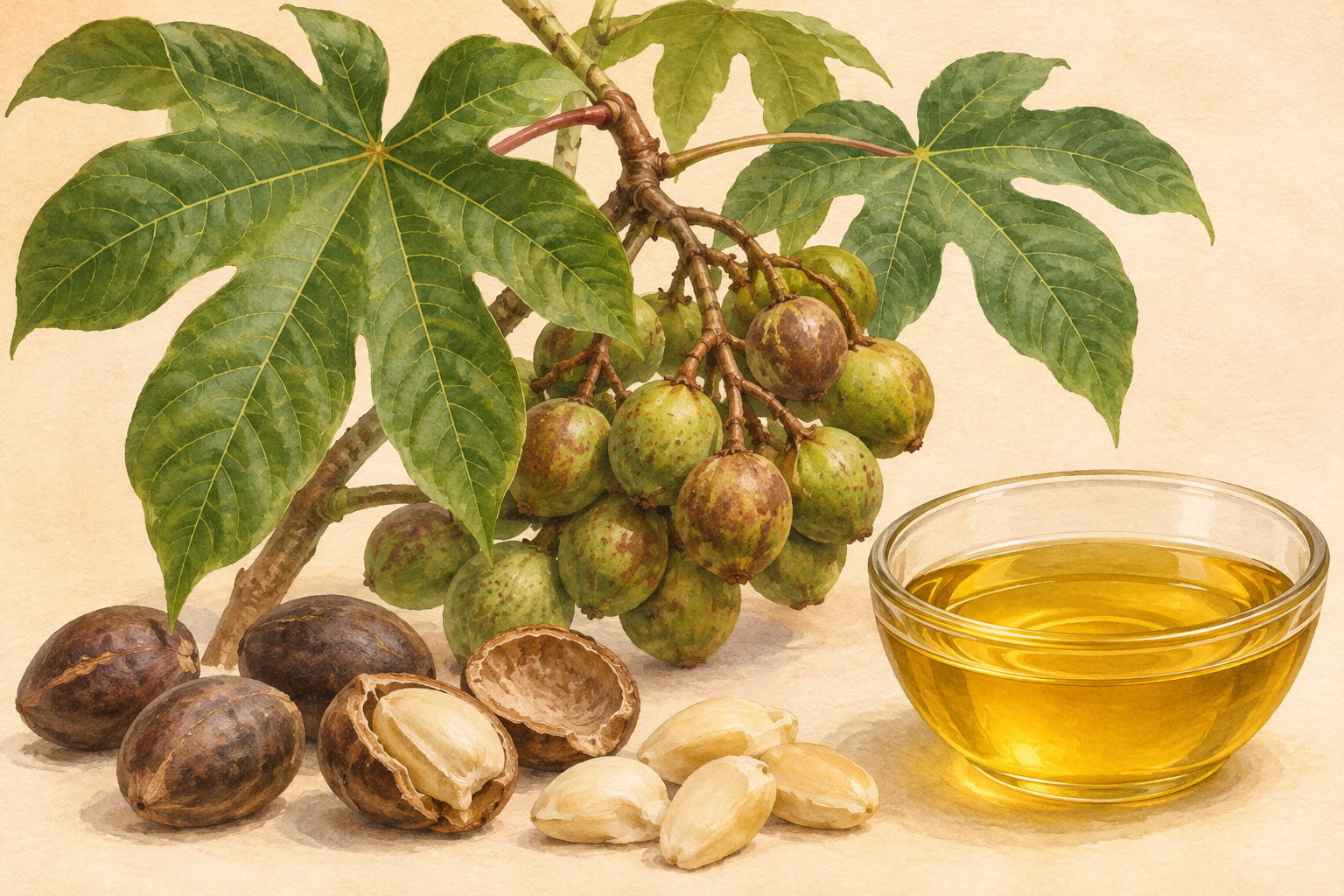
Overview
Caution: historical sources conflict on edibility; suitability of present products remains unverified.
Oil separated from the seed kernel of njansang (Ricinodendron heudelotii). PROTA explicitly records edible oil extracted from the seeds, distinct from using crushed kernels to thicken soup. The source does not identify a named dish prepared with the oil.
Source material
The source species is Ricinodendron heudelotii and the oil-bearing part is the seed kernel. Eating the raw material is distinct from consuming the separated oil.
Region
The species occurs or is used in West and Central Africa. Its range does not prove the same culinary oil practice everywhere.
Food use
PROTA explicitly records the extraction of an edible oil from the seeds of Ricinodendron heudelotii. USDA GRIN independently classifies the oil/fat under human food. A historical review reports a 1935 account of essango oil used for food on the West African coast, but also notes a conflicting source describing the oil as inedible. The historical food-use evidence therefore does not establish that every present-day product is suitable for consumption. Ground kernels used to thicken soup must not be confused with separated oil. A specific named dish and serving quantity have not been verified.
Extraction
Sources document oil separation but do not establish universally validated food-safe processing conditions.
Safety
Use only oil produced and controlled for food use. Historical sources conflict on edibility. A 2026 analytical study reports increased oxidation products associated with traditional seed dehulling. Laboratory extracts and industrial oils are not interchangeable with food-grade products. Product-specific oxidation quality, applicable food standards and legal market status require separate checks. No therapeutic or high-temperature cooking claim is implied.
Product-specific compliance in Japan, the US and EU and safe intake conditions remain unverified. Purchase, consumption and home extraction or detoxification are not recommended here.
Sources
https://plantuse.plantnet.org/en/Ricinodendron_heudelotii_%28PROTA%29 ; https://doi.org/10.1002/aocs.12639 ; https://pmc.ncbi.nlm.nih.gov/articles/PMC11137180/ 4. USDA GRIN Taxonomy, Ricinodendron heudelotii, human-food oil/fat: https://npgsweb.ars-grin.gov/gringlobal/taxon/taxonomydetail?id=403615 5. Plenderleith, Ricinodendron heudelotii: A State of Knowledge Study, section 8.2 (conflicting historical reports): https://carpe.umd.edu/sites/default/files/documentsarchive/report-plenderleith.pdf 6. Journal of Food Composition and Analysis (2026), 153, 109160 (dehulling and oxidation): https://doi.org/10.1016/j.jfca.2026.109160