THE OIL ATLAS
Gac aril oil
Overview
Gac aril oil is separated from the red aril of Momordica cochinchinensis and contains carotenoids. The traditional Vietnamese practice of mixing aril directly into sticky rice is not evidence that separated oil was used in that dish. Research literature also documents production and oral consumption of separated gac oil.
Source material
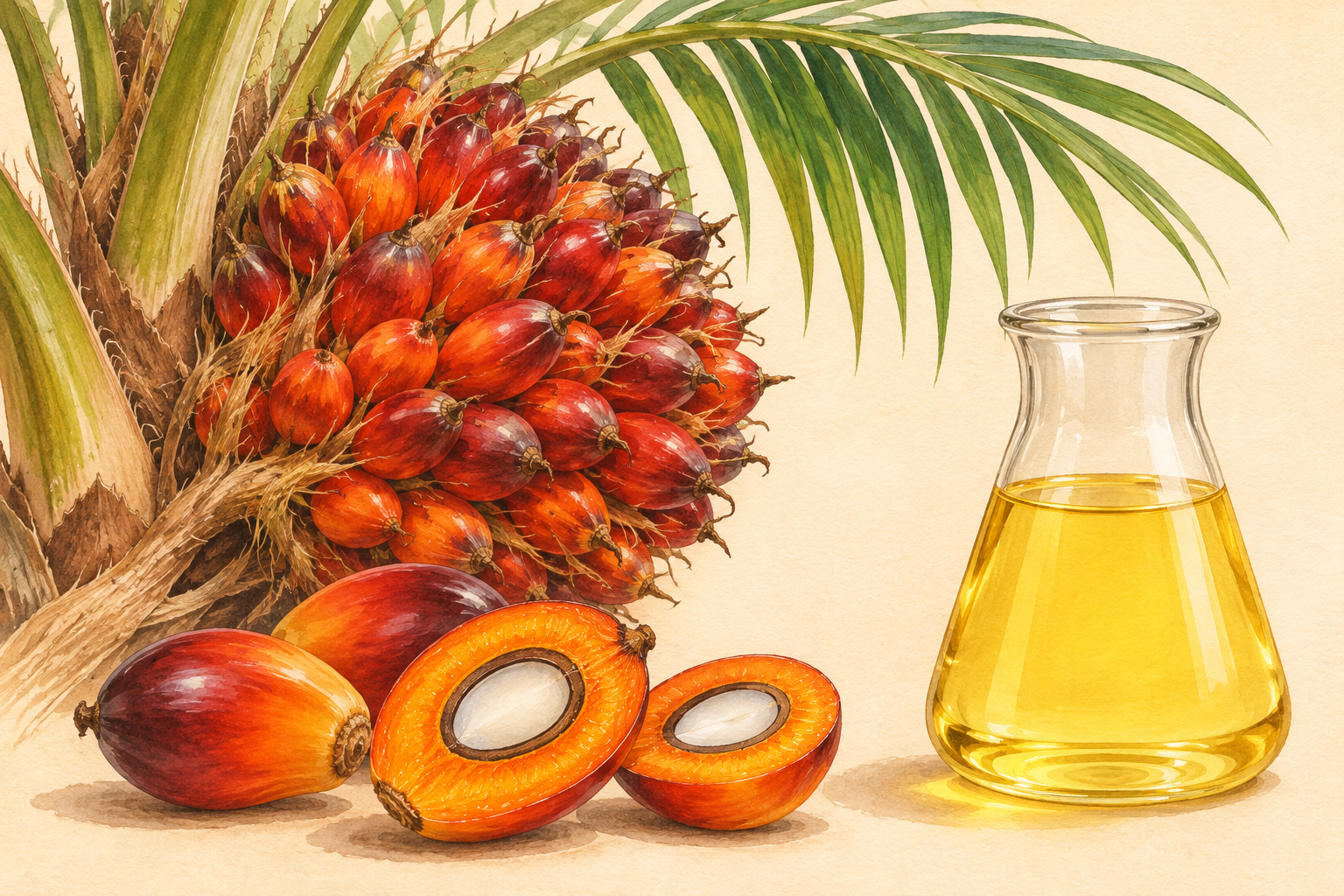
Red aril of gac fruit.
Composition
A 2016 study of enzyme-treated, hexane-extracted gac aril oil reported fatty-acid proportions of oleic 48.99%, linoleic 21.09%, palmitic 24.18%, stearic 3.52% and linolenic 0.86% (percent of fatty-acid composition in the research sample, not guaranteed values for retail products). Under the reported optimized extraction conditions, total carotenoids were 196.47 mg per 100 g of oil. Values depend on sample preparation and analytical conditions.
Region
In Vietnam, gac aril is traditionally incorporated into xoi gac. A scientific review also reports acceptance of separately pressed gac oil for daily consumption by Vietnamese farmers and describes commercial gac oil products. These are distinct types of use.
Food use
Oral consumption of separately recovered gac oil and commercial food/supplement products are documented in a review. Xoi gac, however, is usually made with aril rather than separated oil and is not counted as a dish made with the oil. A specific dish prepared with separately added gac oil has not been established.
Extraction
Oil can be pressed from the red aril. Vietnamese research compares traditional screw pressing with solvent extraction; other work investigates enzyme treatment, drying and hexane extraction. Laboratory-extracted oil is not automatically equivalent to a food-grade retail product.
Safety
Traditional consumption of gac aril does not establish food-grade status for every extracted oil. Laboratory samples extracted with hexane require appropriate solvent-residue and food-quality controls before food use. Historical food use does not establish national authorisation or intake limits.
Sources
Ishida, B. K., Turner, C., Chapman, M. H. & McKeon, T. A. (2004). Fatty acids and carotenoid composition in gac (Momordica cochinchinensis Spreng) fruit. Journal of Agricultural and Food Chemistry, 52, 274–279. USDA ARS record: https://www.ars.usda.gov/research/publications/publication/?seqNo115=153965 (aril composition and traditional use of the aril itself). Wu, P.-H. et al. (2025). A Study on the Enhancement of Storage Stability in Formulated Gac Fruit Oil and Its Encapsulated Form. Processes, 13(6), 1913. https://doi.org/10.3390/pr13061913 (separated oil, food/supplement applications and storage stability). Gac fruit (Momordica cochinchinensis Spreng.): a rich source of bioactive compounds and its potential health benefits, International Journal of Food Science & Technology (2015), https://academic.oup.com/ijfst/article/50/3/567/7867072 Bui Quang Thuat (2012), Research on extraction technology to improve yield and quality of oil from gac aril, https://doi.org/10.15625/0866-708X/48/1/1089 Tran Thi Yen Nhi & Dang Quoc Tuan (2016), Enzyme Assisted Extraction of GAC Oil from Dried Aril, https://doi.org/10.11648/j.jfns.20160401.11