THE OIL ATLAS
Safou pulp oil
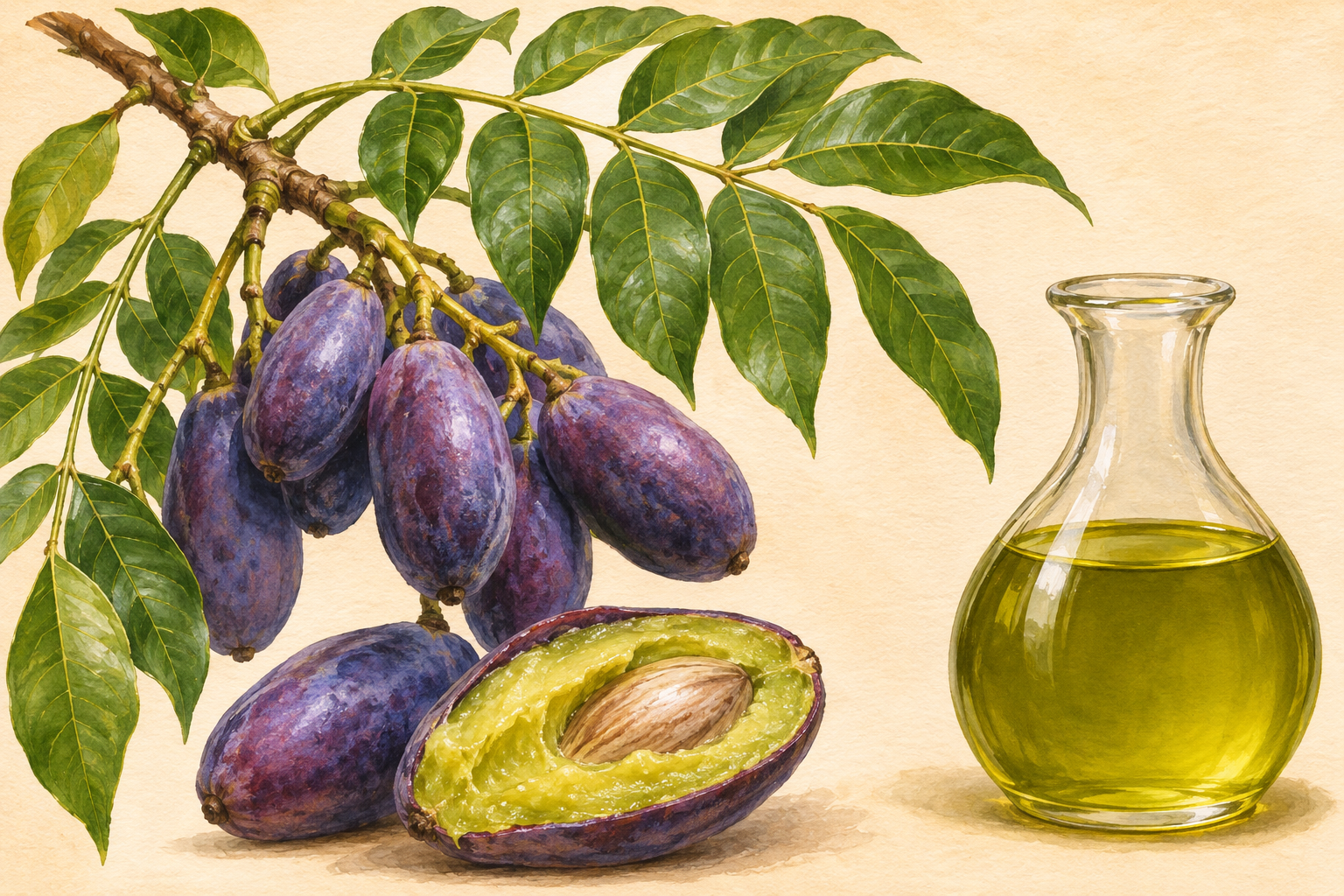
Overview
An oil separated from the pulp of safou (Dacryodes edulis). A 2013 literature review concerning Gabon records safou oils as used for consumption as well as cosmetics, separately from descriptions of eating the pulp itself. Specific dishes, frequency of use and present market scale remain unverified.
Source material
The source species is Dacryodes edulis and the oil-bearing part is the fruit pulp. Eating the raw material is distinct from consuming the separated oil.
Composition
A 2024 hot-water extraction experiment reported oil recovery of 8–38%, averaging 21.14%, from dried pulp. These figures describe recovery under the experiment’s temperature and agitation conditions, not oil content of fresh fruit or the fatty-acid composition of the separated oil. They cannot be generalized across cultivars, ripeness or drying conditions.
Region
The species is found across the Gulf of Guinea and Central Africa. The 2013 account of food use appears in a review focused on safou cultivation in Gabon; it does not establish identical oil-making or culinary practices throughout the species range.
Food use
A 2013 literature review on safou cultivation in Gabon explicitly records safou oils as serving both consumption and cosmetic uses. This supports a documented food-use claim for the separated oil, but does not establish particular dishes, producers, prevalence or continuity of the practice today. Boiling or roasting the whole pulp is a distinct food practice. PROTA describes an extractable oil suitable for food, while reporting no commercial production at the time.
Extraction
A 2024 study investigated recovery of oil from dried pulp using water heated to 50–90°C with agitation. Those experimental temperatures must not be presented as a documented customary household method. PROTA’s account of potential food use is not evidence of established commercial oil production.
Safety
A historical literature record of consumption does not establish the safety or current marketing authorization of a particular oil product. Extraction method, hygiene, oxidation and applicable food regulations require separate assessment. Laboratory oil measurements must not be generalized to every traditionally produced sample.
Sources
https://plantuse.plantnet.org/en/Dacryodes_edulis_%28PROTA%29 ; https://pmc.ncbi.nlm.nih.gov/articles/PMC10223253/ ; https://pubs.sciepub.com/ces/9/1/1/ 7. PROTA, Dacryodes edulis, https://plantuse.plantnet.org/en/Dacryodes_edulis_%28PROTA%29 (extractable food oil; not commercially produced at the time). 8. The Genus Dacryodes Vahl.: Ethnobotany, Phytochemistry and Biological Activities (2023), https://pmc.ncbi.nlm.nih.gov/articles/PMC10223253/ (potential cooking oil). 9. La culture du safoutier (Dacryodes edulis [G.Don] H.J.Lam [Burseraceae]) : enjeux et perspectives de valorisation au Gabon (2013), section 2.5, https://bibli-cloud15.segi.ulg.ac.be/1780-4507/index.php?id=9624 (records safou oils used for consumption and cosmetics; does not specify recipes).