THE OIL ATLAS
Seal blubber and rendered oil
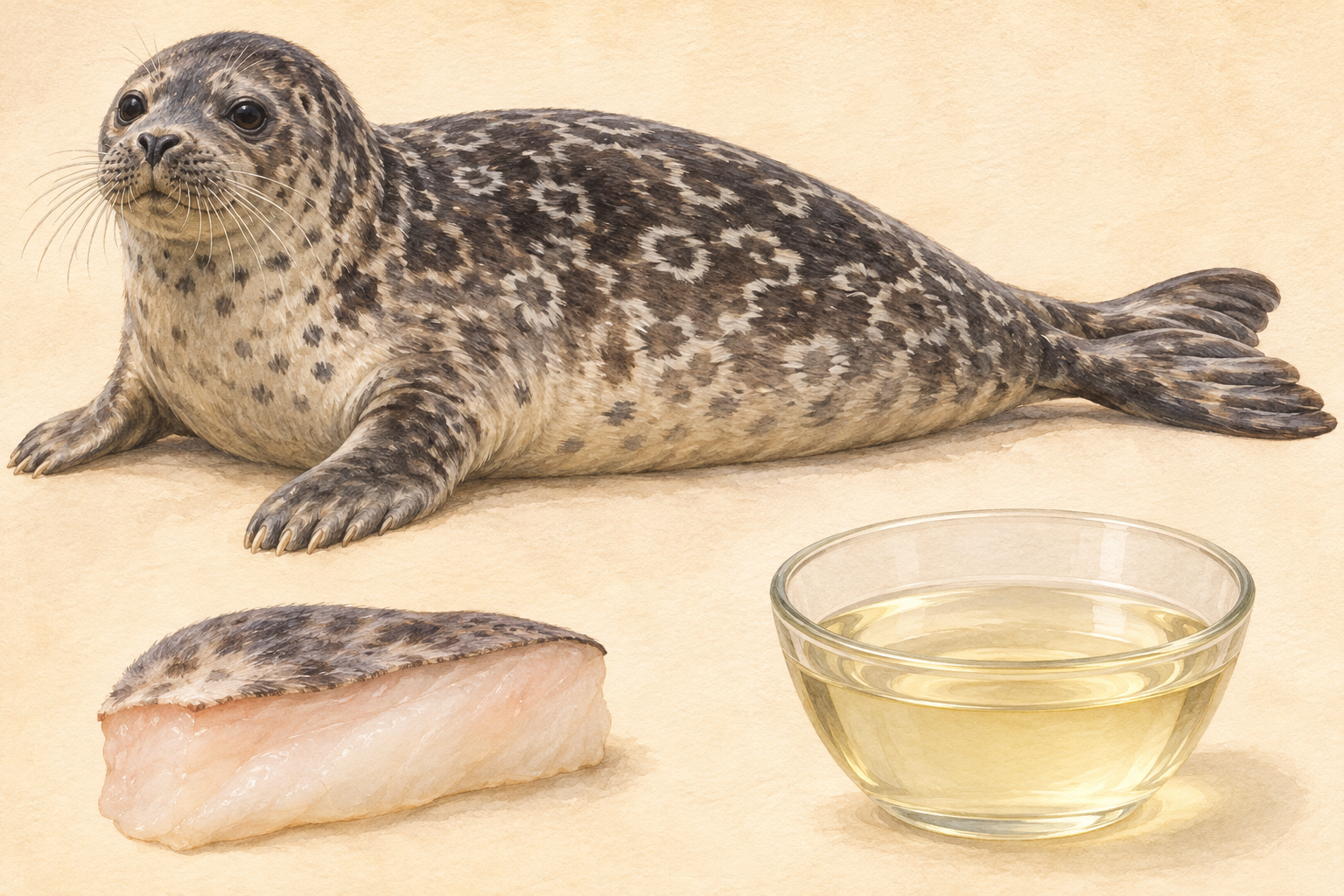
Overview
An edible oil separated from seal blubber in Alaska Native food traditions. This entry distinguishes extracted oil used as a condiment or ingredient from eating blubber itself.
Source material
Blubber from seals. Documented samples include bearded, ringed and spotted seals; their oils should not be assumed to have identical compositions.
Composition
Seal oil is an energy-dense fat. Phillips et al. (2018) examined vitamin D and 25-hydroxyvitamin D in traditional Alaskan foods, including seal-oil samples. The sources do not provide comparable per-100-g values or fatty-acid percentages across seal species, samples and methods.
Region
Food use of separated seal oil is documented in Iñupiat and Yup’ik communities in Alaska, United States. An ethnography of Chenega Bay and Tatitlek also records rendering and use as a condiment. The species’ geographic ranges alone do not establish oil use.
Food use
An Alaska Department of Fish and Game account describes dipping dried fish, dried meat and breads in seal oil, adding it to fish or game soups and stews, and using it in food preservation. These are uses of separated oil, not merely consumption of intact blubber.
Extraction
Blubber is cut into pieces and the oil is separated by controlled standing or gentle heating, as described in Alaskan ethnographic and food-safety accounts. This is a description of documented practice, not an unqualified home-production recommendation.
Safety
Preparation and storage require control of hazards including botulinum toxin. Alaska Sea Grant reports that an acidity- and temperature-based HACCP process for one elder-care facility was approved by ADEC in January 2021. That facility-specific approval does not certify home processes or every product. Harvest, transfer and sale are also restricted under laws including the US Marine Mammal Protection Act.
Sources
1. Alaska Department of Fish and Game, The Production and Exchange of Seal Oil in Alaska. https://www.adfg.alaska.gov/specialpubs/SP2_SP1988-001.pdf 2. Alaska Sea Grant (2021), Alaska Sea Grant Helps Solve Seal Oil Safety Concerns. https://alaskaseagrant.org/2021/03/alaska-sea-grant-helps-solve-seal-oil-safety-concerns/ 3. Phillips et al. (2018), Survey of vitamin D and 25-hydroxyvitamin D in traditional native Alaskan meats, fish, and oils, Journal of Food Composition and Analysis 74:114–128. https://vtechworks.lib.vt.edu/server/api/core/bitstreams/80477495-a39e-4fcd-9d8a-443c4ff7b9db/content 4. An Ethnography of Chenega Bay and Tatitlek, Alaska. https://chugachheritageak.org/resource-files/An_Ethnography_of_Chenega_Bay_and_Tatitlek_Alaska.pdf