THE OIL ATLAS
Historical whale oil
Overview
In several North Pacific coastal communities, oil separated from whale blubber was used as food. Ethnographic accounts compiled in a US NOAA assessment of Makah whaling describe whale oil as a table condiment for dipping dried salmon and berries, stored in purpose-built boxes or marine-mammal organs. A NOAA account of Dena’ina practices describes rendering beluga blubber and covering clams with the oil for winter preservation. Research on traditional foods in Chukotka also documents oil rendered from whale, walrus or bearded-seal blubber being mixed with plant ingredients. These are distinct uses of separated oil, not merely consumption of intact blubber. Species, preparation and uses vary by community, so one fatty-acid or vitamin profile cannot be assigned to all whale oils. Modern use must take account of hunting and trade restrictions and environmental contaminants.
Source material
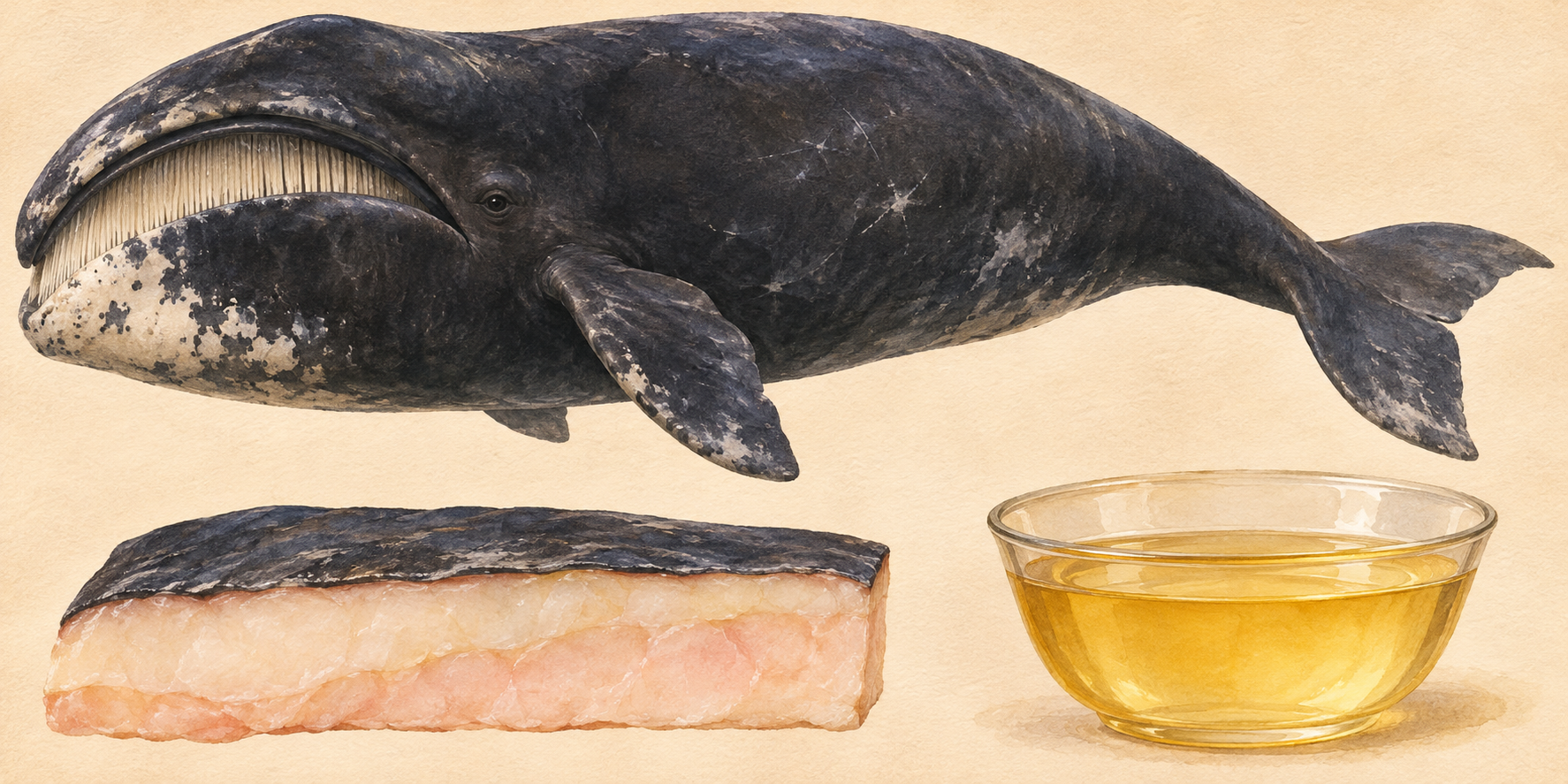
The source is whale blubber; species differ across communities and records.
Composition
Fatty-acid and vitamin values vary by whale species, season, tissue and processing, so no universal quantitative profile is assigned.
Region
Historical culinary records include Makah communities on the North American Pacific coast, Dena’ina communities in Alaska and Chukchi communities.
Food use
Makah accounts describe oil served with dried salmon and berries. Dena’ina records describe shellfish covered in oil for winter preservation. Chukchi food studies record dishes combining marine-mammal oil with plants.
Extraction
A Dena’ina account describes heating beluga blubber to separate oil. Makah records mention storage in dedicated boxes or marine-mammal organs.
Safety
Modern hunting and trade restrictions, contaminant accumulation and hygiene must be considered. Historical documentation is not a recommendation to consume the oil today.
Sources
1. https://media.fisheries.noaa.gov/dam-migration/2008-makah-deis-508.pdf 2. https://repository.library.noaa.gov/view/noaa/18151/noaa_18151_DS1.pdf 3. https://pmc.ncbi.nlm.nih.gov/articles/PMC6427261/ 4. https://pubmed.ncbi.nlm.nih.gov/21797772/