THE OIL ATLAS
Palm stearin
Overview
Palm stearin is the relatively solid edible fraction of palm oil obtained from the fleshy part of the oil-palm fruit. It functions as a harder fat than palm olein.
Source material
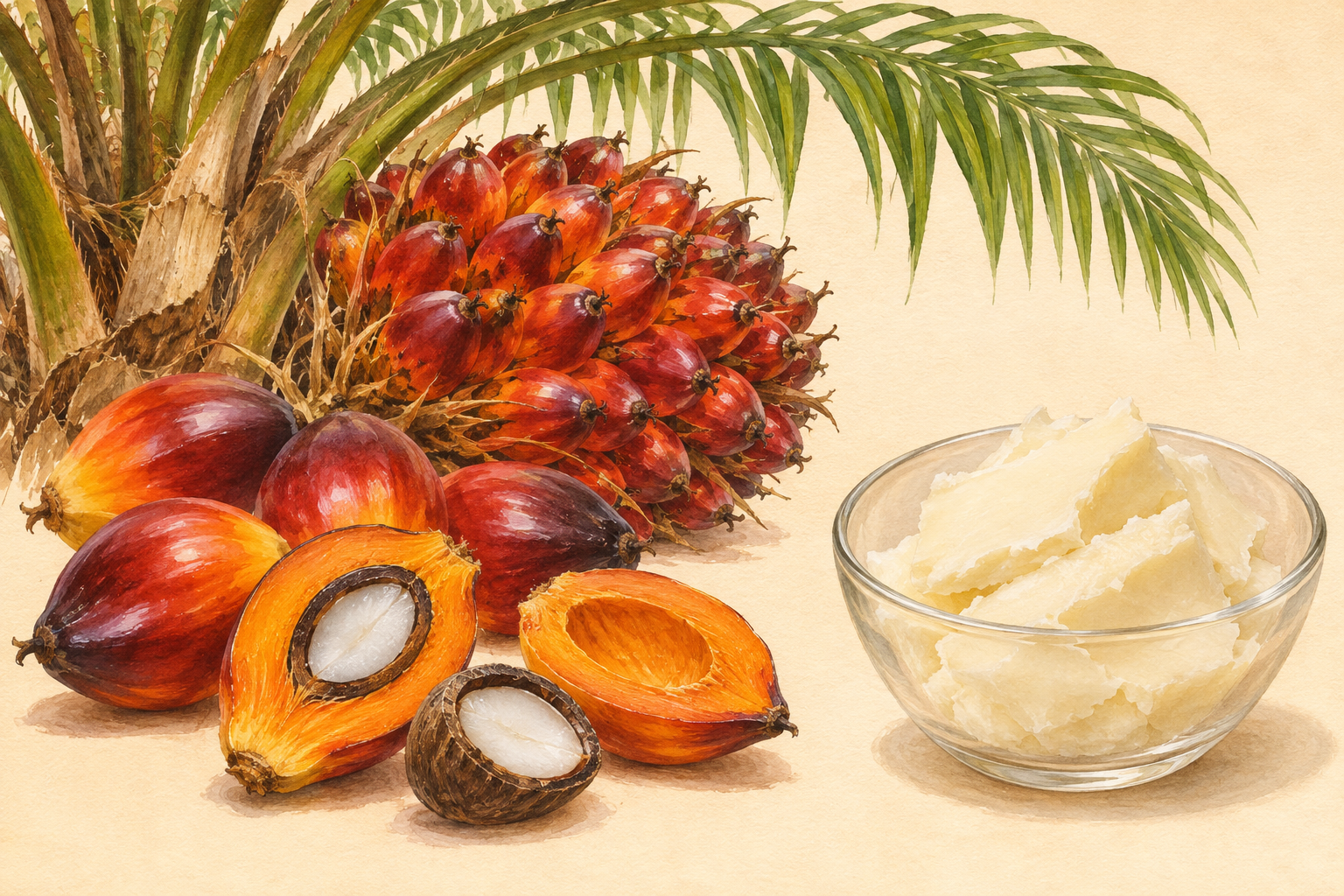
It comes from the fruit mesocarp oil of Elaeis guineensis. The solid fraction is recovered after controlled cooling and crystallization. It is not palm-kernel stearin, which comes from the kernel.
Composition
| Fatty acid (% of total fatty acids) | Codex range | Sample and source |
|---|---|---|
| Palmitic acid C16:0 | 48.0–74.0% | Palm stearin, Codex CXS 210-1999, Table 1 |
| Oleic acid C18:1 | 15.5–36.0% | Same |
| Linoleic acid C18:2 | 3.0–10.0% | Same |
Region
Palm stearin is produced in palm-oil refining and fractionation industries, including Malaysia, and traded as a solid fat ingredient for food manufacturing. Canada specifies its common name when sold separately as a food.
Food use
Palm stearin is used in solid-fat formulations for margarine, shortening, pastries, laminated dough and baked goods. Unlike a liquid frying oil, it helps control firmness and melting behaviour and may be blended with other fats. These are food uses of the separated fat fraction, not of the palm fruit itself.
Extraction
Palm oil is cooled under controlled conditions to form crystals; solid–liquid separation recovers the solid stearin fraction. Blending and interesterification may subsequently adjust melting and processing properties. Fractionation itself is not hydrogenation.
Safety
Use food-grade material that meets applicable specifications. Being solid does not automatically mean a fat contains trans fatty acids; check the formulation and label of the finished product. Limit excessive saturated-fat intake within the context of the whole diet.
Sources
1. Codex Alimentarius, CXS 210-1999, Standard for Named Vegetable Oils: https://www.fao.org/fao-who-codexalimentarius/sh-proxy/en/?lnk=1&url=https%3A%2F%2Fworkspace.fao.org%2Fsites%2Fcodex%2FStandards%2FCXS+210-1999%2FCXS_210e.pdf 2. Canadian Food Inspection Agency, Labelling requirements for fats and oils: https://inspection.canada.ca/en/food-labels/labelling/industry/fats-and-oils 3. Mat Dian et al. (2017), Journal of Oil Palm Research 29(4), 487–511: https://jopr.mpob.gov.my/palm-oil-and-palm-kernel-oil-versatile-ingredients-for-food-applications/ 4. Malaysian Palm Oil Council, Palm Oil Applications: https://www.mpoc.org.my/wp-content/uploads/2024/01/Malaysian-Palm-Oil-in-Professional-Kitchen-1_compressed.pdf