THE OIL ATLAS
Palm olein
Overview
Palm olein is the relatively liquid edible fraction obtained by fractionating palm oil from the fleshy part of the oil-palm fruit. It is distinct from palm-kernel oil.
Source material
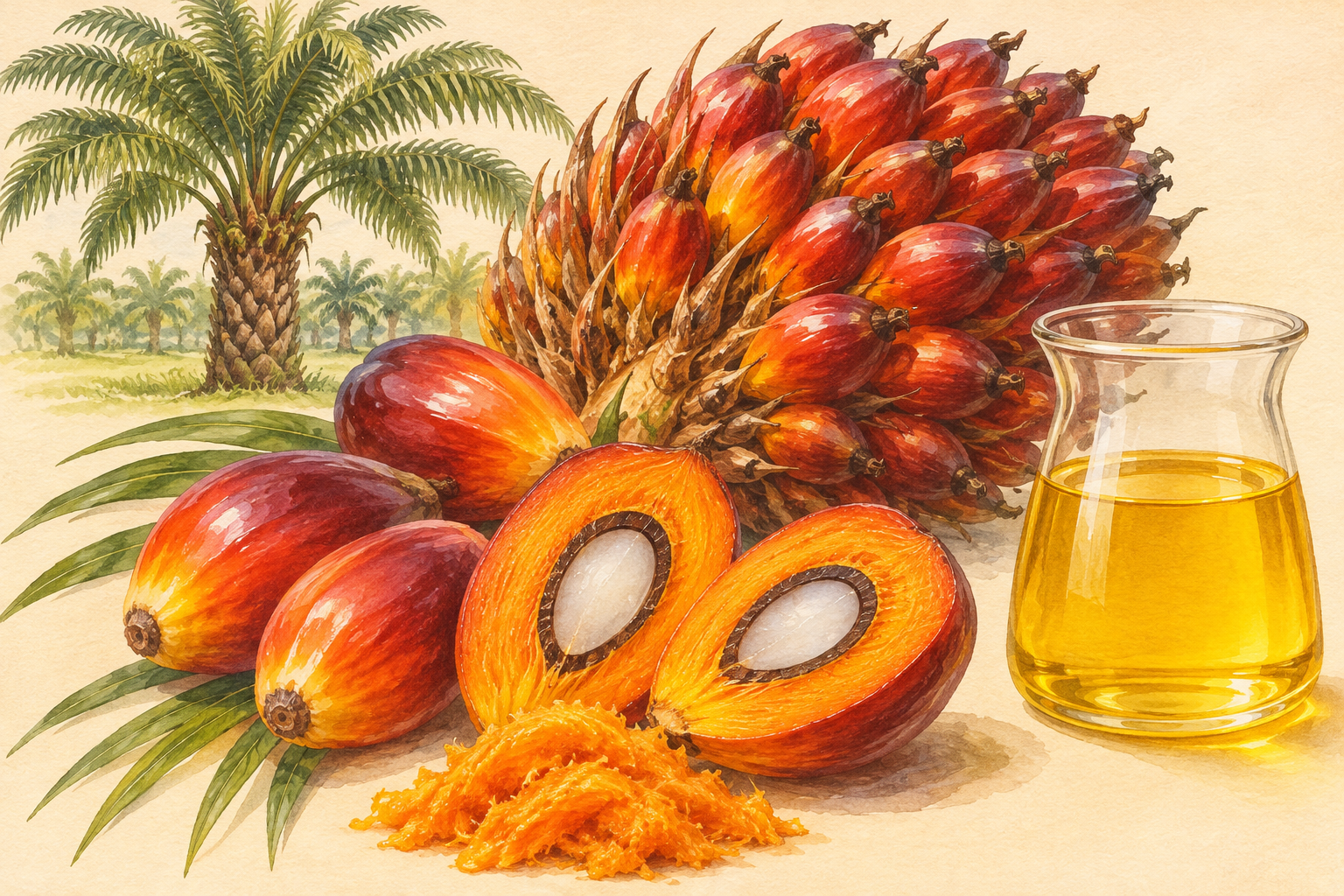
It originates in palm oil extracted from the fruit mesocarp of Elaeis guineensis. Controlled crystallization and separation recover the liquid fraction. Palm-kernel olein, derived from the kernel, is a different product.
Composition
| Fatty acid (% of total fatty acids) | Codex range | Sample and source |
|---|---|---|
| Palmitic acid C16:0 | 38.0–43.5% | Palm olein, Codex CXS 210-1999, Table 1 |
| Oleic acid C18:1 | 39.8–46.0% | Same |
| Linoleic acid C18:2 | 10.0–13.5% | Same |
Distinguish standards for palm olein from analyses of individual products. Fatty-acid percentages should identify their basis as a share of total fatty acids and not be confused with nutrients per 100 g.
Region
Palm olein is produced in oil-palm processing regions including Malaysia. Canada also specifies “palm olein” as the common name when it is sold on its own as a food.
Food use
It is used as household and commercial cooking and frying oil, and in manufactured foods including instant noodles and fried snacks. These are uses of the separated oil, not the whole fruit; they do not establish a traditional use in any particular ethnic dish.
Extraction
Palm oil from the fruit flesh is refined and cooled under controlled conditions so that part of it crystallises. Filtration or a similar separation step divides the liquid olein fraction from the solid stearin fraction. This is fractionation of an existing oil, not extraction from another plant. Further fractionation yields super olein, a product with a different composition and fluidity.
Safety
Choose appropriately processed food-grade products with accurate labels. Discard frying oil that develops off-odours or marked discoloration after excessive heating or repeated use. As it contains saturated fatty acids, consider overall dietary fat balance.
Sources
1. Codex Alimentarius, CXS 210-1999, Standard for Named Vegetable Oils: https://www.fao.org/fao-who-codexalimentarius/sh-proxy/en/?lnk=1&url=https%3A%2F%2Fworkspace.fao.org%2Fsites%2Fcodex%2FStandards%2FCXS+210-1999%2FCXS_210e.pdf 2. Canadian Food Inspection Agency, Labelling requirements for fats and oils: https://inspection.canada.ca/en/food-labels/labelling/industry/fats-and-oils 3. Mat Dian et al. (2017), Journal of Oil Palm Research 29(4), 487–511: https://jopr.mpob.gov.my/palm-oil-and-palm-kernel-oil-versatile-ingredients-for-food-applications/ 4. Malaysian Palm Oil Council, Palm Oil Applications: https://www.mpoc.org.my/wp-content/uploads/2024/01/Malaysian-Palm-Oil-in-Professional-Kitchen-1_compressed.pdf