THE OIL ATLAS
Smooth loofah seed oil
Overview
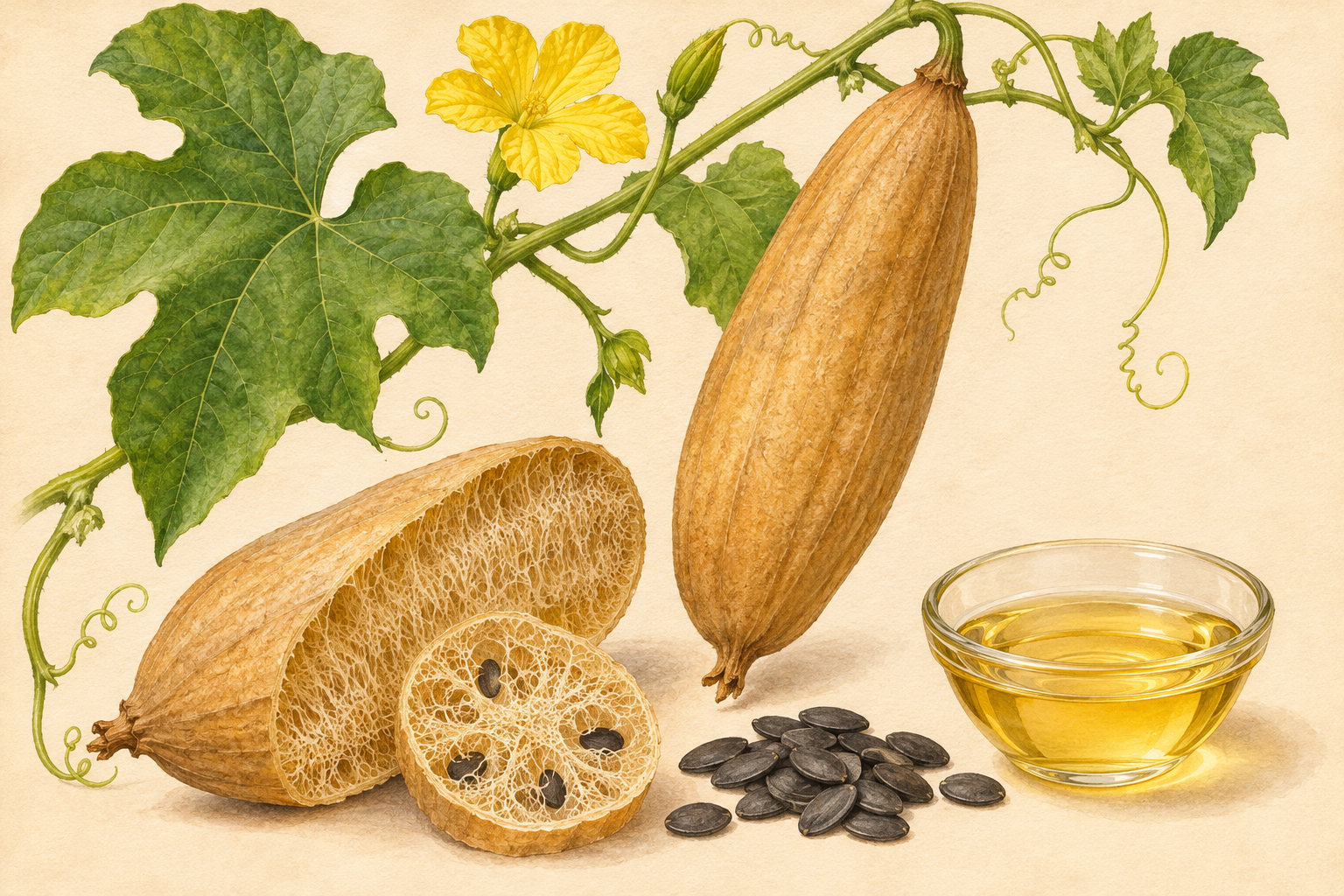
Oil separated from mature smooth-loofah seeds (listed by FAO as Luffa cylindrica). FAO records edible oil produced from seeds recovered during manufacture of loofah fibre products. This is distinct from eating the young fruit as a vegetable.
Source material
The raw material is black seed recovered from dried mature fruits while making loofah fibre products. FAO cites seed oil content of 37–46% by seed mass.
Composition
FAO cites Eckey for a fatty-acid profile of 9.6% palmitic, 18.9% stearic, 6.9% oleic and 64.6% linoleic acid (percentages of oil fatty acids). Seed oil content of 37–46% by seed mass is a different measure. The cited historical compilation does not specify an individual sample origin or analytical method.
Region
FAO lists China, India, Japan, Indonesia, Malaysia, the Philippines and Brazil among production regions of the crop. This is not evidence that the separated oil is eaten in every listed region.
Food use
FAO records edible oil made from seeds recovered during loofah production. The account does not establish particular dishes or the scale of commercial distribution.
Extraction
According to FAO, mature fruits dry on the vine, the outer skin and pulp are removed, and seeds are collected during fibre processing. FAO explicitly notes that it found no details of the oil-extraction method itself.
Safety
FAO records edible use of the separated seed oil but does not establish the safety of individual products, current food authorisation, or hygienic conditions of extraction. Do not consume seed oil unless its food-grade manufacture and supply are established.
Sources
FAO, Minor Oil Crops, Smooth Loofah (Luffa cylindrica), sections I and III: https://www.fao.org/4/X5043E/x5043E08.htm Herklots, Vegetables in South East Asia (1972), and Eckey, Vegetable Fats and Oils (1954), as cited by FAO.