THE OIL ATLAS
Chinese tallow tree seed fat
Overview
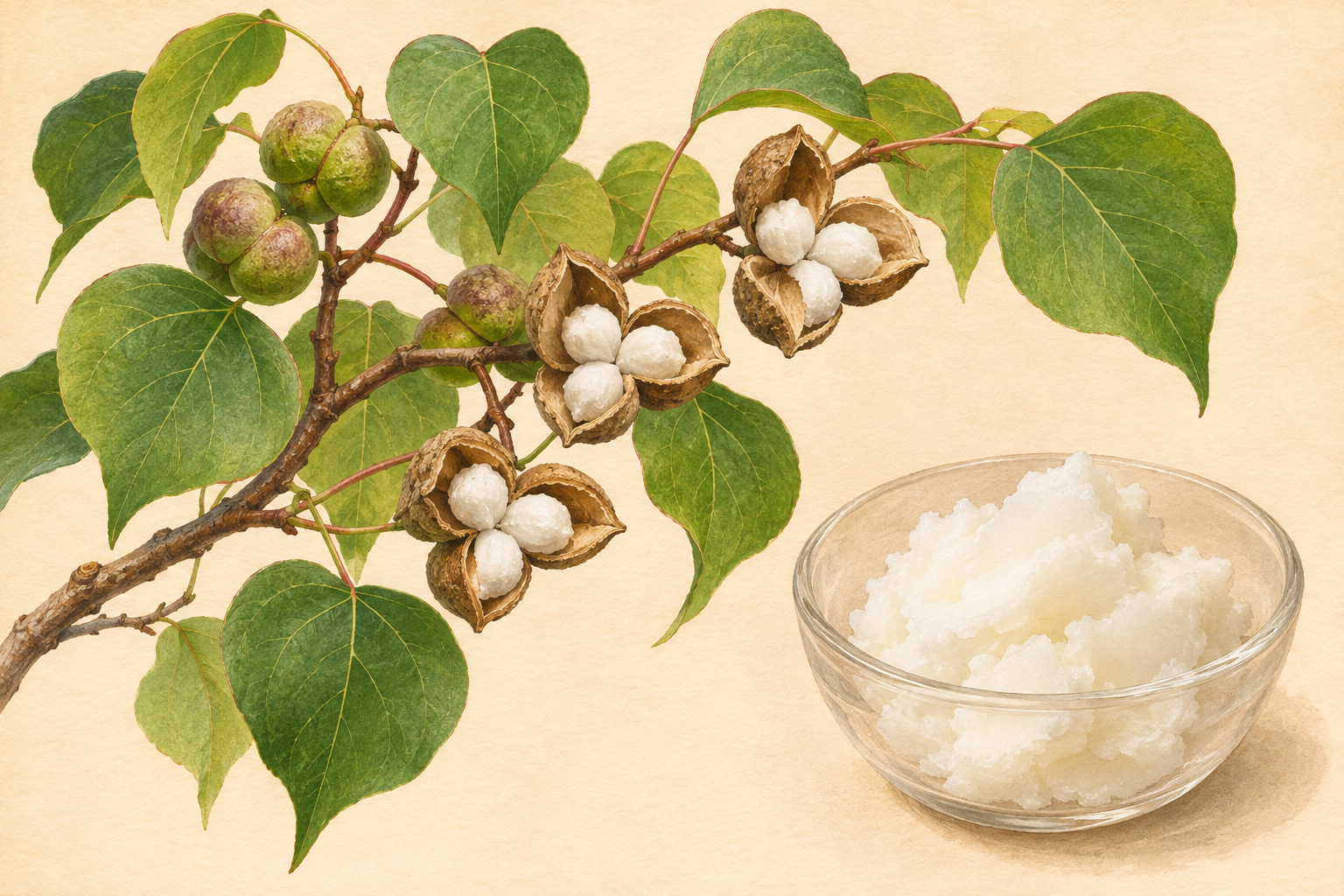
Chinese vegetable tallow is a solid fat from the white outer seed covering of the Chinese tallow tree, distinct from kernel-derived stillingia oil.
Source material
The species is Triadica sebifera, treated in older sources as Sapium sebiferum, Stillingia sebifera or Triadica sebiferum. The source is the white fleshy outer seed coat.
Composition
PROSEA’s general profile gives about 60% palmitic and 30% oleic acid in tallow fatty acids, distinct from kernel oil and not an analysis of an individual food product.
Region
FAO and PROSEA record food use in China. Candle, soap and lighting uses are separate and do not themselves establish edibility.
Food use
The whitish, hard, relatively tasteless fat is recorded as an animal-fat substitute and for firming softer edible fats.
Extraction
Fat is recovered from the separated white covering. A mixture with kernel oil is not equivalent to pure vegetable tallow.
Safety
PROSEA identifies kernel stillingia oil as poisonous and emetic, making contaminated tallow inedible. Historical food use is not a home-extraction procedure or modern market authorisation. Kernel oil and industrial fat are not food.
Sources
FAO, Minor oil crops, Chinese vegetable tallow: https://www.fao.org/4/x5043e/x5043E06.htm PROSEA, Triadica sebiferum, handbook 14: https://prosea.prota4u.org/view.aspx?id=853