THE OIL ATLAS
Ghee
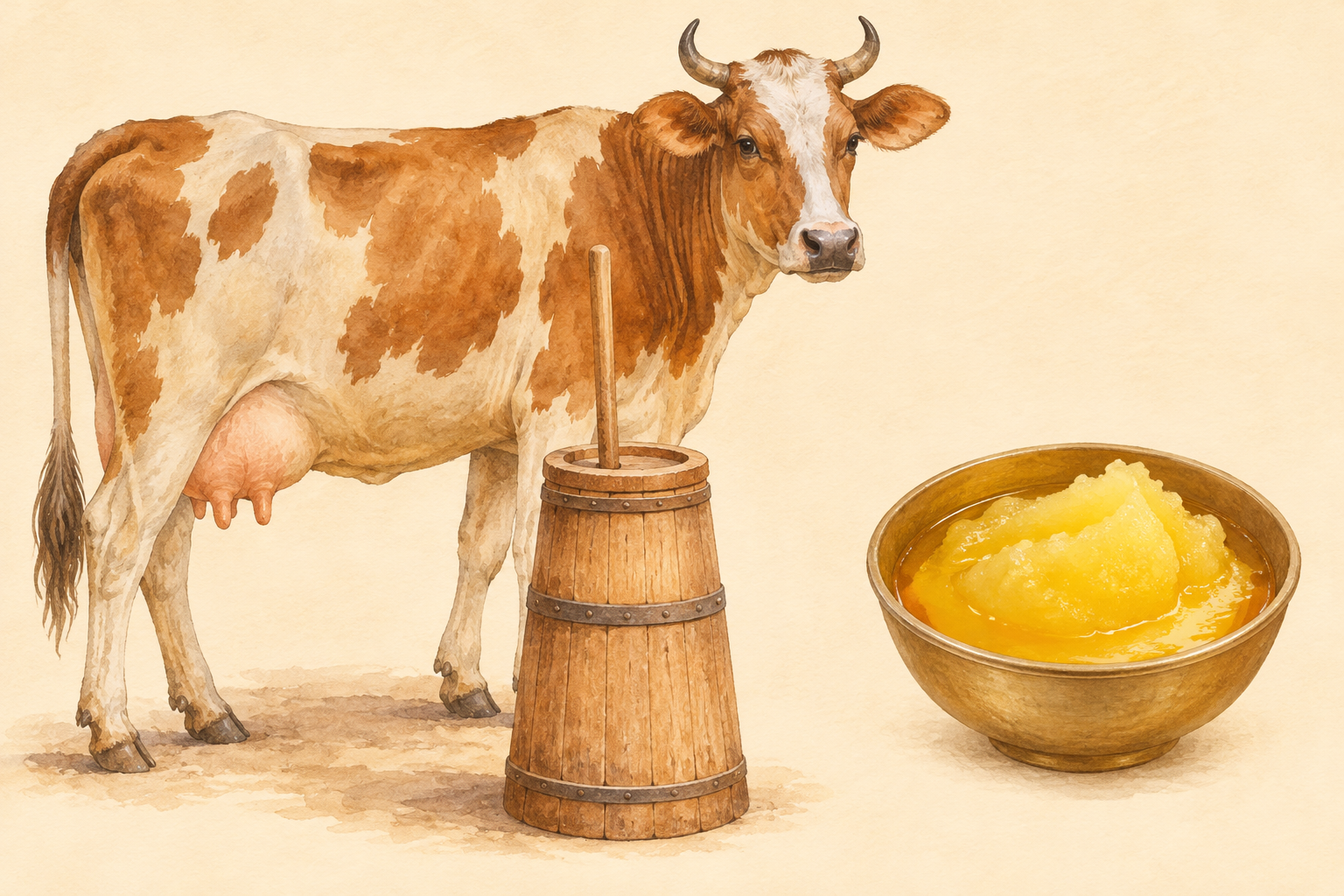
Overview
Ghee is an edible milk fat made by heating dairy ingredients to remove most water and non-fat milk solids. It has a distinctive cooked aroma and is used in South Asian cooking and sweets. It is not identical to butter or vegetable oil.
Source material
Milk, cream or butter derived from dairy animals such as cows and buffaloes. Codex CXS 280-1973 defines ghee as a milk-derived fat with a distinctive flavour and physical structure after the near-total removal of water and non-fat solids.
Composition
| Measure | Value | Material, conditions and source |
|---|---|---|
| Milk fat | At least 99.6% | Codex CXS 280-1973 specification for ghee, % by mass |
| Milk fat | At least 99.5% | Indian FSSAI 2020 compendium, % by mass; a different jurisdictional standard |
| Moisture | No more than 0.5% | Indian FSSAI 2020 compendium, % by mass |
| Milk fat | 99–99.5% | Typical cow- and buffalo-milk ghee composition reported by FAO for traditional products; not a legal limit |
| Moisture | 0.2–0.5% | Same FAO typical-composition examples, % by mass |
Region
Ghee has a long history of production in India. FAO describes both a traditional method using makkhan, an unsalted butter prepared from cultured milk, and industrial methods based on cream or butter.
Food use
Ghee is a milkfat product with most water and nonfat milk solids removed. It is used for sautéing, rice dishes, sweets, and finishing dishes with aroma. This is a culinary use of separated and clarified fat, distinct from consuming milk or butter as such. Its moisture content and behavior during heating differ from ordinary butter, so substitutions depend on the dish.
Extraction
Ghee is made by heating butter or milk fat, removing water and separating milk solids. The degree of heating affects its toasted flavor, so it need not taste identical to all clarified butter. Low moisture and fewer milk solids do not make a product sterile; shelf life depends on processing, packaging and storage.
Safety
Ghee has reduced moisture, but that does not mean every product can be kept indefinitely at room temperature. Follow the labeled storage conditions and date, and do not use a product with abnormal odors or deterioration. It remains a milk-derived product.
Sources
Codex Alimentarius, CXS 280-1973, Standard for Milkfat Products. https://www.fao.org/fao-who-codexalimentarius/sh-proxy/tr/?lnk=1&url=https%253A%252F%252Fworkspace.fao.org%252Fsites%252Fcodex%252FStandards%252FCXS%2B280-1973%252FCXS_280e.pdf FAO, The technology of traditional milk products in developing countries, §6.2. https://www.fao.org/4/t0251e/t0251e04.htm FSSAI, Food Products Standards and Food Additives Regulations, 2020 compendium, §2.1.8. https://fssai.gov.in/upload/uploadfiles/files/Compendium_Food_Additives_Regulations_08_09_2020-compressed.pdf
Additional references - https://www.fao.org/4/t0251e/t0251e07.htm - https://egazette.gov.in/WriteReadData/2024/255481.pdf - https://www.fao.org/4/i2085e/i2085e00.pdf