THE OIL ATLAS
Butter
Overview
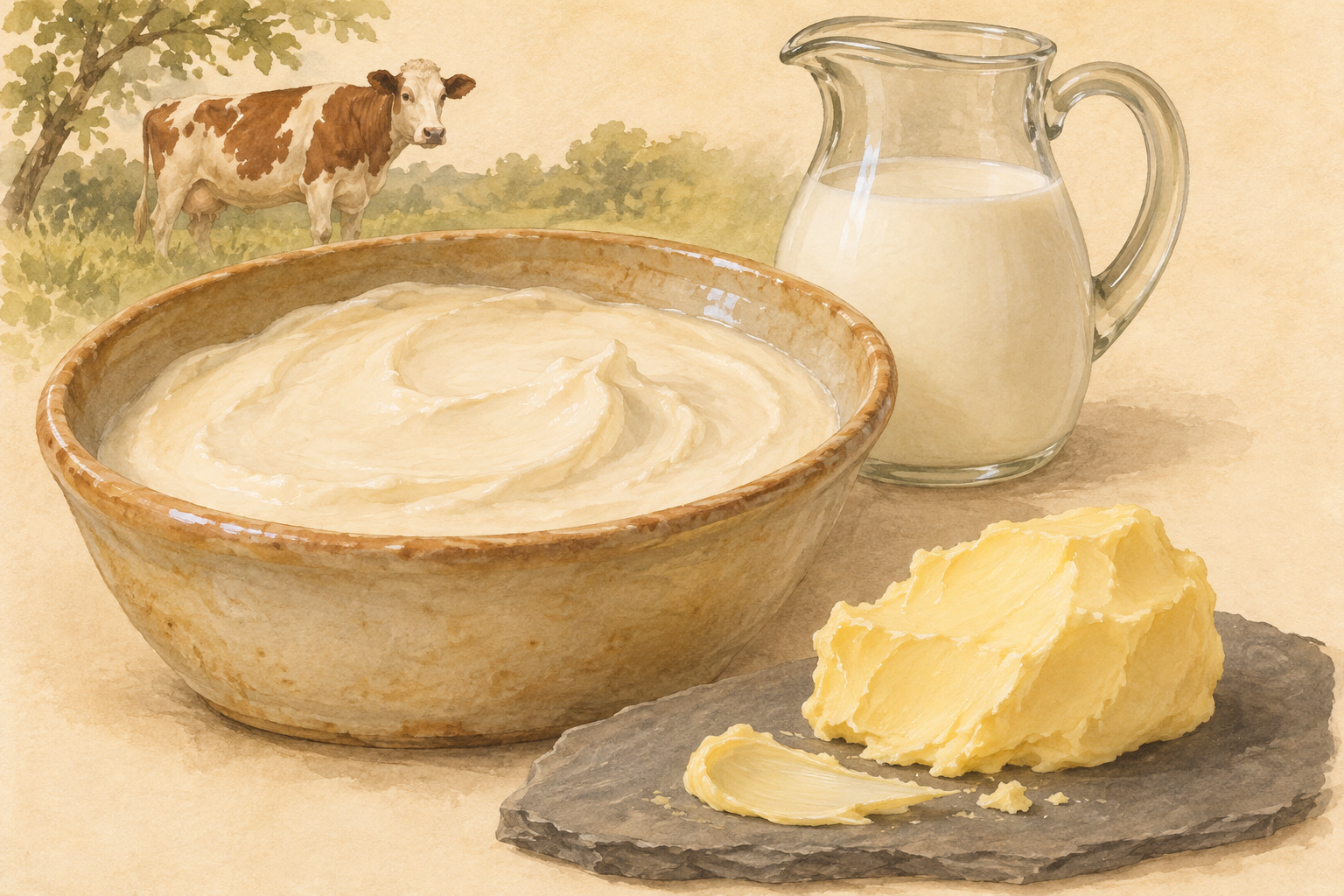
Butter is a water-containing milk-fat food produced by churning cream. It differs from ghee, which has most water and non-fat milk solids removed. Avoid it if allergic to milk.
Source material
Cream separated from cow or other dairy milk, or churned fermented milk, is worked until fat globules gather and buttermilk separates.
Composition
| Measure | Value | Material and source |
|---|---|---|
| Milk fat | At least 80% | Codex CXS 279-1971 butter standard; % by product mass |
| Water | No more than 16% | Same standard; % by product mass |
| Milk solids-not-fat | No more than 2% | Same standard; % by product mass |
| Milk fat | 78–81% | Illustrative makkhan analysis in FAO traditional dairy documentation |
| Water | 18–20% | Same makkhan analysis |
Region
In India, traditional makkhan is made by churning fermented milk called dahi and is eaten with chapati, paratha and rice. Butter is also produced and consumed widely elsewhere.
Food use
Butter is used with bread, in pastries, sauces and sautéing. Indian makkhan may be served with chapati, paratha and rice. These culinary uses are distinct from the manufacturing steps of churning cream and removing buttermilk.
Extraction
Common steps include cream separation, pasteurization, cooling, churning, buttermilk drainage, working and packaging. Traditional fermented-milk churning is another route.
Ordinary butter retains water and milk solids as well as milk fat, accounting for foaming and browning during heating. This is an important processing distinction from ghee, in which much of the water and milk solids are removed.
Safety
Contains milk allergens. Its water and milk solids cause foaming and browning on heating. Follow product refrigeration guidance and discard butter showing mould or off-odours.
Sources
Codex Alimentarius, CXS 279-1971, Standard for Butter. FAO, traditional milk products and makkhan. https://www.fao.org/4/t0251e/t0251e04.htm https://www.manage.gov.in/publications/eBooks/Recent%20Advances%20in%20Dairy%20farming.pdf