THE OIL ATLAS
Mango kernel fat
Overview
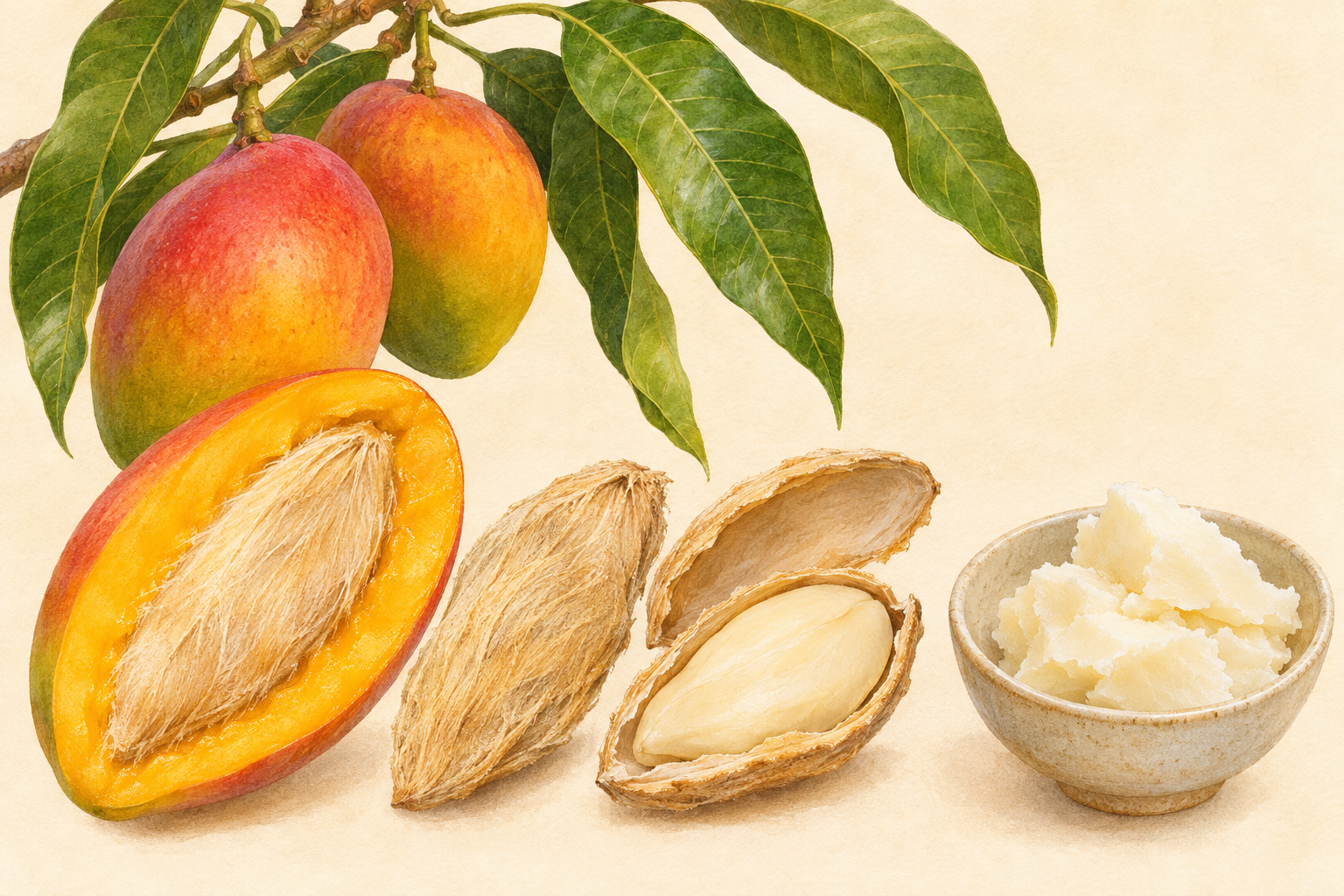
A fat recovered from the kernel inside a mango stone and investigated for confectionery applications; it is not derived from the edible pulp.
Source material
Kernel of Mangifera indica, rather than the flesh or the hard stone itself.
Composition
Results for mango-kernel fat from the Thai Kaew cultivar reported in a 2014 study are listed below.
| Fatty acid | Share of total fatty acids | Sample and conditions |
|---|---|---|
| Stearic | 46.6% | Thai Kaew mango-kernel fat, 2014 study |
| Oleic | 41.1% | Same |
| Palmitic | 5.4% | Same |
A separate study of four Thai cultivars described differences in crystallisation and samples melting completely near 35°C. Neither result is a universal specification for all cultivars.
Region
Besides compositional and melting studies of Thai cultivars, India’s FSSAI food standards expressly define “Mango Kernel Fat” as a distinct refined food fat. The geographical spread of mango fruit consumption does not establish a corresponding traditional culinary history for the separated kernel fat.
Food use
Food-development studies have investigated this relatively solid fat as a cocoa-butter alternative in chocolate and as a shortening ingredient. A studied application is not automatically an established everyday culinary use. Eating mango pulp is not evidence of consuming the separated kernel fat.
Extraction
Kernels are dried, milled and pressed or extracted to recover the fat.
Safety
India’s FSSAI “Mango Kernel Fat” standard requires fat from clean, sound kernels, obtained by expression or solvent extraction and then refined. The melted fat must be clear and free from rancidity, adulterants and foreign matter. Home-extracted or unrefined fat should not be assumed to meet food-grade specifications. Raw-material hygiene and storage stability remain important.
Sources
Food Safety and Standards Authority of India (FSSAI), Food Products Standards and Food Additives Regulations, “Mango Kernel Fat” and “Chocolates”: https://fssai.gov.in/upload/uploadfiles/files/Compendium_Food_Additives_Regulations_21_10_2022.pdf 関連研究: https://pmc.ncbi.nlm.nih.gov/articles/PMC4190219/ ; https://www.jstage.jst.go.jp/article/jos/63/7/63_ess14036/_article