THE OIL ATLAS
Avocado oil
Overview
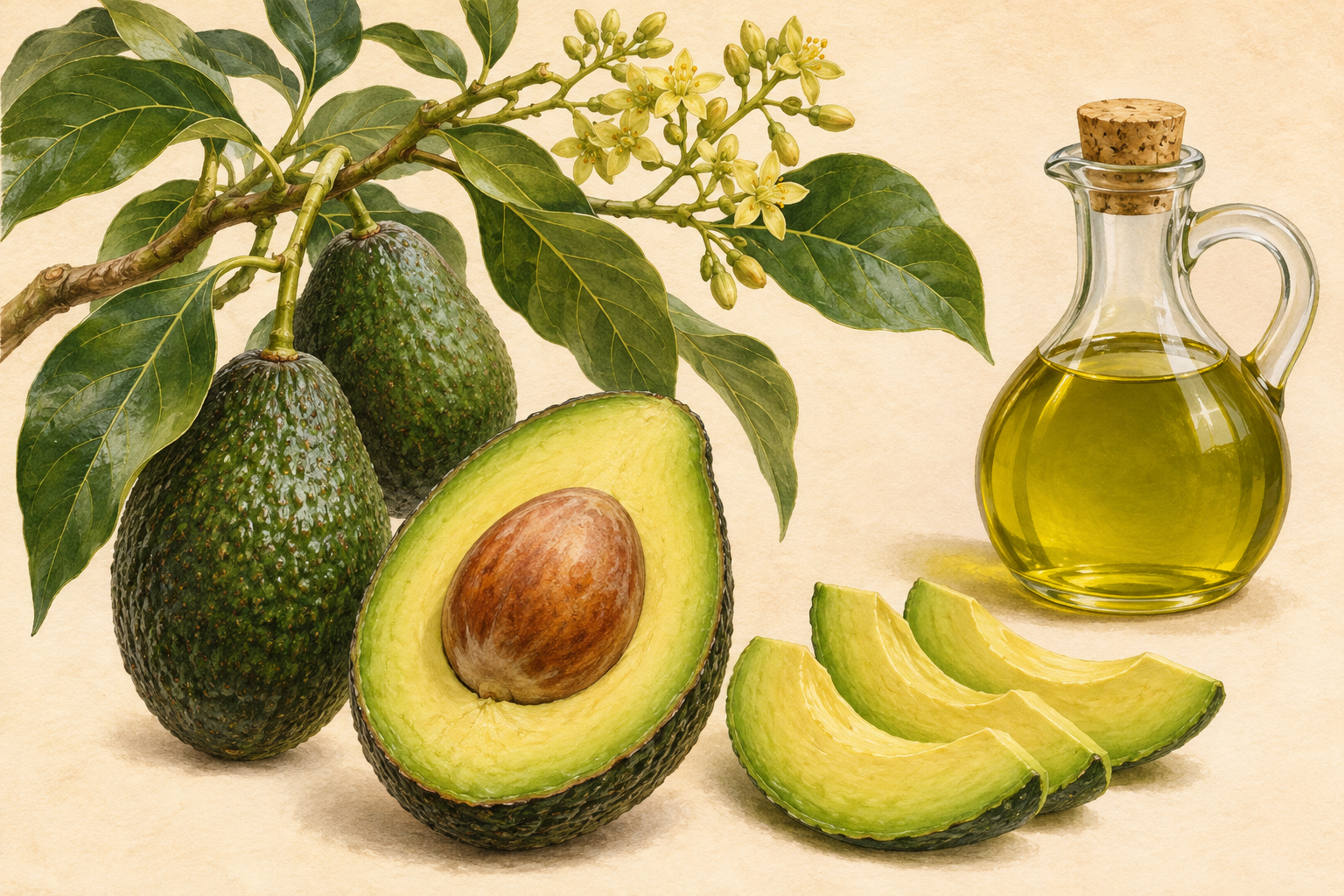
Avocado oil is a food oil separated mainly from avocado flesh. Unrefined oils can retain a green colour and fruit-derived flavour; refined oils are generally paler and milder. Uses include dressings, finishing dishes, cooking and mayonnaise.
Source material
The source is chiefly the fleshy mesocarp of Persea americana Mill. Eating the seed or extracting oil from seeds experimentally should not be confused with ordinary culinary avocado oil production.
Composition
| Constituent | Reported range | Sample basis and unit |
|---|---|---|
| Oleic acid | 42.0–75.0% | Codex oil category, % of total fatty acids |
| Palmitic acid | 11.0–26.0% | Same basis |
| Palmitoleic acid | 4.0–17.1% | Same basis |
| Alpha-tocopherol | 70–190 mg/kg | Cold-pressed oil examples discussed by AOCS |
| Chlorophylls | 11–19 mg/kg | Same examples |
| Carotenoids | 1.0–3.5 mg/kg | Same examples |
| Phytosterols | 2.23–4.48 mg/g | Same examples |
The Codex fatty-acid ranges are not guarantees for any individual bottle. The minor-component figures should not be generalized to all refined oils.
Oil yield from pulp, fatty-acid percentages of extracted oil, and nutrients per 100 g of finished oil are distinct measurements. Check whether each reported figure describes pulp or isolated oil before comparing values.
Region
On 5 October 2000, the New Zealand government announced the opening of a culinary avocado-oil facility in Tauranga. The producer used fruit unsuitable for the fresh-fruit market to make a separate edible oil. An AOCS technical account (2010) reports that two New Zealand processors began cold-pressed culinary oil production in 2000 and also documents production in Chile, South Africa and Kenya. This establishes commercial food use, not an ancient culinary tradition.
Food use
Unrefined cold-pressed oil can contribute green colour and grassy, avocado-like flavour to salads, dressings and finishing dishes. AOCS documents its sale as a culinary oil for salads and cooking. A New Zealand government announcement in 2000 explicitly describes a scallop dish prepared with separated avocado oil. Refined oil generally has a milder flavour and may be chosen for different applications.
Extraction
In the New Zealand mechanical process described by AOCS, processors remove the skin and stone from ripe fruit, crush the flesh, and malax it for 40–60 minutes at 45–50°C. A decanter centrifuge separates the oil and water from the pulp, followed by further centrifugal polishing. These temperatures and times describe a particular process, not a universal requirement. Refining can alter colour, aroma and minor constituents.
Safety
Choose products labelled for food use and protect them from light, heat and air. AOCS notes that chlorophyll contributes to the green colour of unrefined oil but can promote photo-oxidation under light. Rotten or damaged fruit is unsuitable for quality oil production, making fruit selection and hygienic processing important. The presence of fatty acids and minor constituents does not establish disease-prevention or treatment claims.
Sources
New Zealand Government (5 October 2000), opening of a culinary avocado-oil facility. AOCS (Wong et al., 2010), technical account of unrefined cold-pressed avocado oil. Codex CXS 210-1999, named vegetable oils https://www.beehive.govt.nz/release/chef-anderton-opens-avocado-oil-facility https://www.aocs.org/resource/what-is-unrefined-extra-virgin-cold-pressed-avocado-oil/ https://www.fao.org/4/y2774e/y2774e04.htm