THE OIL ATLAS
Virgin coconut oil
Overview
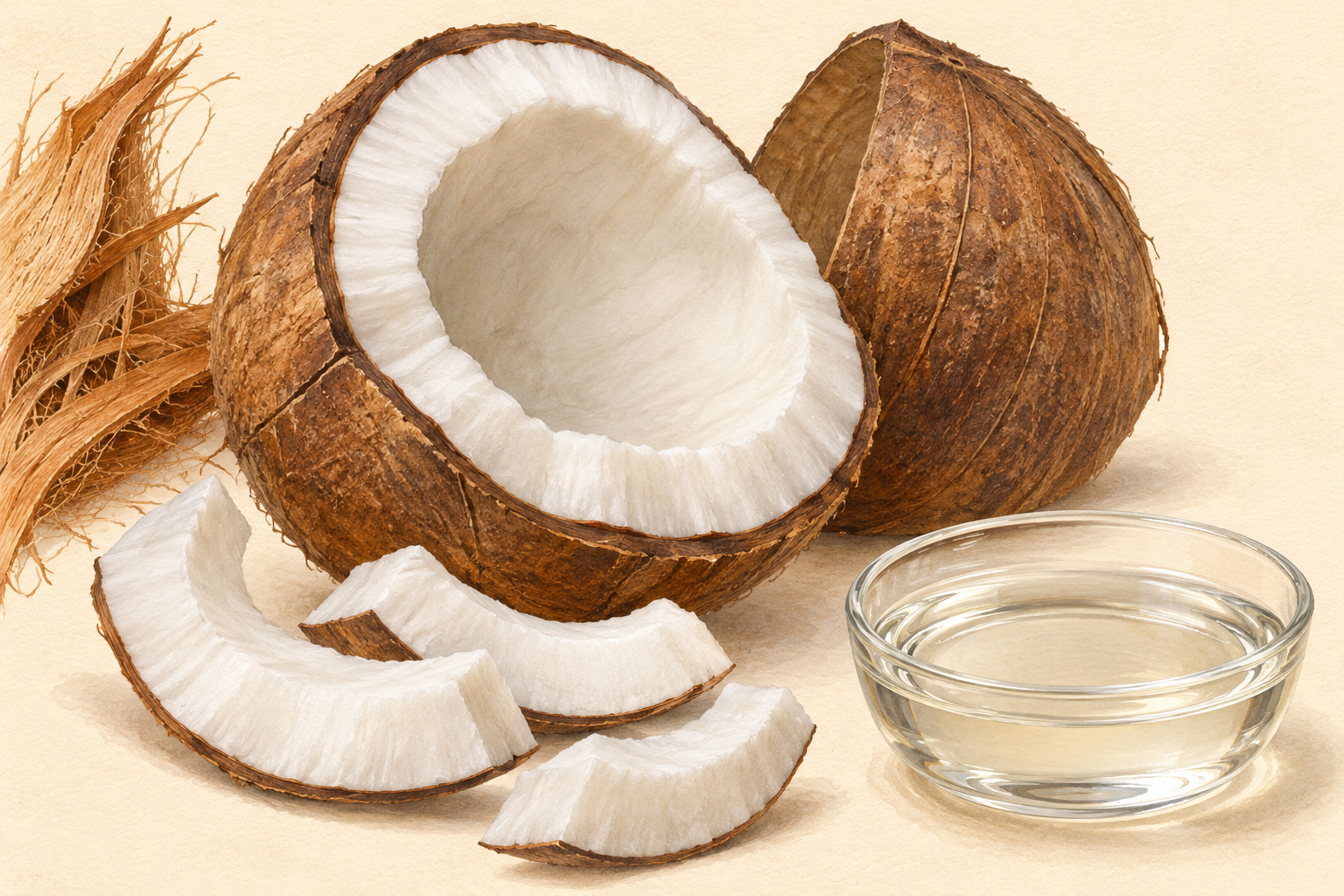
Virgin coconut oil is an edible fat separated from the white endosperm of mature coconuts. It is distinct from coconut milk and coconut water, and some products retain a recognisable coconut aroma.
Source material
The source is the mature endosperm of Cocos nucifera L. Codex defines coconut oil by this raw material and separately specifies the permitted processing methods for virgin oils.
The virgin designation does not change the source tissue: coconut endosperm rather than fruit mesocarp. Compared with refined coconut oil, the important distinction is processing after extraction, not a different source organ.
Composition
| Fatty acid | Codex coconut-oil range (% of total fatty acids) |
|---|---|
| Lauric (C12:0) | 45.1–53.2 |
| Myristic (C14:0) | 16.8–21.0 |
| Caprylic (C8:0) | 4.6–10.0 |
| Oleic (C18:1) | 5.0–10.0 |
Source: Codex STAN 210-1999, Table 1, gas-liquid chromatography ranges for authentic coconut-oil samples. These are neither measurements exclusive to virgin oil nor nutritional values per 100 g of product.
Region
In the Philippines, virgin oil separated from mature coconut kernels is manufactured and marketed for human consumption. The Philippine Coconut Authority’s 2005 regulation sets quality requirements for domestic and export products, including licensing for human-consumption products and process identification on labels. This establishes the separated oil as a food product, not its use in any particular traditional dish.
Food use
As a separated food oil, it is used in confectionery, baked foods and dressings, rather than being interchangeable with coconut milk used directly in cooking. Virgin oil can be chosen where a coconut aroma is desirable, but no particular traditional dish is claimed to require virgin oil.
Extraction
The Philippine Coconut Authority distinguishes fresh-dry processing (grating and drying fresh kernel before oil extraction) from fresh-wet processing (extracting coconut milk and then separating the oil). Wet separation may involve fermentation, centrifugation or heating. Its 2005 regulation calls for identifying methods such as latik, fermentation, centrifugation or expelling on labels. This differs from conventional chemically refined, bleached and deodorised oil.
In fresh-wet processing, the oil phase is separated from an emulsion obtained from the kernel. Adding coconut milk directly to a dish is therefore not the same as extracting and using virgin coconut oil.
Safety
The oil is high in saturated fatty acids. The Philippine 2005 regulation requires sanitary manufacture, packaging and storage controls to limit microbial and particulate contamination. Choose properly labelled food-grade products and avoid oils showing off-odours or suspected moisture contamination. Do not present the oil as guaranteeing health benefits.
Sources
PCA 2005 VCO regulation: https://elibrary.judiciary.gov.ph/thebookshelf/showdocs/10/49616 PCA VCO processing technologies: https://www.pca.gov.ph/pdf/cocoTech/processingTechnologies_Food/VCO.pdf PCA 2025 research journal: https://www.pca.gov.ph/images/Publication/PCA-RESEARCH-JOURNAL-VOLUME-2-ISSUE-NO-1-JANUARY-JUNE-2025.pdf Codex Alimentarius CXS 210-1999 (fatty-acid composition ranges): https://www.fao.org/4/y2774e/y2774e04.htm