THE OIL ATLAS
Palm kernel oil
Overview
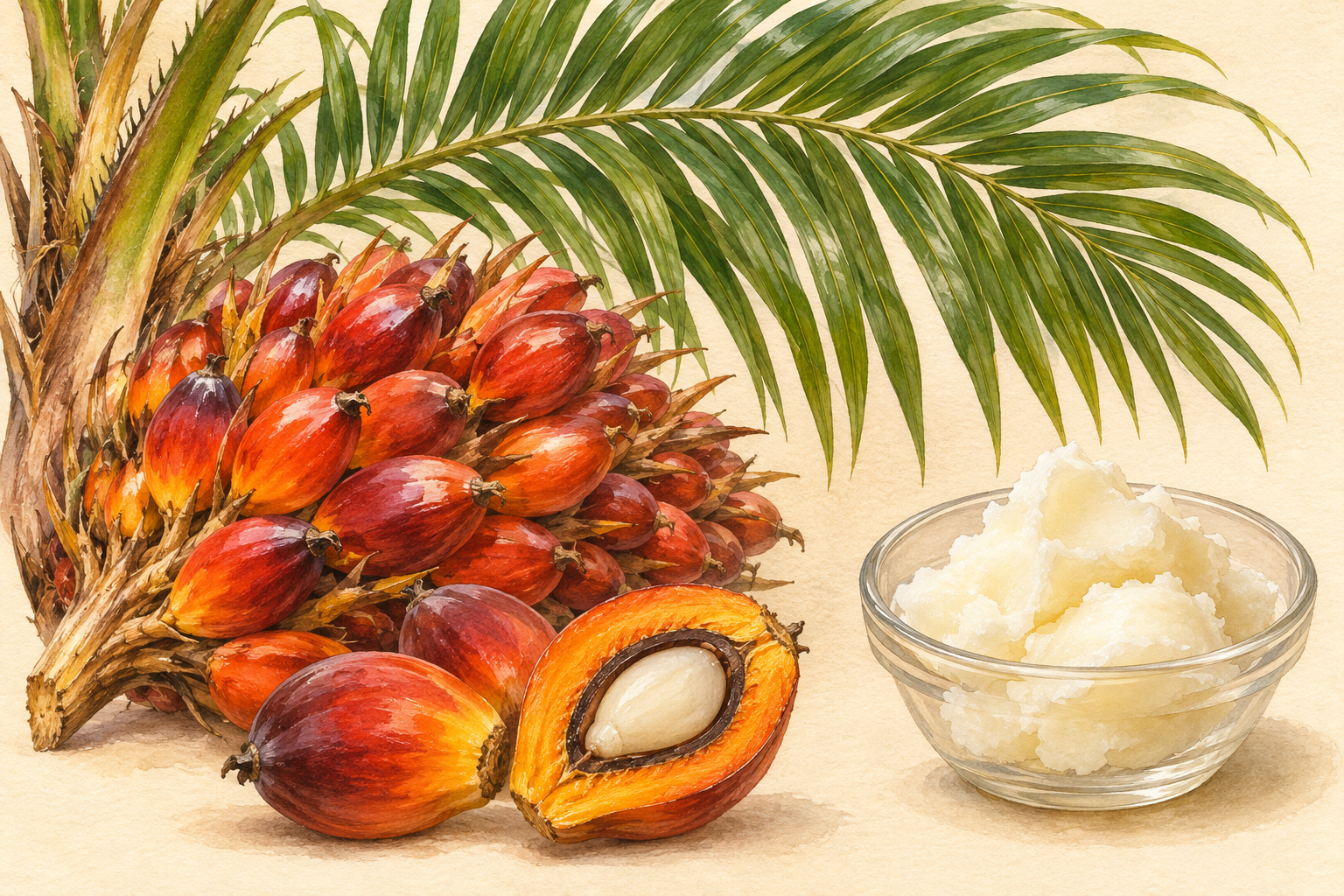
A lauric-acid-rich fat from oil-palm kernels. It differs in both source tissue and composition from mesocarp palm oil.
Source material
Extracted from the kernel enclosed by the hard shell of Elaeis guineensis fruit.
Composition
Codex CXS 210-1999 identity ranges for palm-kernel oil: lauric acid 45.0–55.0%, myristic acid 14.0–18.0%, oleic acid 12.0–19.0%, and linoleic acid 1.0–3.5% (each as a percentage of total fatty acids). These are not measurements of one retail sample.
| Fatty acid | Codex range (% of total fatty acids) |
|---|---|
| Lauric (C12:0) | 45.0–55.0 |
| Myristic (C14:0) | 14.0–18.0 |
| Oleic (C18:1) | 12.0–19.0 |
| Linoleic (C18:2) | 1.0–3.5 |
Source: Codex CXS 210-1999, compositional ranges for palm-kernel oil. These are not grams per 100 g of finished product.
Region
FAO documents food-oil processing from both pulp and kernels in West Africa. The growth of international kernel trade after 1832 does not date the beginning of edible use.
Food use
Used in confectionery coatings, creams and formulated food fats. Fractionation changes melting and crystallisation behaviour.
These formulated-food uses differ from adding red mesocarp palm oil to a dish. In confectionery fats, fractionation and processing matter alongside the name of the source oil.
Extraction
Kernels are removed from shells, dried and crushed, then pressed or extracted. Oil may be refined and fractionated into palm-kernel olein and stearin.
Safety
Check food-grade suitability rather than using industrial or cosmetic products. Consider its high saturated-fat content in the context of the overall diet.
Sources
1. https://www.fao.org/fao-who-codexalimentarius/sh-proxy/en/?lnk=1&url=https%3A%2F%2Fworkspace.fao.org%2Fsites%2Fcodex%2FStandards%2FCXS+210-1999%2FCXS_210e.pdf 2. https://www.fao.org/4/y4355e/y4355e03.htm 3. https://www.fao.org/4/t9450e/t9450e04.htm 4. https://www.fao.org/fao-who-codexalimentarius/sh-proxy/tr/?lnk=1&url=https%3A%2F%2Fworkspace.fao.org%2Fsites%2Fcodex%2FStandards%2FCXS+210-1999%2FCXS_210e.pdf 5. https://www.cambridge.org/core/journals/journal-of-global-history/article/why-dont-some-cuisines-travel-charting-palm-oils-journey-from-west-african-staple-to-malayan-chemical/B65D588A60E4544064E783F6BE882830/share/18361d5b439b6c62237acd9d7ea46ec7ed28cf7a