THE OIL ATLAS
Blackcurrant seed oil
Overview
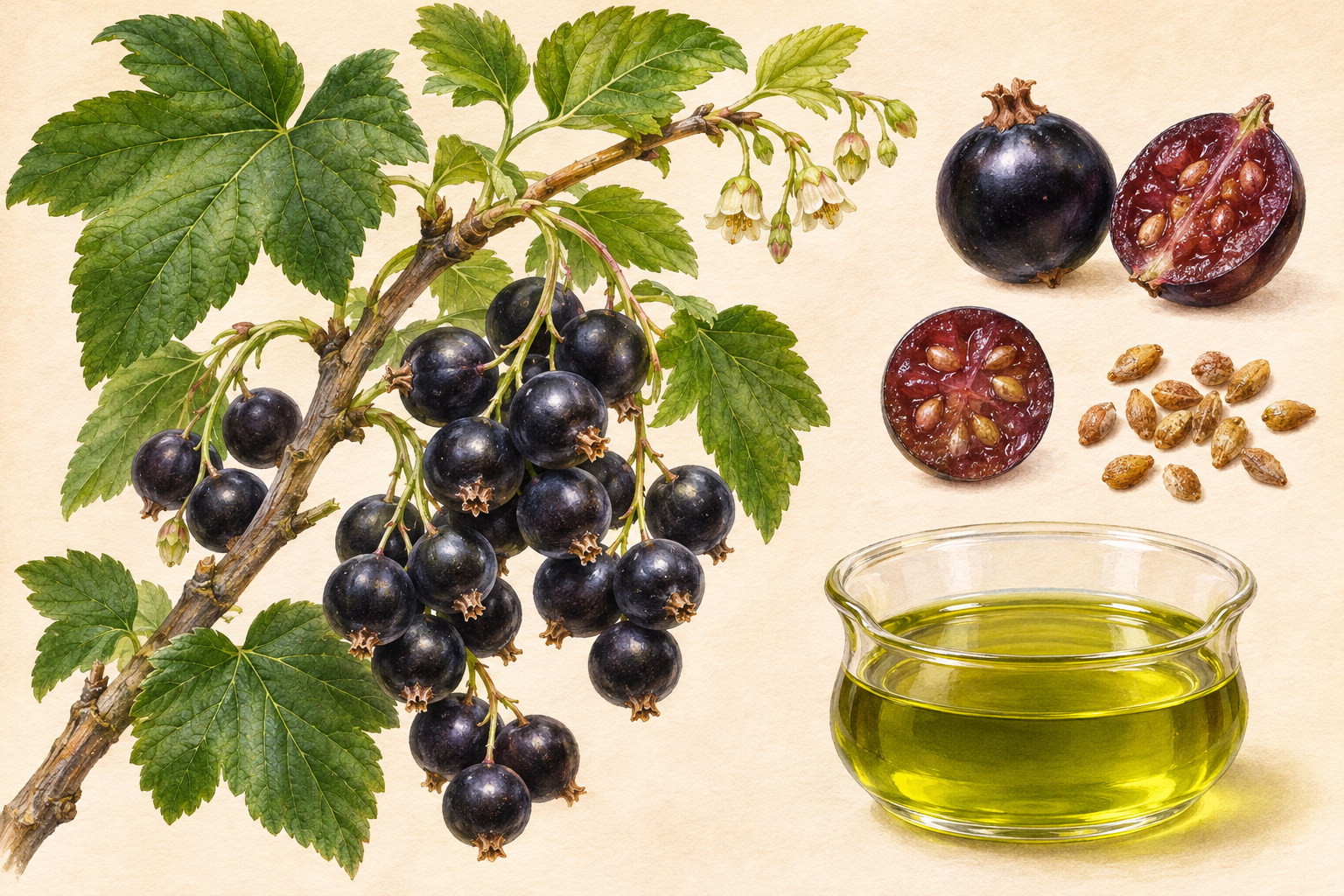
Blackcurrant seed oil is extracted from seeds of Ribes nigrum, often a by-product of juice processing. It is studied as a niche edible oil. A 2012 lipid-science paper records use of the separated oil as a dietary supplement, which is not the same as evidence of widespread cooking use.
Source material
Seeds of blackcurrant, Ribes nigrum, recovered from juice-processing pomace. Consumption of the fruit or juice is not evidence of culinary use of the separated oil.
Composition
| Measure | Reported value | Sample, unit and source |
|---|---|---|
| Seed oil content | 27–33% | Five cultivars from western Canada; percentage of seed mass, 2009 study |
| Gamma-linolenic acid | 11–17% | Same study; percentage of total oil fatty acids, cultivar dependent |
A separate 2002 study of 36 UK genotypes found gamma-linolenic acid commonly at 11–19%, with some genotypes at 22–24%. These are distinct study populations, not one product specification.
Region
A 2009 study analyzed oil from five cultivars grown in western Canada. A UK research institute compared multiple genotypes. Research locations do not establish the geography of culinary oil traditions.
Food use
A 2012 lipid-science paper reports that separated blackcurrant seed oil is used as a dietary supplement. A 2025 food-science study examined it among unconventional edible-oil candidates. The sources checked here do not document a particular recipe or widespread regional cooking tradition. The US NIH Dietary Supplement Label Database records a marketed blackcurrant seed-oil softgel product, entered on 22 March 2024. This documents an oral product containing separated oil, not an agency endorsement of its efficacy or safety.
Extraction
Juice pomace is air-dried and seeds are separated by sieving. A 2012 study describes hexane extraction or combinations of solvent extraction and cold pressing. Laboratory solvent extracts are not automatically food-grade products.
Safety
Use only products verified and labeled for consumption. Dietary-supplement use does not demonstrate treatment efficacy or certify all extracted oils as safe. Do not ingest research-grade or cosmetic-grade oils.
Sources
1. “Characterization of Canadian Black Currant (*Ribes nigrum* L.) Seed Oils and Residues”, *J. Agric. Food Chem.* (2009), https://pubmed.ncbi.nlm.nih.gov/19928765/ (oil content, gamma-linolenic acid, tocopherols and phytosterols). 2. “Genotypic Variation in Fatty Acid Content of Blackcurrant Seeds”, *J. Agric. Food Chem.* (2002), https://doi.org/10.1021/jf010899j (genotype variability). 3. *European Journal of Lipid Science and Technology* (2012), https://doi.org/10.1002/ejlt.201100313 (seed recovery, extraction and dietary-supplement use). 4. “Determination of main lipids and volatile compounds in unconventional cold-pressed seed oils” (2025), https://pubmed.ncbi.nlm.nih.gov/39828411/ (research on novel edible oil sources). 5. NIH Office of Dietary Supplements, Dietary Supplement Label Database, Black Currant Seed Oil, ID 304352 (label entered 2024-03-22; oral softgel): https://dsld.od.nih.gov/label/304352