THE OIL ATLAS
Raspberry seed oil
Overview
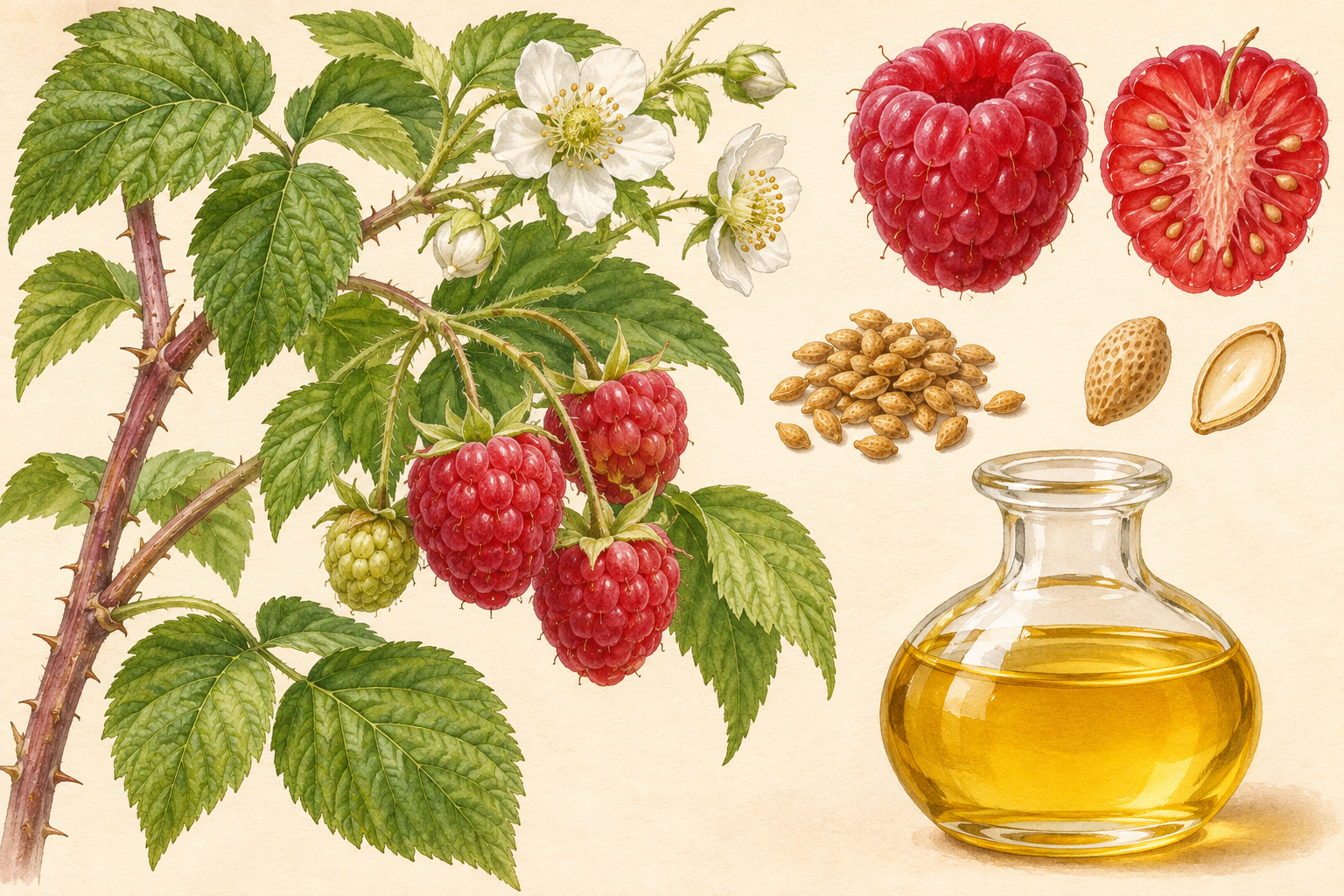
Raspberry seed oil is separated from seeds of Rubus idaeus, often recovered from fruit-processing residues. A food-science study explicitly describes cold-pressed oil for salad dressings and cooking. This is distinct from its use as a cosmetic ingredient.
Source material
Seeds of red raspberry, Rubus idaeus, recovered from processing fruit for juice, jam or similar products. Eating raspberry fruit is not evidence of using the separated seed oil.
Composition
| Measure | Reported value | Sample, unit and source |
|---|---|---|
| Seed oil content | 11–23% | Percent of seed mass, range cited by a 2021 review |
| Tocopherols in raspberry seed oil | 109.17 ± 4.96 mg/100 g oil | Asturias, Spain, samples analyzed in a 2013 study |
| Gamma-tocopherol in the same oil | 58.19 ± 0.61 mg/100 g oil | Same study |
These are study-specific measurements, not guaranteed retail-product specifications. The cited material does not establish the percentage of each fatty acid in this oil.
Region
An analysis used samples from Asturias, Spain, while a 2023 food-science paper investigated oxidative stability of cold-pressed oil. Study locations do not establish a traditional regional culinary practice.
Food use
A 2023 Foods paper explicitly describes cold-pressed raspberry seed oil as suitable for direct use or consumption, including salad dressing and cooking oil. The source does not establish a named traditional dish or a population-level consumption rate.
Extraction
In a 2023 experimental study, 300 g batches of raspberry (Rubus idaeus) seeds were cold-pressed with an approximately 45 °C outlet temperature. The oil was cold-filtered; some samples were subsequently centrifuged to remove fine seed residues. These are conditions of a particular experiment, not a universal commercial production method.
Safety
Because the oil contains polyunsaturated fatty acids, oxidation and storage conditions matter. In a 2023 experiment, oils from older seeds showed poorer oxidation indicators, while centrifugally clarified samples had shorter oxidation induction times measured at 120 °C. These findings concern specific samples and test conditions; they do not establish that every clarification process is unsafe. Use appropriately stored, food-grade oil.
Sources
1. *Foods* (2023), 12(2), 358, “Influence of Seeds’ Age and Clarification of Cold-Pressed Raspberry (*Rubus idaeus* L.) Oil ...”, https://doi.org/10.3390/foods12020358 (culinary uses, pressing, clarification, oxidation). 2. “Red Raspberry (*Rubus idaeus* L.) Seed Oil: A Review” (2021), https://pmc.ncbi.nlm.nih.gov/articles/PMC8151122/ (seed oil content and raw material). 3. “Characterization of Berry and Currant Seed Oils from Asturias, Spain” (2013), https://doi.org/10.1080/10942912.2011.614369 (tocopherol analysis).