THE OIL ATLAS
Quinoa oil
Overview
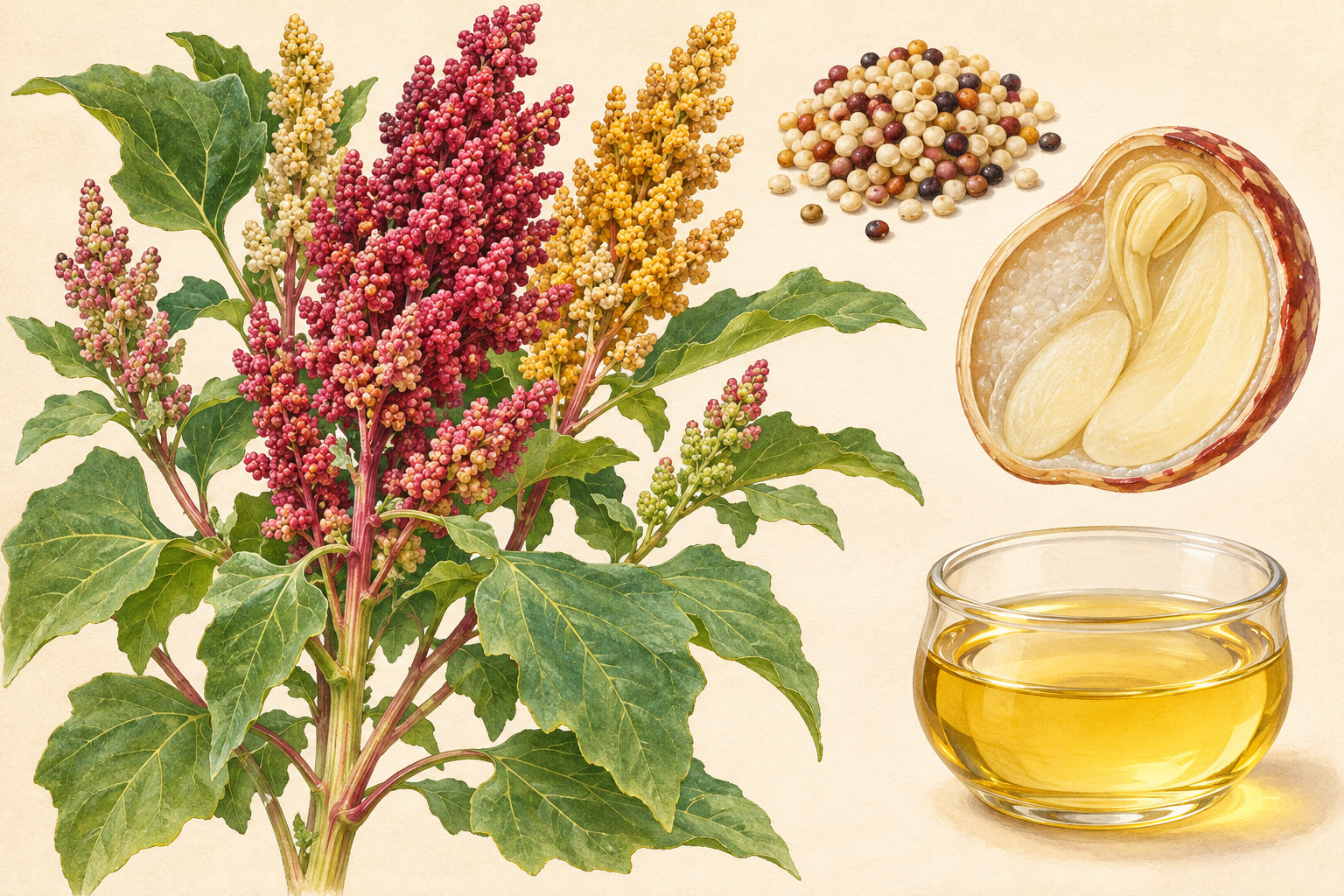
Quinoa oil is oil separated from seeds of Chenopodium quinoa Willd. The Andean history of eating quinoa grain remains distinct from food use of the separated oil. A 2026 food study emulsified commercial quinoa oil, incorporated it into fresh goat cheese, and performed food-product and sensory evaluation.
Source material
The feedstock is quinoa seeds. Consumption of the fruit, grain or seed itself is not evidence of food use of oil extracted from it.
Composition
A 1993 comparison of three cultivars reported an average seed lipid content of 5.3% by seed mass, with linoleic acid at 52.3%, oleic acid at 23.0% and α-linolenic acid at 8.1% of total fatty acids. A separate study of extracted quinoa oil reported 10.5 g oil per 100 g endosperm, with 55.3% linoleic, 24.9% oleic and 4.0% linolenic acid. These studies differ in material, cultivar and conditions and should not be averaged.
Region
Quinoa is grown and eaten in many places, but this does not show that its separated oil is also eaten in each of those places.
Oil can be extracted from quinoa seeds. Eating quinoa as a grain is different from using its separated oil in cooking. A food-use account of the oil requires evidence of edible products or culinary practice beyond extraction studies.
Food use
A study added quinoa-oil emulsion to goat milk at 3 or 6 g/L, manufactured fresh cheese, and evaluated it with a 47-person sensory panel. The fortified cheeses showed good acceptance similar to the control. This is direct evidence of separated oil being incorporated into and tasted as a food, but not evidence of a traditional dish or widespread retail use.
Extraction
The 2026 study used quinoa oil purchased from a food-ingredient supplier, emulsified it with calcium caseinate, and added the emulsion to milk before coagulation. Earlier studies also solvent-extracted oil from wholemeal or germ flour. These are controlled research processes and should not be presented as traditional Andean oil-making.
Safety
The direct evidence concerns food-grade material in a controlled research food. Appropriate food-grade oil and processing remain necessary. Acceptance of a prototype does not establish broad health effects or the safety of oil produced by any extraction method.
Sources
1. Muñoz-Tebar et al. (2026). Application of quinoa oil emulsions in fresh goat cheese: effects on lipid profile, technological properties and microstructure. Food Chemistry. https://pubmed.ncbi.nlm.nih.gov/42034081/ ; full text: https://dspace.umh.es/bitstream/11000/39888/1/1-s2.0-S0308814626015426-main.pdf 2. Wood et al. (1993). Seed Lipid Content and Fatty Acid Composition of Three Quinoa Cultivars. https://doi.org/10.1006/jfca.1993.1005 3. Oxidative Stability and Characterization of Quinoa Oil Extracted from Wholemeal and Germ Flours (2019). https://doi.org/10.1002/aocs.12308 4. Preliminary study of physicochemical, thermal, rheological, and interfacial properties of quinoa oil (2023). https://pmc.ncbi.nlm.nih.gov/articles/PMC11162528/