THE OIL ATLAS
Corn oil
Overview
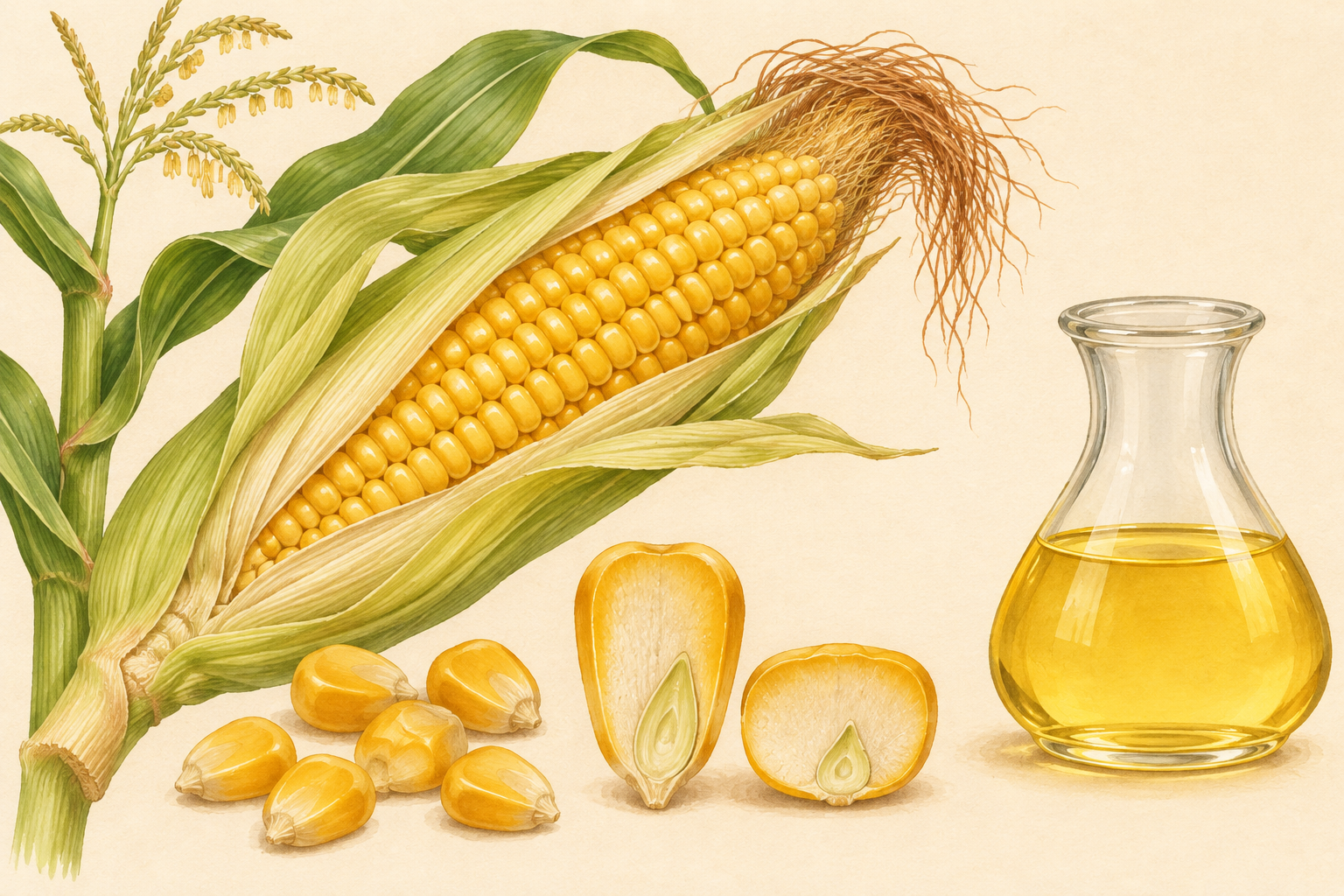
Corn oil is an edible oil obtained principally from maize germ. Unlike eating whole maize kernels, its production requires recovering and refining the oil from the germ. Common refined products have a relatively mild flavour and are used in cooking and processed foods.
Source material
The raw material is the germ of maize (Zea mays L.), not the whole kernel. Eating maize as a grain is distinct from consuming oil extracted and separated from its germ.
The germ is only one part of the kernel; corn oil is not juice pressed from the whole maize grain.
Composition
Under Codex CXS 210-1999, the range for linoleic acid (C18:2) in authentic corn-oil samples is 34.0–65.6% of total fatty acids. This is neither grams per 100 g of finished oil nor a guarantee for every retail product; composition varies with material and processing.
The wide Codex range for linoleic acid means that an individual product should be assessed from its own label or analytical data.
Region
In the United States, corn germ recovered from wet milling is processed into edible oil for home kitchens and food manufacture. A USDA technical account describes corn germ as a coproduct of wet milling and a principal feedstock for corn oil.
Food use
Refined corn oil is used for frying potatoes and snack foods, and as an ingredient in salad dressings, mayonnaise, margarine and sauces. The US corn-refining industry also documents its use in tortilla chips.
Extraction
Wet or dry milling separates the germ from maize kernels. Pressing and solvent extraction may then recover crude oil. Food-grade refining can involve degumming, neutralisation, bleaching, dewaxing and deodorisation, with the sequence depending on the product.
Germ separation and oil extraction are distinct operations. Subsequent refining changes the residual flavour and minor components.
Safety
Choose oil labelled and manufactured for food use, not crude industrial coproduct oil. Repeated prolonged heating degrades frying oil; discard oil that develops off-odours, abnormal darkening or smoking.
Sources
Codex CXS 210-1999 (corn-oil fatty-acid profile); USDA ARS, “Corn Oil” (2002); U.S. Grains Council, Importer Manual, Chapter 2; Corn Refiners Association, “Corn Oil”.