THE OIL ATLAS
High-erucic rapeseed oil
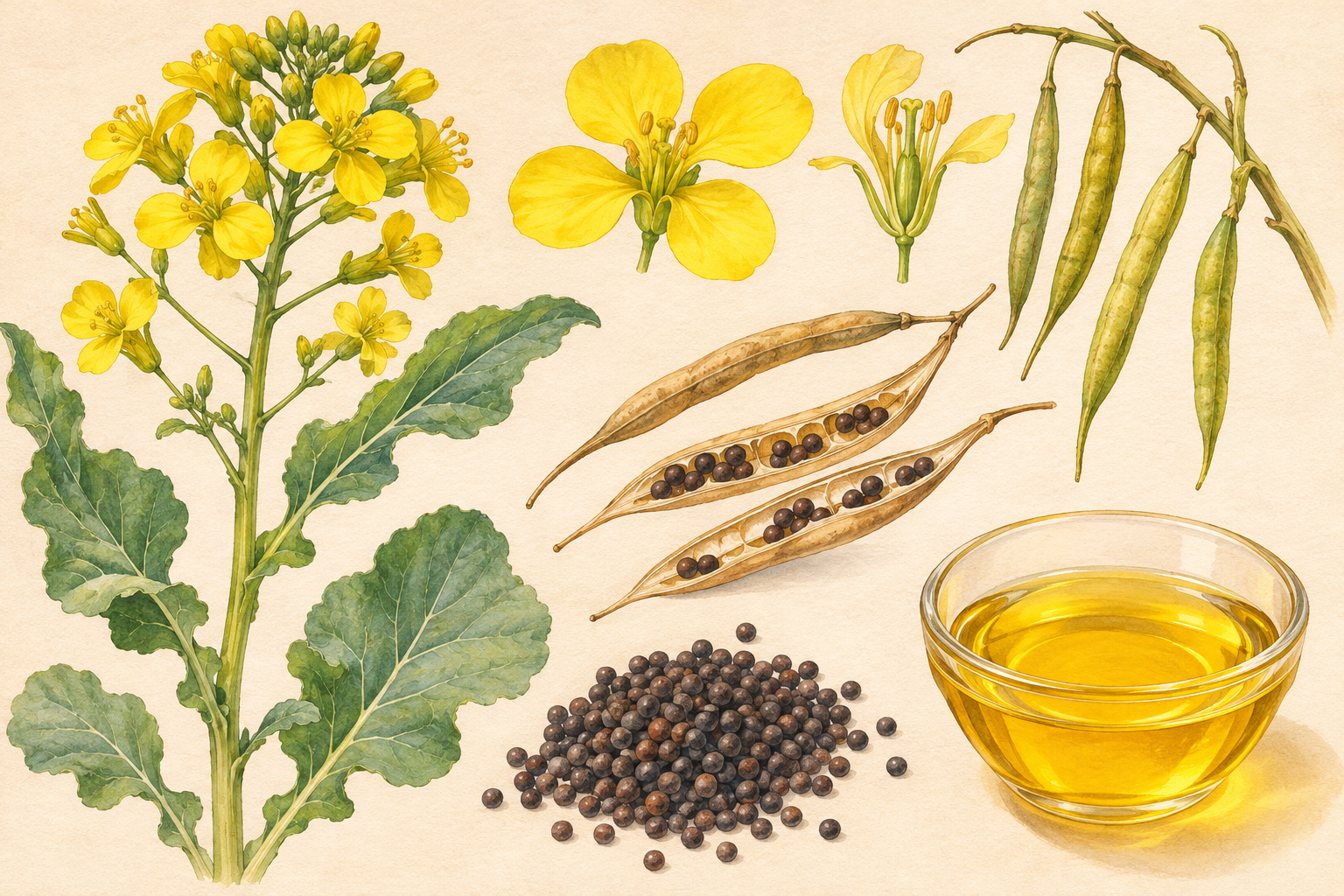
Overview
Higher-erucic rapeseed oil differs from low-erucic canola oil. Chinese edible rapeseed oil includes ordinary and low-erucic categories.
Source material
Seeds of rapeseed plants such as Brassica napus, Brassica rapa and Brassica juncea supply the oil. Erucic-acid content depends on cultivar and product specifications, rather than species alone.
Composition
China’s 2023 consumer guidance describes ordinary rapeseed oil as containing 3–60% erucic acid in its fatty acids and the low-erucic category as at most 3%. These are Chinese categories, not an analysis of an individual product.
Region
Major Chinese production regions include the Yangtze basin and southwestern and northwestern China. SAMR guidance describes selection and household use of the food product.
Food use
Chinese guidance describes rapeseed oil in stir-frying, frying and other cooking. It has a traditional distinctive flavour; repeated heating of the same oil is discouraged.
Extraction
Crude oil from pressing or solvent extraction is processed for food. The Chinese standard distinguishes crude oil, unsuitable for direct consumption, from finished rapeseed oil.
Safety
Food-use history does not guarantee the safety of high erucic-acid levels. The EU limit for general vegetable oils and fats is 20 g/kg, which higher-erucic products may exceed. Check food labelling and local requirements; industrial oil is not food.
Sources
SAMR, consumer guidance on rapeseed oil, 2023: https://www.samr.gov.cn/spcjs/yjjl/art/2023/art_062d638b781c45c7aac0949a8bd4e3e1.html GB/T 1536-2021, Rapeseed oil: https://fgw.ankang.gov.cn/UploadFiles/akjyhfj11/file/20220216/20220216092837_8945.pdf EU Regulation 2023/915, Annex I 2.1: https://eur-lex.europa.eu/legal-content/EN/TXT/?uri=CELEX:02023R0915-20260819