THE OIL ATLAS
Indaiá palm kernel oil
Overview
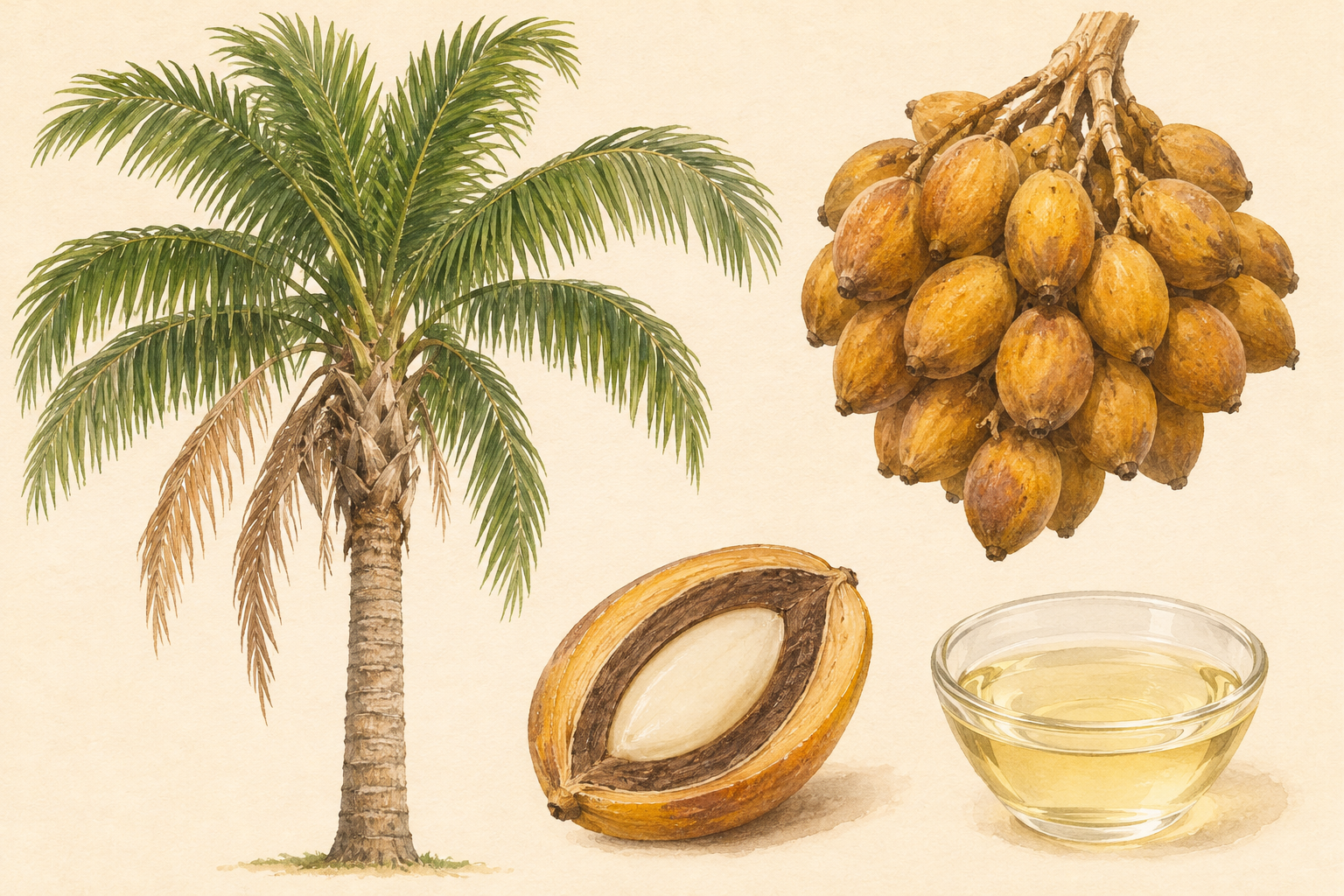
Indaiá kernel oil is separated from the kernels of Attalea dubia, a palm of Brazil’s Atlantic Forest. A 2012 comparative study explicitly records oil made by local communities from the kernels and used in cooking. This species-specific account should not be generalized to every palm called indaiá.
Source material
The white, oily endosperm (kernel) inside the fruit of Attalea dubia (Mart.) Burret (Arecaceae), distinct from fruit-mesocarp oil and oils of other indaiá palms.
Composition
A 2012 comparison of Attalea dubia and babassu oils reported total unsaturated fatty acids of 5.8% for indaiá oil versus 9.4% for the comparator babassu oil. These are fatty-acid percentages for the study samples, not nutritional values per 100 g of retail oil; they should not be generalized to all traditional batches.
Region
Attalea dubia occurs in Brazil’s Atlantic Forest. The 2012 paper reports oil production and culinary use in local communities without establishing a named dish or frequency of consumption.
Food use
The paper states that oil produced from the kernels in local communities can be used for cooking. This is a record of separated-oil use, not merely kernel consumption or laboratory extraction potential.
Extraction
Kernels are recovered from the fruit and processed to obtain oil. The cited comparison records local production but does not establish a standardized traditional sequence of heating, pressing or refining.
Safety
Historical or community culinary use is not proof of compliance with present-day food standards or marketing authorization. Wild-harvest restrictions, sanitary production, oxidation and food-grade status require separate checks.
Sources
A Comparison of the Physicochemical Properties and Fatty Acid Composition of Indaiá (Attalea dubia) and Babassu (Orbignya phalerata) Oils (2012), https://onlinelibrary.wiley.com/doi/10.1100/2012/532374 (species, community cooking use and analytical comparison)