THE OIL ATLAS
Ethiopian Podocarpus Seed Oil
Overview
An oil separated from the kernels of Afrocarpus falcatus and reported for household consumption in eastern Ethiopia. A 2022 food-science study investigated aqueous extraction. Its experimental measurements are not specifications for all edible products.
Source material
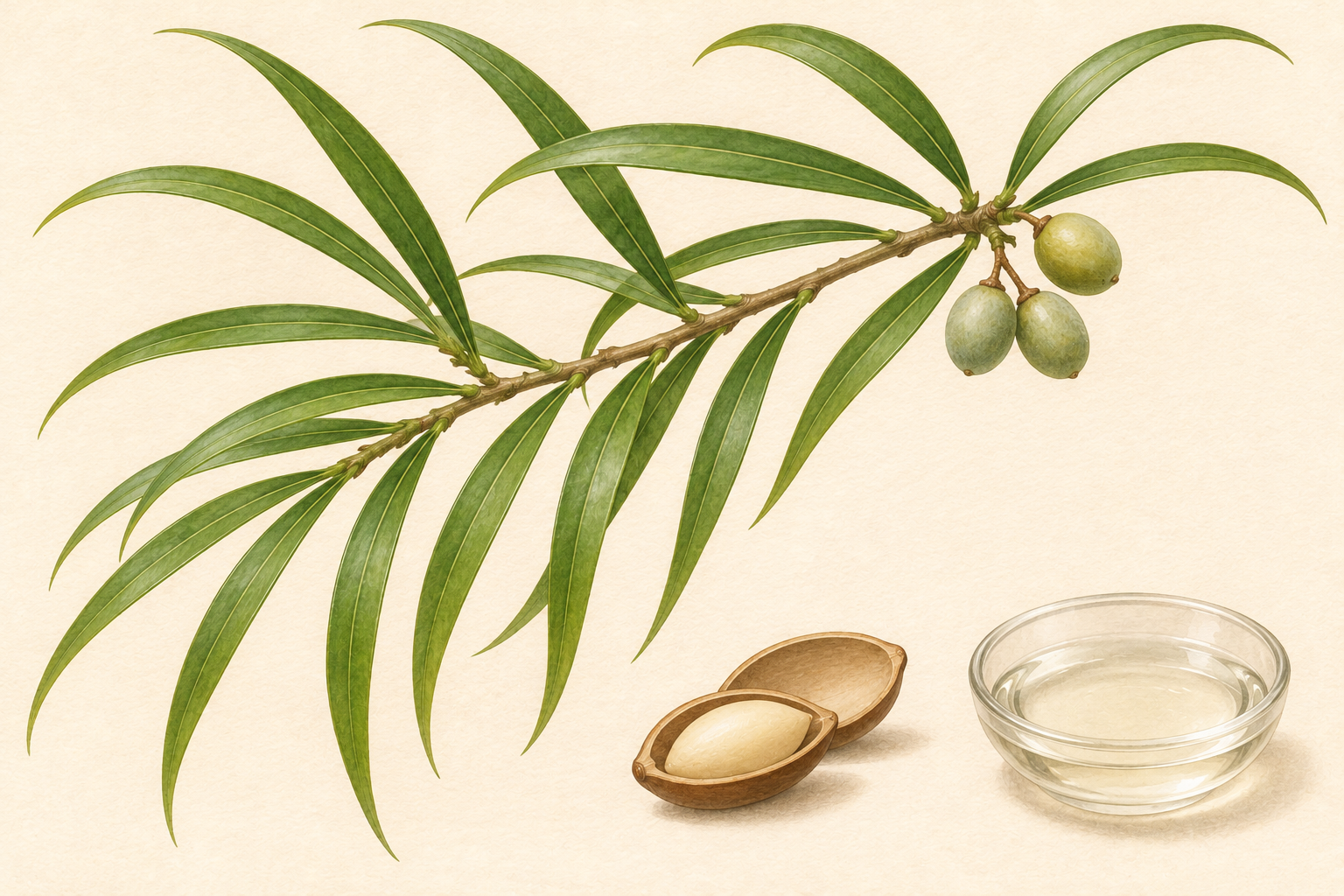
The source is the seed kernel of Afrocarpus falcatus, called Podocarpus falcatus in the cited paper. The subject is the separated oil, not consumption of the fruit or seed itself.
Composition
A 2022 aqueous-extraction experiment reported a maximum extraction yield of 25.25% at a particle size of 0.25 mm and 70°C (a condition-dependent experimental result). This is neither total seed lipid content nor a nutrition-label value for commercial oil. The source account does not provide an applicable individual fatty-acid table.
Region
In Ethiopia, records describe communities around Assela, Shashemene and Hirna collecting seeds to produce edible oil. A 2022 study also reports traditional extraction for household consumption in the eastern Chercher highlands. These are accounts of separated oil in use, not merely edible seeds or laboratory extraction potential. Regional prevalence and current commercial distribution remain unverified.
Food use
The oil is reported as a household cooking oil in the locality. The study does not identify specific dishes or cooking durations, so no named recipe is attributed to it.
Extraction
Traditional accounts describe drying, crushing and heating the seeds, then boiling them with water to separate oil. A 2022 aqueous-extraction experiment compared particle sizes of 0.25–0.75 mm and temperatures of 70–90°C. These are experimental settings, not evidence that households follow identical conditions.
Safety
Historical and household food use is documented, but it does not establish compliance with current national food standards or comprehensive safety approval. Reported peroxide and other quality measurements apply to the studied samples and extraction conditions. Home extraction and consumption of unidentified seed oils is not recommended.
Sources
Goben, D. A. et al. (2022), “Effects of Extraction Temperature and Particle Size on Quality of Edible Oil from Podocarpus Falcatus Seed by Aqueous Method, Ethiopia”, *Journal of Food Science and Nutrition Therapy* 8(1):6–10. https://www.foodscigroup.us/articles/JFSNT-8-132.php DOI:10.17352/jfsnt.000032 Feleke et al. (2012), “Characteristics of seed kernel oil from Podocarpus falcatus”, Journal of Tropical Forest Science 24(4):512–516 (traditional use around Assela, Shashemene and Hirna). Goben et al. (2022), full text: https://www.foodscigroup.us/articles/JFSNT-8-132.php (household use and aqueous-extraction experiment).