THE OIL ATLAS
Mbayaka raffia fruit-pulp oil
Overview
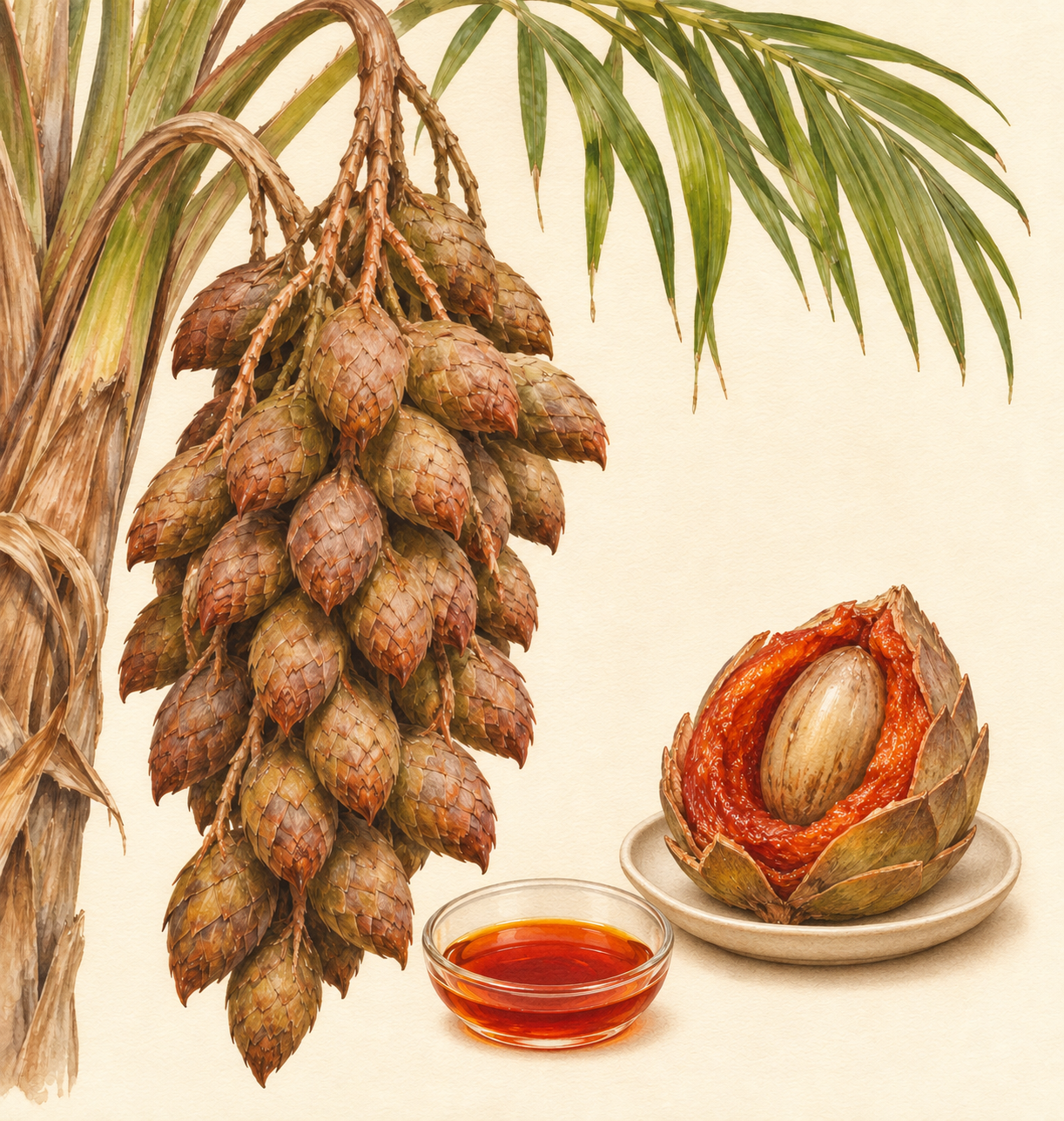
Mbayaka is a reddish raffia-palm fruit-pulp oil recorded in the Republic of the Congo. Local extraction and analysis of the separated oil are documented. Both the 2000 oil study and the 2026 taxonomic survey associate this pulp oil with Raphia laurentii.
Source material
Fruit pulp of a raffia palm, not the seed kernel. Both the 2000 oil study and the 2026 taxonomic survey associate this pulp oil with Raphia laurentii.
Region
Wetland forest areas of the Republic of the Congo. A 2026 botanical survey records the local name Mbayaka among the Moyis. Current national production and market distribution have not been established.
Food use
The 2000 study addresses raffia pulp oils as oils consumed by Congolese populations and documents local processing. A 2012 ethnographic account also describes Mbayaka as locally appreciated. This is evidence concerning separated oil rather than merely eating the pulp; specific dishes and frequency of use remain unverified.
Extraction
The 2000 study compares local oil processing involving fruit fermentation with laboratory extraction from fresh fruit. Locally fermented samples showed poorer quality indicators than laboratory samples; precise temperature, hygiene and storage conditions cannot be assumed equivalent.
Safety
Traditional consumption does not establish current product safety or marketing permission. Fermentation, hydrolysis, oxidation and hygiene during production and storage require attention. Choose products with food-grade quality controls.
Sources
1. Silou T. et al. (2000), Caractéristiques physicochimiques et composition en acides gras des huiles de Raphia sese et Raphia laurentii, Tropicultura 18(1):26–31. https://doaj.org/article/9bd049d94a584e7caea997f193571a6b 2. Ndolo Ebika S.T. et al. (2026), Synopsis of the genus Raphia in the Republic of the Congo, PhytoKeys 271:37–71. https://doi.org/10.3897/phytokeys.271.174506 3. Loubelo E. (2012), Impact des produits forestiers non ligneux sur l’économie des ménages et la sécurité alimentaire : cas de la République du Congo (traditional local names and consumption; secondary ethnographic account).