THE OIL ATLAS
Kolo raffia fruit-pulp oil
Overview
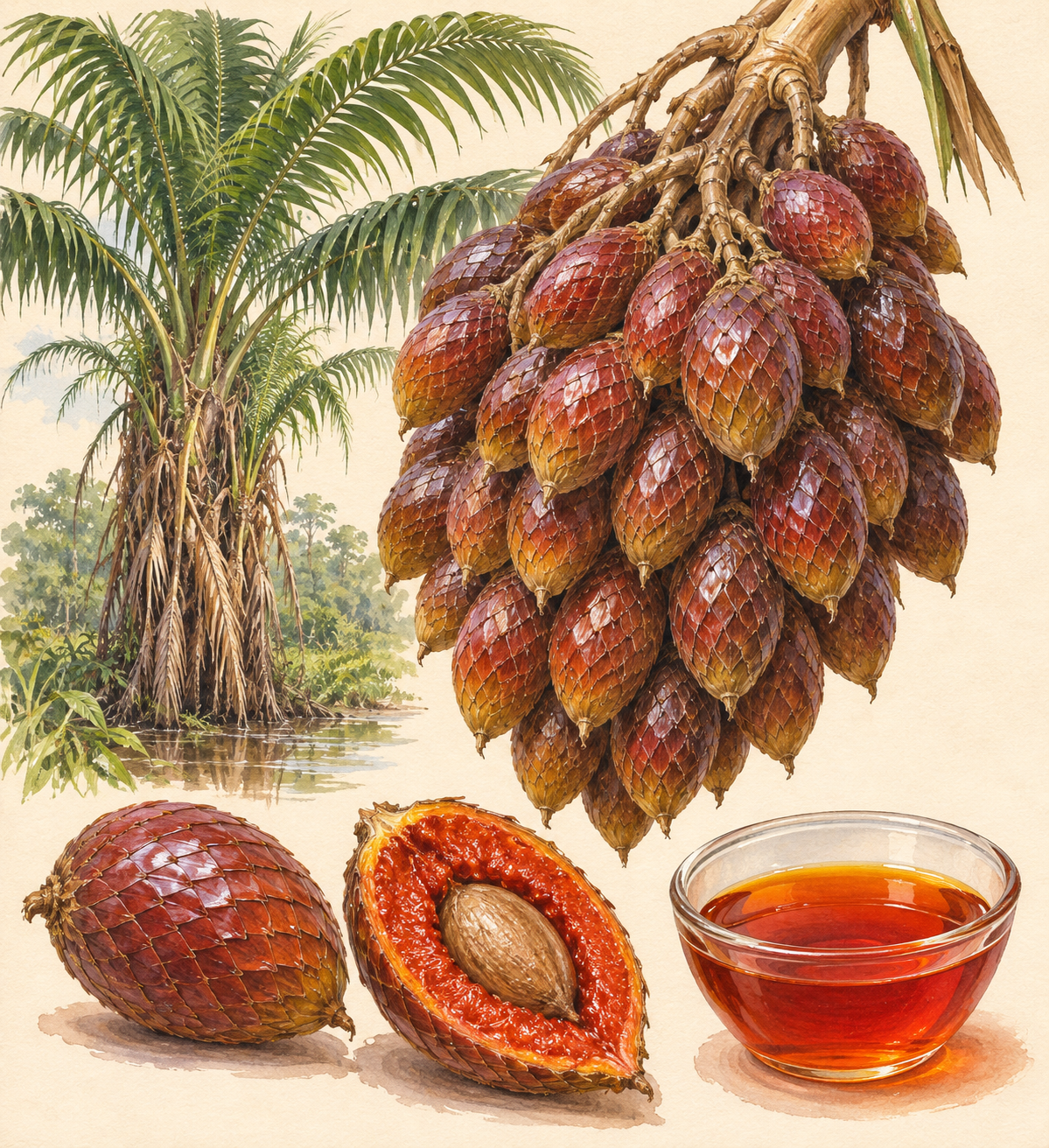
Kolo is a raffia-palm fruit-pulp oil of the Republic of the Congo. The 2000 oil study identified Raphia sese; the 2026 field-based taxonomic study suggests it was probably R. hookeri, based on northern Congolese specimens and the Mbochi name. The regional oil-use record is distinguished from the reassessment of species identity.
Source material
The material is fruit pulp, not seed kernel. The 2026 authors propose R. hookeri rather than definitively re-identifying the old samples, and call for further investigation of both species. Older analytical values are not treated as a standard profile for authenticated R. hookeri.
Region
Wetland forest areas of the Republic of the Congo. A 2026 botanical survey records the local name Kolo among the Mbochi. Current national production and market distribution have not been established.
Food use
The 2000 study addresses raffia pulp oils as oils consumed by Congolese populations and documents local processing. A 2012 ethnographic account also describes Kolo as locally appreciated. This is evidence concerning separated oil rather than merely eating the pulp; specific dishes and frequency of use remain unverified.
Extraction
The 2000 study compares local oil processing involving fruit fermentation with laboratory extraction from fresh fruit. Locally fermented samples showed poorer quality indicators than laboratory samples; precise temperature, hygiene and storage conditions cannot be assumed equivalent.
Safety
Traditional consumption does not establish current product safety or marketing permission. Fermentation, hydrolysis, oxidation and hygiene during production and storage require attention.
Sources
1. Silou T. et al. (2000), Caractéristiques physicochimiques et composition en acides gras des huiles de Raphia sese et Raphia laurentii, Tropicultura 18(1):26–31. https://doaj.org/article/9bd049d94a584e7caea997f193571a6b 2. Ndolo Ebika S.T. et al. (2026), Synopsis of the genus Raphia in the Republic of the Congo, PhytoKeys 271:37–71. https://doi.org/10.3897/phytokeys.271.174506 3. Loubelo E. (2012), Impact des produits forestiers non ligneux sur l’économie des ménages et la sécurité alimentaire : cas de la République du Congo (traditional local names and consumption; secondary ethnographic account).