THE OIL ATLAS
Sawfish liver oil
Overview
Caution: this article records regional food use and does not recommend capture, purchase or consumption.
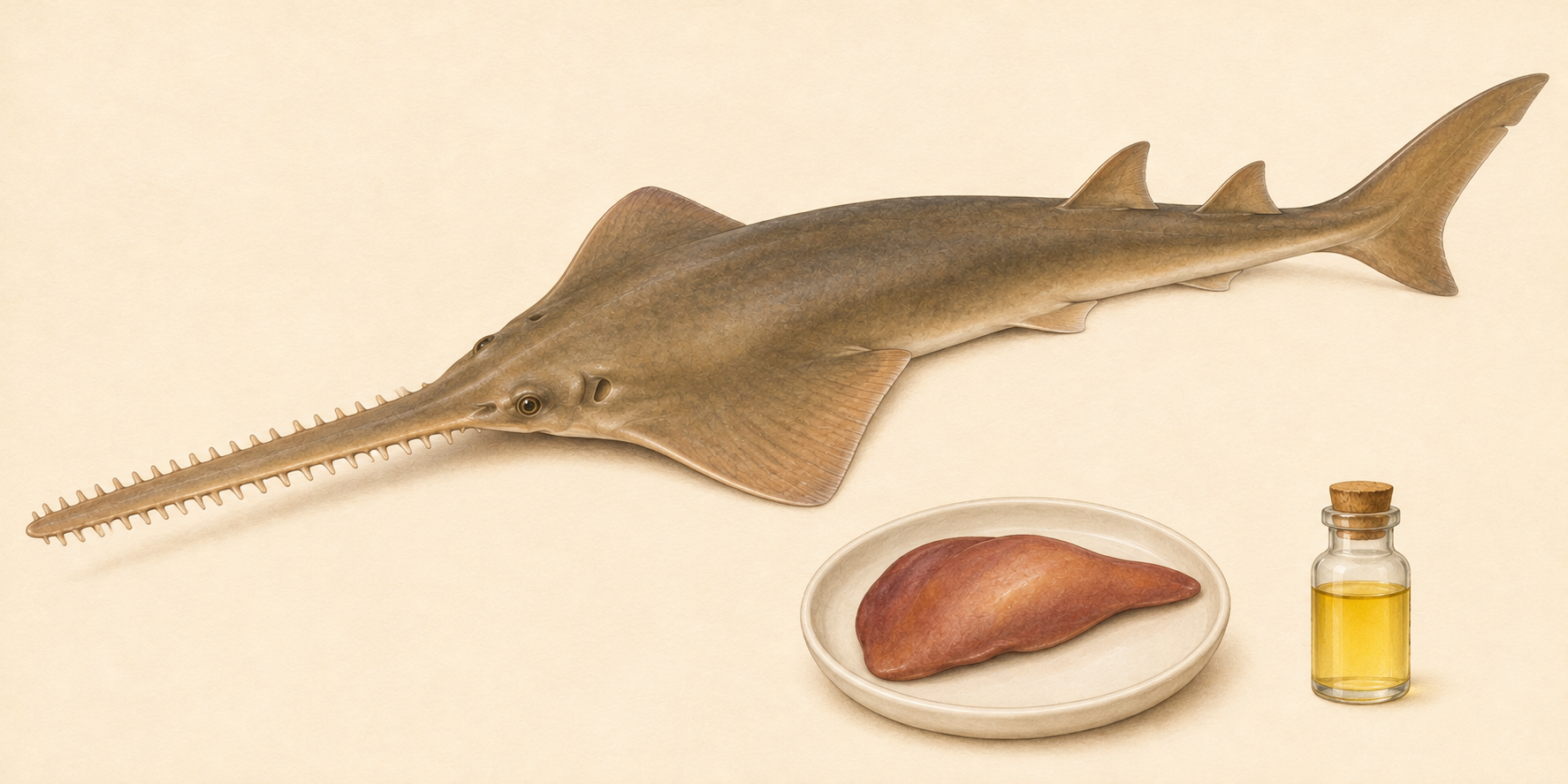
Oil separated from sawfish livers and used in cooking, documented in a 2017 interview study in Papua New Guinea.
Source material
The source is liver oil of sawfishes, family Pristidae. Pristis pristis and Anoxypristis cuspidata were confirmed in the study area, but individual oil-use responses cannot be assigned to species. Sawsharks and shark liver oils generally are distinct.
Region
The record comes from April 2017 interviews with fishing communities around the Sepik, Ramu and Keram rivers in northern Papua New Guinea. Boat-treatment records alone are not used as food evidence.
Food use
Leeney and colleagues report that many respondents extracted oil from sawfish livers and cooked with it. Figure 5 distinguishes liver-oil cooking from meat consumption. This is interview evidence, not direct observation of cooking.
Extraction
The paper records oil separation from livers but does not validate food-processing or storage conditions.
Safety
This ethnobiological study did not analyse liver-oil vitamins, contaminants, oxidation or intake-dependent risk. The oil is not equated with ordinary fish-oil supplements or declared safe. Sawfishes are subject to conservation and trade controls. CITES Appendix I restrictions on commercial international trade are distinct from national domestic rules. Do not consume products whose food suitability and legal status are unverified.
Sources
Leeney, Mana & Dulvy (2018), Fishers’ ecological knowledge of sawfishes in the Sepik and Ramu rivers, northern Papua New Guinea, Endangered Species Research 36:15–26, Fig.5 and p22. https://doi.org/10.3354/esr00887 CITES, Appendices I, II and III, valid from 5 March 2026, Pristidae spp.: https://cites.org/eng/app/appendices.php