THE OIL ATLAS
Socotri leatherjacket and triggerfish oil
Overview
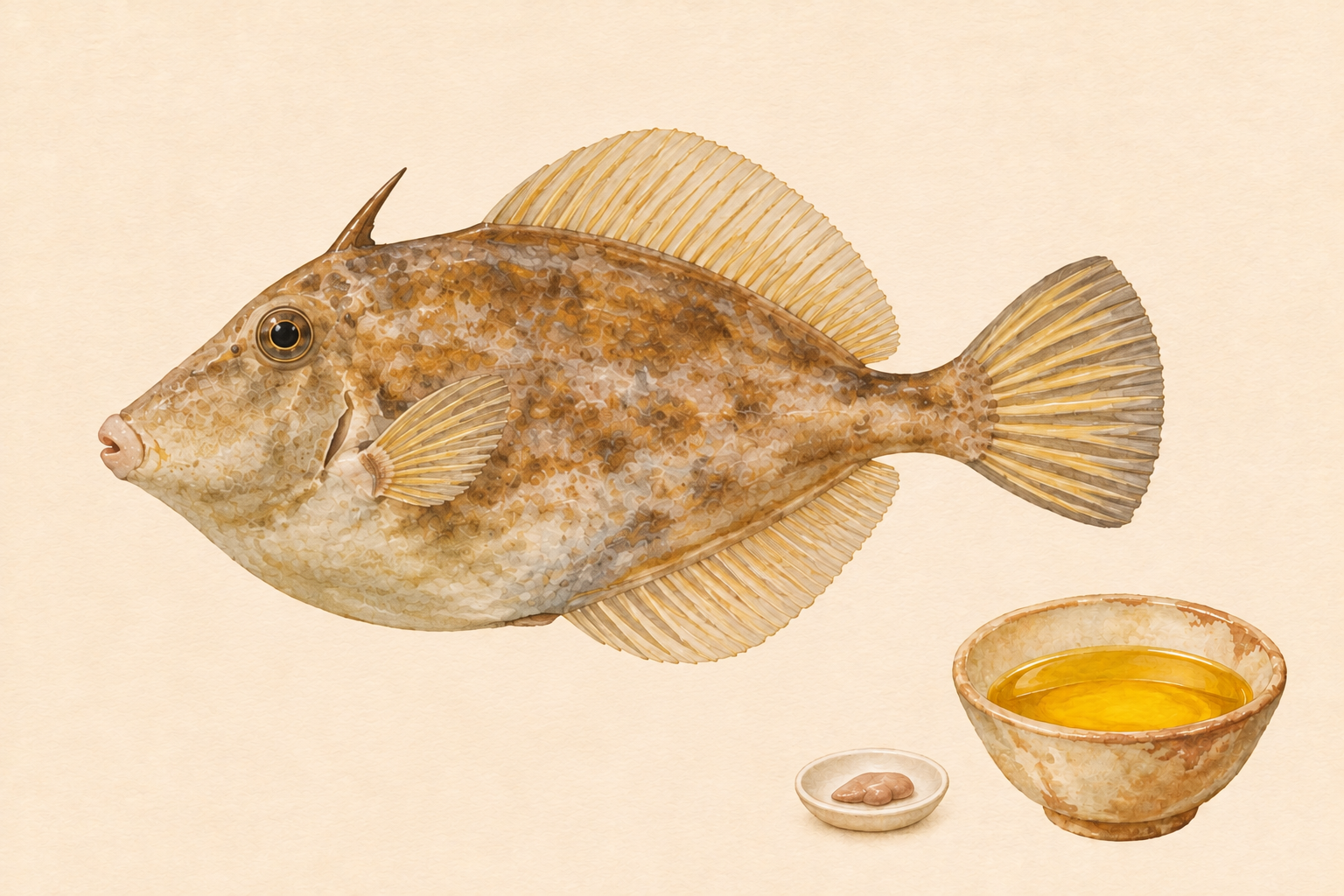
An edible oil separated from leatherjackets and triggerfishes, recorded in the ethnography of Socotra. Fish fat was recovered as oil, stored and added to food.
Source material
The source fishes belong to Monacanthidae and Balistidae. The ethnography mentions subcutaneous fat and then describes oil recovery from livers. The oil cannot be restricted to a single species or exclusively to liver.
Region
The account concerns the use of marine resources on Socotra. A companion lexicon also links Soqotri fish names with oil recovery from fat or livers.
Food use
The separated, stored oil was also added to ribīs, a dish of pounded shark foetus. This is distinct from eating fish liver without separating its oil.
Extraction
The ethnography describes straining oil separated by heating and keeping it in clay pots. Subcutaneous fat and liver appear in the same account; proportions or yields for each source part are not specified.
Safety
The local belief that this oil was especially nutritious for children does not establish a modern medical benefit or a recommendation for children to consume it.
Sources
Morris, M. J., al-Soqoṭri, M. ˁĪsa Walīd & al-Soqoṭri, A. Saˁd Taḥkí (2025), Harvesting the Sea in Soqoṭra, section 6.1.5, pp.580–582, in Harvesting the Sea in Southeastern Arabia, vol.1: https://doi.org/10.11647/OBP.0409 Morris, M. J., Anonby, E. & Watson, J. C. E. (2026), Harvesting the Sea in Southeastern Arabia, vol.2, Part II, entries for ḳarbōbə/ḳerbóbə: https://doi.org/10.11647/OBP.0538.02