THE OIL ATLAS
Himalayan wild peach kernel oil
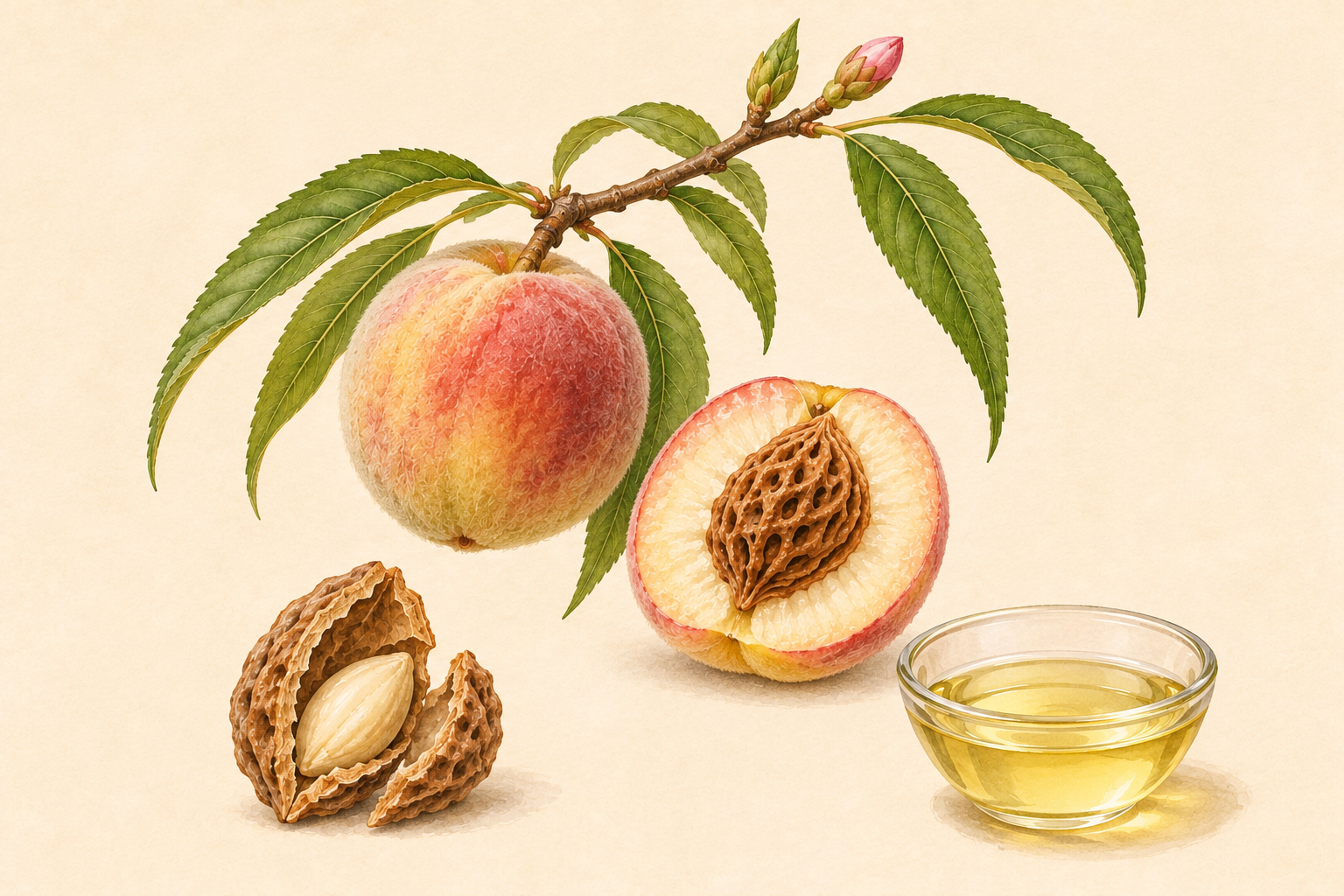
Overview
An edible oil separated from the kernels of wild peach in the western Himalaya. A food-processing document from Uttarakhand, India explicitly records that local people use wild-peach (aaru) kernel oil for cooking. This is evidence for consumption of a separated oil, not merely for eating peach flesh or kernels.
Source material
The raw material is the kernel inside the hard stone of wild-growing Prunus persica L. in Uttarakhand. This geographically documented food use should be distinguished from generic cosmetic peach-kernel oils derived from cultivated fruit and from other processing grades.
Composition
A 2021 study analyzed oil obtained from kernels of wild Prunus persica collected in the western Himalaya. Its accessible abstract discusses unsaturated fatty acids, but the source material checked here does not support precise percentages or nutrition-per-100-g figures, so none are supplied. The research samples came from wild populations around Joshimath and Tapovan in Chamoli district, Uttarakhand; they do not represent every commercial peach-kernel oil.
Region
Wild peach (aaru) is documented in the Garhwal and Kumaon regions of Uttarakhand, northern India. The 2021 research sampled wild trees around Joshimath and Tapovan in Chamoli district and reports field information that kernels of the studied species have long been used for oil extraction in the region.
Food use
A Himalayan food-processing document explicitly states that wild-peach kernel oil is used for cooking by local people in Uttarakhand. This establishes a regional food use of separated oil beyond laboratory extraction or a proposal for a novel food ingredient. Specific recipes and frequency of household use were not established by the consulted sources.
Extraction
The stone is removed from ripe wild peaches and the kernel is separated to recover oil. The 2021 study documents collection, pulp removal, kernel preparation and analytical oil isolation. Its laboratory procedure should not be presented as the customary local manufacturing method; the precise traditional pressing and refining steps remain unverified.
Safety
Peach kernels can contain cyanogenic precursors including amygdalin. Evidence of local culinary use does not establish that raw kernels or unprocessed homemade oil are safe. Use only appropriately manufactured food-grade oil; the evidence does not establish a blanket regulatory authorization for sale in every jurisdiction.
Sources
1. National Mission on Himalayan Studies, “Wild Peach or Aaru”, food-processing/SOP document, https://www.nmhs.org.in/w/pdf/List_of_SOPs_25_July_2022/01--09.Food_supplement_for_wild_products_Dr.Rajendra_Dobhal/5.Wild_Peach_or_Aaru.pdf (local cooking use). 2. “Nutritional Composition of Seed Kernel and Oil of Wild Edible Plant Species from Western Himalaya, India”, 2021, DOI:10.1080/15538362.2021.1907009 (sampling, field observations, and analytical scope).