THE OIL ATLAS
Alaskan lamprey oil
Overview
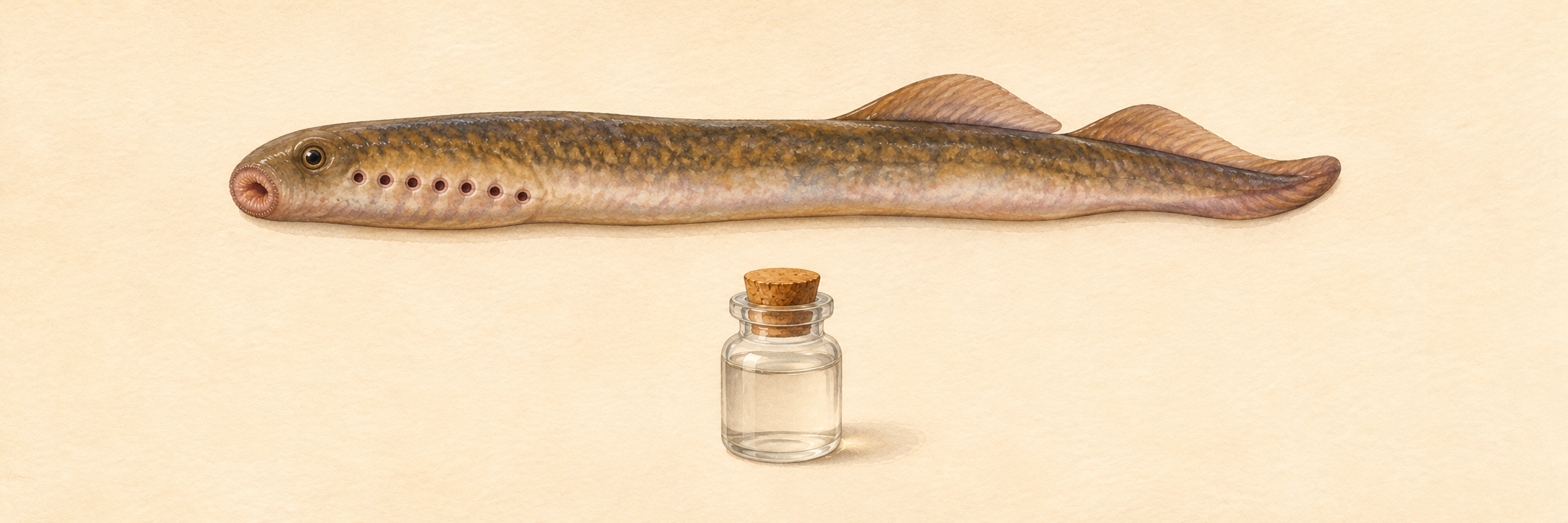
Alaskan lamprey oil is fat rendered from the bodies of lampreys, locally called “eels.” An Alaska Department of Fish and Game ethnographic report records separated oil eaten with cooked lampreys and used in traditional snow ice cream.
Source material
Bodies of lampreys harvested in Yukon River communities of Alaska. The local term “eel” should not be confused with true eels; the species represented by every historical account is not individually resolved.
Composition
The source describes lampreys as fatty fish but provides no verified fatty-acid profile or per-100-g nutritional composition for the rendered oil. Fish-body fat content is not substituted for an oil analysis.
Region
The documented accounts come from the Alaska state study of Grayling, Anvik, Shageluk and Holy Cross. The practice is not generalized to all Alaska Native communities.
Food use
The report describes pounding and heating lampreys to render oil, then dipping cooked lampreys into the oil. A community interview also recalls its use in “Indian ice cream” or “snow ice cream.”
Extraction
Historical accounts describe pounding lampreys and heating them to separate the oil; an interview describes pounding frozen fish and roasting them. No specific temperature, yield or refining process is established.
Safety
Ethnographic food use does not demonstrate that a modern product is safe or compliant with food regulations. Species identification, hygiene, contaminants and storage require separate evaluation.
Sources
Alaska Department of Fish and Game, Division of Subsistence, *Contemporary Subsistence Uses and Population Distribution of Non-Salmon Fish in Grayling, Anvik, Shageluk, and Holy Cross*, Technical Paper No. 289, https://www.adfg.alaska.gov/techpap/tp289.pdf