THE OIL ATLAS
Eulachon / ooligan grease
Overview
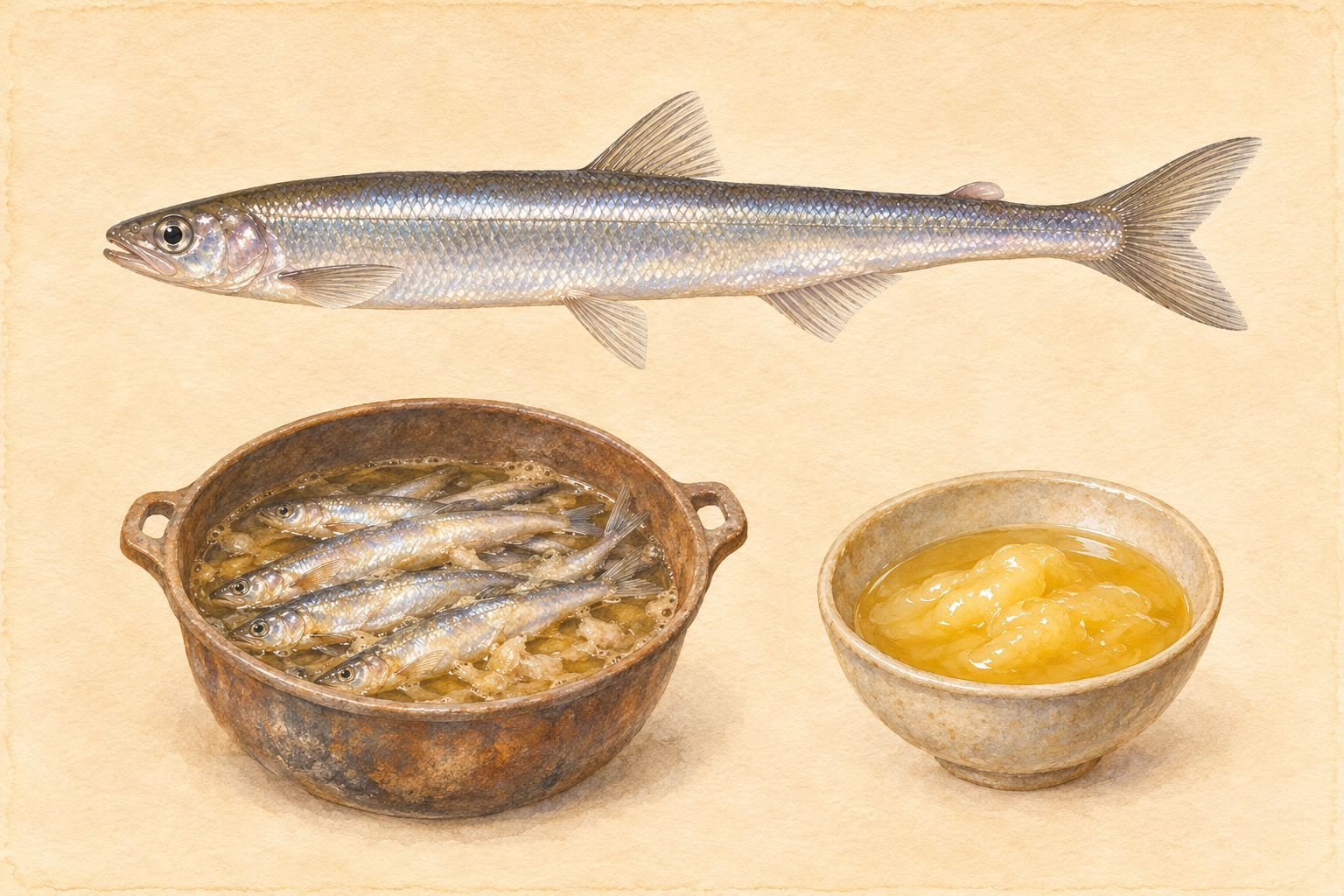
Ooligan grease is a traditional fat rendered from ripened eulachon (Thaleichthys pacificus). Indigenous communities on Canada’s Pacific coast have used the separately recovered fat for food seasoning and preservation. This is distinct from simply eating fatty fish.
Source material
The source is the body of the small Pacific fish known as ooligan or eulachon, not the direct consumption of roe or liver.
Composition
In five Nuxalk (Bella Coola) family preparations studied in 1982, the mean fatty-acid methyl ester proportions were 32.2% saturated (range 30–33%), 64.5% monounsaturated (63–66%) and 0.9% polyunsaturated (0.8–1.1%). A separate 1996 study across five coastal communities reported 98.0% total fat, 197 ± 76 mg cholesterol/100 g, 2,000 ± 1,200 retinol equivalents of vitamin A/100 g wet weight and 19 ± 4.4 g omega-3 fatty acids/100 g. A 1998 study of 18 preparations reported retinol at 2,444 ± 1,198 RE/100 g. These figures concern different years, samples and measurement bases: fatty-acid methyl ester percentages must not be confused with nutrient amounts per 100 g of grease or averaged across studies.
Region
The 1982 study analysed preparations from the Nuxalk community of Bella Coola, British Columbia, Canada. The 1996 study examined grease from five coastal First Nations communities: Nass River, Kitimaat, Bella Coola, Kingcome Inlet and Knights Inlet. The fish’s entire natural range is not evidence that the same rendering tradition is practiced everywhere.
Food use
A 1982 ethnobiological study documents the rendered fat as a flavouring for many foods. Salish culinary documentation also describes adding it to preserved fish and fruit preparations.
Extraction
Eulachon (Thaleichthys pacificus) harvested in early spring are allowed to ripen in containers, then heated so that the rendered grease can be separated from the fish. The 1982 ethnobiological study documents this as a distinct fat-rendering tradition, not merely consumption of whole fish. Ripening and sanitation conditions vary; the ethnographic description is not a validated home-processing protocol.
Safety
A 1998 analysis of 18 family preparations reported mean total chlorinated pesticides of 110 ng/g lipid and PCBs of 30 ng/g lipid, below the Canadian regulatory limits cited at the time. This conclusion applies to those historical samples, not to all grease produced today. Source waters, ripening, heating, storage and contaminants require product-specific attention.
Sources
Kuhnlein, H. V. et al. (1982). Ooligan Grease: A Nutritious Fat Used by Native People of Coastal British Columbia. *Journal of Ethnobiology* 2(2):154–161. https://ethnobiology.org/sites/default/files/pdfs/JoE/2-2/Kuhnlein_et_al1982.pdf ; Kuhnlein, H. V. et al. (1996). Nutritional Qualities of Ooligan Grease: A Traditional Food Fat of British Columbia First Nations. *Journal of Food Composition and Analysis* 9(1):18–31. https://doi.org/10.1006/jfca.1996.0004 ; Kuhnlein, H. V. & Chan, H. M. (1998). Ooligan grease: a traditional food fat of western Canada and Alaska. *International Journal of Circumpolar Health* 57 Suppl 1:211–214. https://pubmed.ncbi.nlm.nih.gov/10093275/