THE OIL ATLAS
Dhatelo seed oil
Overview
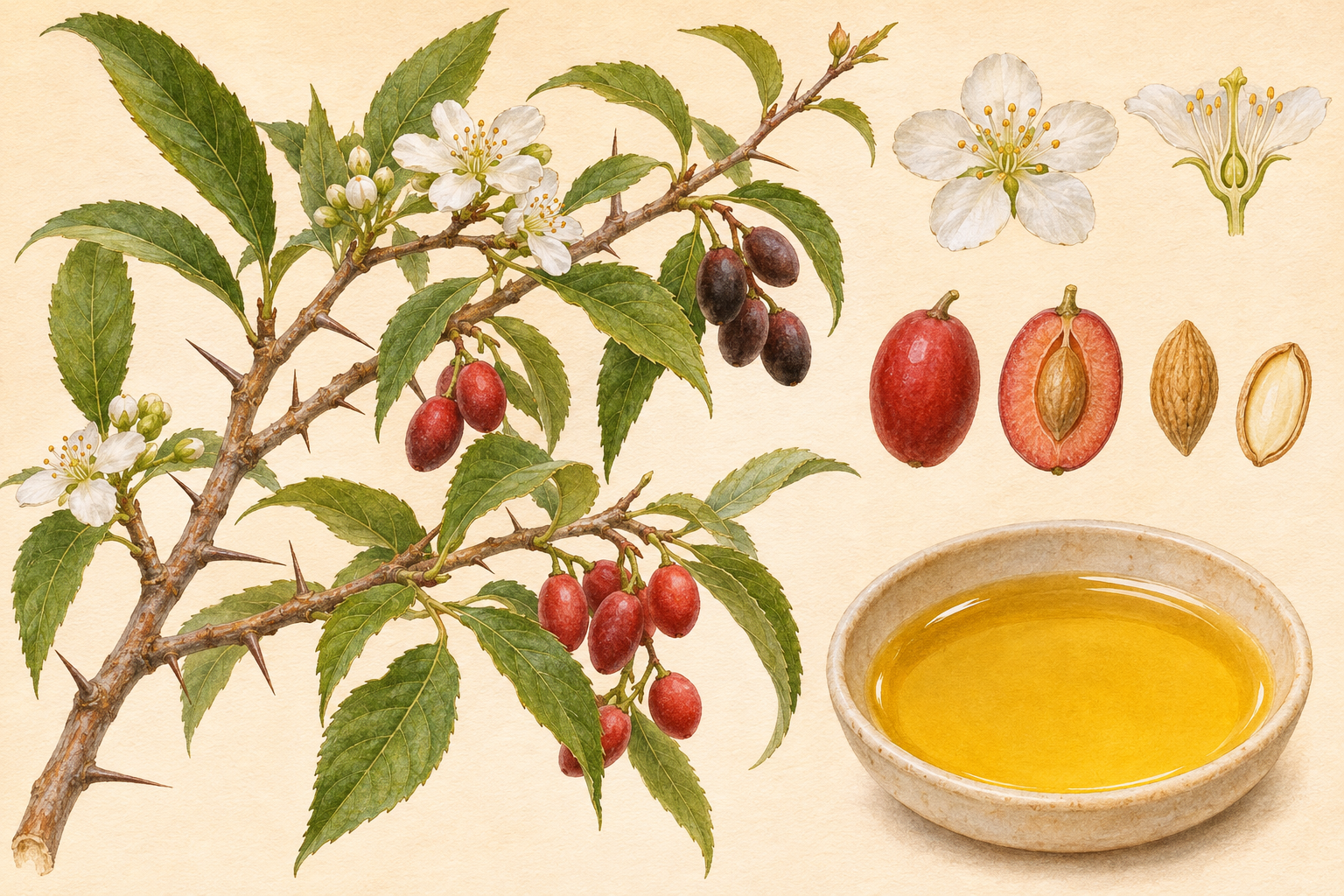
Dhatelo seed oil is separated from the seeds of the Himalayan rosaceous shrub Prinsepia utilis Royle. Ethnobotanical fieldwork in Nepal documents both its extraction and its use as an edible oil, distinct from eating the fruit or using the oil externally.
Source material
Cotyledons of seeds removed from mature fruits of Prinsepia utilis Royle (Rosaceae). The pulp is discarded before the seed material is processed for oil.
Composition
The ICIMOD field account reports approximately 1 litre of oil from 4–5 kg of cotyledons. This is a traditional extraction yield, not a fatty-acid percentage or a nutritional value per 100 g. No unsupported quantitative composition values are supplied.
Region
Traditional oil extraction is documented in Bajhang and Humla districts of western Nepal. A separate study of the Sinja Valley also identifies the plant among locally used edible oil-producing species.
Food use
The ICIMOD field report explicitly identifies the separated oil as edible; a Nepalese technical document also describes its use in cooking as a substitute for vegetable oil. These records do not establish a particular named dish or the current frequency of use across Nepal.
Extraction
Mature fruits are collected and dried; the pulp is removed. Cotyledons are pounded, roasted, mixed with a little hot water, wrapped in cloth and pressed to extract oil. This is a documented local method, not an industrial refining specification.
Safety
Historical edible use does not establish the safety or regulatory compliance of every contemporary product. Oil prepared for external application or lighting should not be presumed food grade.
Sources
ICIMOD, *Traditional Practice and Knowledge of Indigenous and Local Communities in Kailash Sacred Landscape, Nepal* (Working Paper 2017/1), https://www.academia.edu/119759484/Traditional_Practice_and_Knowledge_of_Indigenous_and_Local_Communities_in_Kailash_Sacred_Landscape_Nepal_ICIMOD_Working_Paper_2017_1 ; Nepal NPRL, *Technology Development*, https://nprl.gov.np/storage/blogs/file/487149a70ec951e4ff35eabf5adf467c.pdf ; Environment Protection and Study Center, https://www.enprosc.org.np/edible-oil-producing-plants-in-the-sinja-valley-jumla-nepal/